At IndiaVerve, we go beyond the noise to bring you meaningful stories of change, resilience and progress—from India to the world stage. Our mission is to bring readers credible, wide-ranging coverage across politics, business, sports, culture, society and more.

Sri Lanka receives 38,000 mt fuel from India, president thanks New Delhi

New Delhi: Sri Lankan President Anura Kumara Dissanayake on Sunday expressed gratitude to India for sending 38,000 Metric Tonnes (MT) of fuel. Sri Lanka is currently facing a major fuel crisis due to the Middle East conflict.

A few days ago, Dissanayake and Prime Minister Narendra Modi held a telephonic conversation in which the two leaders discussed the evolving situation in West Asia, with a focus on disruptions affecting global energy security.

Modi informed the Sri Lankan president about India’s firm commitment to work closely together in addressing shared challenges, in line with India’s Neighbourhood First policy and MAHASAGAR Vision.

In a post on X, Dissanayake said: “Grateful for India’s swift support. 38,000 MT of fuel arrived in Colombo yesterday. My thanks also to EAM @DrSJaishankar for his close coordination.”

The Indian High Commission in Colombo said that the Indian shipment comprised 20,000 metric tonnes of diesel and 18,000 metric tonnes of petrol.

It added that the assistance followed similar support extended by India to Bangladesh amid the ongoing crisis. The High Commission also noted that External Affairs Minister S. Jaishankar and Sri Lankan Foreign Minister Vijitha Herath held a telephonic conversation on March 23.

Meanwhile, Sajith Premadasa, Leader of the Opposition and head of the Samagi Jana Balawegaya, also thanked India for extending emergency support to Sri Lanka.

In a post on X, he said: “Let us not forget those who stood by us when it mattered.”

CoAS General Dwivedi witnesses integrated air defence exercise in Gopalpur

Bhubaneswar: Upendra Dwivedi, Chief of Army Staff (CoAS), on Saturday witnessed the Integrated Air Defence Firepower exercise at the Army Air Defence College in Gopalpur during his three-day visit to Odisha.

The exercise demonstrated seamless synergy among multiple air defence weapon systems operating in a networked environment. It effectively validated the complete detection-to-engagement cycle against new-age hybrid aerial threats.

In a post on X, the CoAS praised the Air Defence personnel for their relentless commitment to strengthening India’s defence capabilities. He urged them to continue striving for excellence and maintain operational dominance in the evolving battlespace.

Senior officials briefed him on advanced training facilities at the college. The facilities are aligned with evolving warfare concepts and integrate modern methodologies with hands-on, research-driven, and innovation-focused learning.

During his address, General Dwivedi outlined the Indian Army’s transformation roadmap. He highlighted the growing importance of Multi-Domain Operations and stressed the need for adaptive leadership to meet future battlefield challenges.

The Army chief also awarded Commendation Cards to selected personnel. He commended the Army Air Defence College for its pioneering role in technology-driven training and for building a future-ready air defence capability.

On Friday, the CoAS met Odisha Governor Dr. Hari Babu Kambhampati at Lok Bhavan. During the meeting, the governor congratulated Dwivedi and the Indian Army on the successful execution of Operation Sindoor, which reflects their unwavering dedication and exemplary service to the nation.

PM Modi hails two Odia individuals in Mann Ki Baat programme

Bhubaneswar: Prime Minister Narendra Modi, in his monthly programme Mann Ki Baat, on Sunday, hailed two individuals from Odisha for their contributions to nation-building.

In his address, Modi mentioned Om Prakash Rath from Kendrapara for sharing ideas on advancing women-led development.

He praised Rath for his contribution to the MY Bharat Budget Quest 2026 initiative, which drew participation from nearly 12 lakh youth across the country.

Modi noted that Rath’s essay on women-led development stood out among 1.6 lakh shortlisted entries and reflected strong ideas for inclusive growth.

He noted that young people from other states had also shared ideas on skill development and ease of doing business. Modi said he commended all those contributing such ideas, adding that they were crucial for taking the country forward.

Modi also spoke about Sujata Bhuyan from Sambalpur, whose work in fish farming made her self-reliant, according to an official statement.

He said that despite initial struggles in fish farming in the Hirakud reservoir, she eventually succeeded in her business.

The prime minister added that she had faced numerous challenges, including weather changes, arranging food for the fish, and balancing household responsibilities, but her spirit remained unwavering. He said that within two to three years, she transformed her efforts into a thriving business and that her success had become a new ray of hope for women in the community.

Modi further said that he was extremely happy that such efforts were not only enriching the fisheries sector but also instilling a spirit of innovation. He added that innovations were taking place in fisheries and seaweed, and that fishermen were becoming self-reliant.

‘No Kings’ protests draw millions across US, Europe

Millions of people took to the streets across the United States and parts of Europe on Saturday in coordinated “No Kings” protests against President Donald Trump and the ongoing war in Iran, marking one of the largest waves of demonstrations in recent months.

The protests spanned all 50 US states, with organisers registering more than 3,100 events. From major cities like New York to smaller towns such as Driggs in Idaho, crowds gathered to voice opposition to what they described as authoritarian tendencies and controversial policy decisions.

Minnesota emerged as a focal point of the demonstrations, where thousands assembled at the State Capitol in St. Paul. Protesters carried placards and symbolic imagery, including inverted US flags, traditionally used as a sign of distress.

According to organisers, earlier rounds of the “No Kings” movement had drawn over 5 million participants in June and 7 million in October. For the latest mobilisation, turnout was expected to reach around 9 million, although final figures are yet to be confirmed.

Quoting organisers, BBC World reported that the protests were driven by concerns over democratic values. “Trump wants to rule over us as a tyrant. But this is America, and power belongs to the people — not to wannabe kings or their billionaire cronies,” they said.

“Those of us who are standing up for American values are united in our anger, but also in our love for each other and our love for this country,” California-based KQED quoted Joey Raff, an organizer with Oakland’s “No Kings” protest as saying.

The White House, however, dismissed the demonstrations, with a spokesperson describing them as “Trump Derangement Therapy Sessions” and downplaying their significance.

Adding a cultural dimension to the protests, musician Bruce Springsteen performed in Minnesota, debuting a song inspired by recent incidents involving federal agents and public protests. Addressing the crowd, he said the continued public resistance offered hope for the country.

Demonstrations also took on creative forms in several locations. In Topeka, Kansas, protesters used satire and costumes to express dissent, while others travelled between cities to participate in multiple rallies.

The widespread protests underscore growing domestic and international criticism of US policies amid escalating tensions in West Asia, as public mobilisation continues to shape the political discourse.

Government reviews West Asia situation, IGoM stresses coordinated response

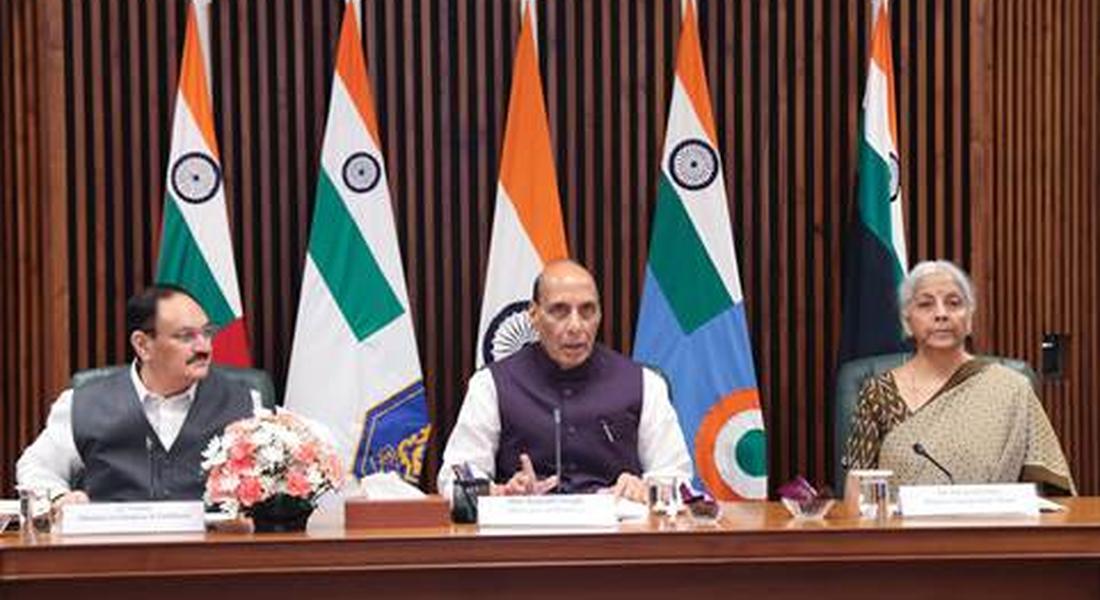
New Delhi: Amid escalating tensions in West Asia, the government on Saturday convened the first meeting of the Informal Group of Ministers (IGoM) to assess the situation and ensure a coordinated national response.

Chaired by Defence Minister Rajnath Singh, the meeting on Saturday assessed risks across key sectors and outlined both immediate and long-term preparedness measures, according to an official statement.

Following the meeting, Singh said the government remains committed to safeguarding Indian citizens from any fallout of the conflict. “The NDA Government under the leadership of PM Shri @narendramodi is closely monitoring the situation, and it is committed to safeguarding the Indian people from any impact of the conflict,” he said in a post on X.

Seven Empowered Groups of Secretaries made detailed presentations, highlighting sector-specific challenges and the policy measures currently in place. The defence minister directed the groups to maintain close monitoring and adopt a medium- to long-term preparedness strategy, with emphasis on timely decision-making and inter-ministerial coordination.

He stressed that policy interventions must remain aligned and be implemented in a time-bound manner, while also seeking inputs from ministers to further strengthen India’s preparedness and resilience.

The IGoM underlined the importance of coordination with state and district administrations, particularly in ensuring effective last-mile implementation of policy measures. It also emphasised the need for timely communication with the public to prevent panic and counter misinformation.

To streamline information dissemination, all ministries and departments have been directed to share updates and advisories through the Ministry of Information and Broadcasting’s WhatsApp channel to ensure accurate and verified information reaches citizens.

The meeting was attended by Finance Minister Nirmala Sitharaman, Parliamentary Affairs Minister Kiren Rijiju, Petroleum and Natural Gas Minister Hardeep Singh Puri, Power Minister Manohar Lal, Chemicals and Fertilisers Minister J.P. Nadda, Consumer Affairs Minister Prahlad Joshi, Civil Aviation Minister Kinjarapu Rammohan Naidu, and Minister of State (Independent Charge) for Science and Technology Dr Jitendra Singh, among others.

Meanwhile, Prime Minister Narendra Modi spoke with Saudi Arabia’s Crown Prince and Prime Minister Mohammed bin Salman on Saturday to discuss the ongoing conflict in West Asia.

During the conversation, Modi reiterated India’s condemnation of attacks on regional energy infrastructure and stressed the importance of ensuring freedom of navigation and keeping key shipping routes open and secure.

In a post on X, the Prime Minister said, “Thanked him for his continued support for the welfare of the Indian community in Saudi Arabia.”