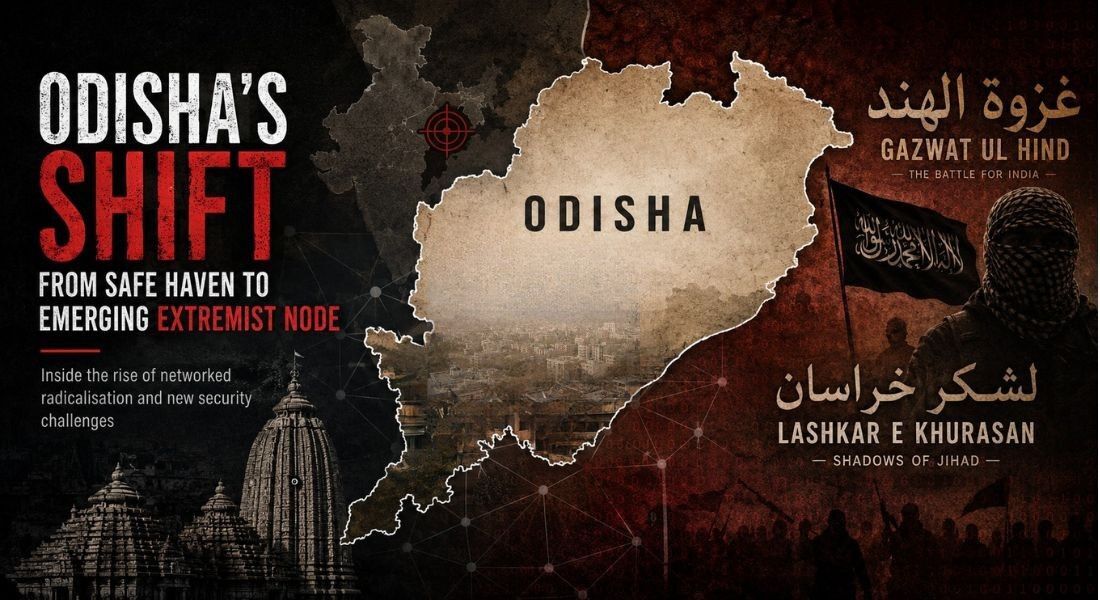
At least two incidents in 2026, including an explosion in Bhubaneswar’s Sundarapada locality that killed two people and the arrest of Sheik Imran from the same city for conspiring to wage war against India in a separate incident, highlight more than isolated security breaches. These developments related to growing Islamist extremism in Odisha point to a gradual structural shift in the state’s role within India’s evolving terrorism landscape. It somehow indicates the emergence of localized clusters embedded within broader, networked extremist-criminal ecosystems in the state.
For much of the past two decades, Odisha occupied a marginal position in India’s jihadist/ Islamist-focused counterterrorism grid. It functioned largely as a low-visibility state, occasionally intersecting with extremist-jihadi networks but rarely serving as a site of mass radicalization, a sustained recruitment space, or a hub for operational planning. However, these characterizations are changing. Current indicators point to a shift from a dormant space to an active node within distributed jihadist networks, where digital radicalization converges with ideological and logistical support.
To understand this shift, let’s distinguish three functional stages in how extremist networks use territory. First, concealment or hibernating spaces serve as low-visibility environments where operatives evade detection without building local linkages. Second, transit or support nodes facilitate movement, financing, and logistical coordination, often linking multiple territories without sustained local embedding. Third, operational nodes are sites where recruitment, ideological dissemination, reconnaissance, and attack planning intersect, supported by a local overground network or digitally connected micro-networks. Odisha has historically fit the first category, occasionally the second. Current indicators suggest a movement toward the third, marking a transition from passive refuge to an emerging operational node within distributed extremist ecosystems.
Early Indicators: From Refuge to Latent Network Presence
Earlier instances of extremist activity in Odisha largely reflected its role as a low-visibility refuge rather than an active operational space. The December 2015 arrest of Abdul Rehman in Paschimkachha village in Jagatpur area of Cuttack, linked to Al-Qaeda in the Indian Subcontinent (AQIS), pointed to the existence of limited facilitation, grassroots presence, and recruitment linkages. He was arrested along with Mohammed Asif, India’s head (Amir) of AQIS, who was detained separately in Seelampur, Delhi in December 2015. Abdul Rehman was accused of radicalizing youth in his Madrasas (Islamic Seminary), maintaining transnational contacts (in Pakistan, Saudi Arabia, Dubai), and providing logistical support to operatives beyond the state. Police investigation revealed he sheltered two Pakistan-based extremists who were later killed in a Lucknow encounter and had links to the 2007 Glasgow airport attack plotter. His brother, Tahir Ali, had prior terror links and was arrested for his involvement in the 2001 American Center attack in Kolkata. While Abdul Rehman’s conviction under the Unlawful Activities (Prevention) Act underscored the seriousness of the network, its footprint remained contained and did not translate into sustained local mobilization.
A similar pattern was evident in the 2016 arrests of operatives associated with the Students’ Islamic Movement of India in Rourkela. The group of four operatives, identified as Mohammad Khalid, Amjad Khan, Zakir Khan, and Mahboob Khan, all escapees from Khandwa (Madhya Pradesh) jail, used Odisha as a temporary hideout under false identities while engaging in criminal activities, such as bank robberies, to fund operations elsewhere. Investigations linked them to multiple terror-related incidents across India, yet their presence in Odisha was transient and operationally disconnected from the local environment.
Apart from the incidents mentioned above, Odisha has also made news in a few cases where terror groups or extremist individuals were reported to have traveled through or stayed in the state to evade arrest. In January 2014, two Indian Mujahideen (IM) terrorists, Tehsin Akhtar and Zia ur Rehman (Waqas), a Pakistani national, visited Bhubaneswar, the state capital, and the coastal city of Puri. However, investigating agencies couldn’t determine their motives after interrogation.
All these cases actually highlight a consistent historical pattern: the state functioned as a peripheral support space, primarily useful for transit shelter and hibernation to evade arrest. However, Odisha was never used as a site of sustained recruitment, ideological consolidation, or operational planning till this time.
Digital Ecosystems and Networked Extremism
Almost a decade has passed since the Rourkela incident. Fast forward to 2026, extremist-related developments suggest that Odisha is no longer merely a fallback space but is increasingly embedded within the operational logic of contemporary extremist networks. Latest cases indicate a convergence of ideological motivation, digital connectivity, and operational intent. Individuals were not only consuming extremist content but also engaging in reconnaissance, facilitation, and attempts at recruitment. This reflects a broader transformation in the architecture of Islamist extremism in India: a shift from centralized, organization-driven models to decentralized, networked systems. In this framework, geographically peripheral regions gain relevance as low-visibility nodes that support the functioning of a wider ecosystem. The significance of such spaces lies not in the scale of activity, but in their ability to host micro-level processes, including communication, planning, and ideological reinforcement, without attracting sustained attention.
A central driver of Odisha’s evolving role is the expansion of digitally mediated radicalization. Contemporary extremist networks increasingly operate through decentralized online ecosystems rather than hierarchical organizational structures. Encrypted platforms such as Telegram, WhatsApp, and Signal have become primary vectors for dissemination, recruitment, and coordination, enabling geographically dispersed individuals to connect with transnational ideological streams while remaining locally embedded.
Within this ecosystem, ‘vernacularization’ of terror propaganda has emerged as a critical enabler. Transnational Jihadist-Extremist groups and their propagandists have moved beyond Urdu, Arabic, and English to translate and circulate material in regional languages, including Odia. This shift lowers linguistic and cultural barriers, enabling global jihadist narratives to reach previously insulated audiences. The process is not merely translational but adaptive: content is reframed to resonate with local socio-political contexts, often invoking themes of grievance, victimhood, and religious obligation.
Evidence of this trend emerged as early as 2022, when pro-jihadi media channels associated with translation networks like the Islamic Translation Center (ITC) started recruiting volunteers for “jihadi media work.” They asked, “Which language can you work with? Come, let’s take part in our project… Media is half of the Jihad.” Their stated objective was the translation of writings by “Mujahid Ulama” and militant ideologues for dissemination among “native brothers and sisters,” signaling a deliberate attempt to penetrate non-Urdu-speaking Muslim communities through vernacular outreach. One such Odia-language translated publication, circulated in March 2022 under the title “Muslims in India are going to be massacred!”, used inflammatory narratives around the Karnataka hijab controversy to provoke anger and victimhood. The text portrayed Indian Muslims, particularly women, as under siege from “extremist Hindu idol worshippers,” invoked communal humiliation, and ended with an explicit mobilizing call: O Muslim brother! Are you still sleeping? “Wake up! Be angry! Join the great war of Ghazwat-ul Hind (GuH-a mythical Islamic war campaign against Hindu India).”
Such messaging was not merely religious commentary; it was ideological conditioning designed to turn local grievances into transnational jihadist consciousness. By translating these narratives into Odia (and Tamil, Bengali, and other regional languages), extremist propagandists sought to influence young minds at the grassroots level, to normalize the language of siege and revenge, and to gradually embed concepts such as the Caliphate, Hijab, and Ghazwat-ul-Hind within local discourse. This marked a transition from Odisha being a passive shelter for fugitives to becoming a target space for ideological recruitment and digital radicalization.
Again, the early 2026 cases in Odisha reflect this progression, underscoring how digital ecosystems enable low-cost, low-visibility expansion without requiring physical infrastructure. Investigations into Sheik Imran’s case in the state capital Bhubaneswar revealed that he had surveilled sensitive locations such as the Red Fort and India Gate in Delhi in December 2025, posted images of a black flag atop the Red Fort to inspire others, and discussed plans to target religious sites and key government installations, including Ram Mandir, Parliament, and military facilities. He also sought funds and offered arms and physical training in Odisha as part of a larger plan inspired by the same GuH ideology. Imran and three of his apprehended associates, Mosaib Ahmad, Muhammad Hammad (Maharashtra), and Mohammad Sohail (Bihar), were found to be motivated by the goal of establishing an Islamic Caliphate and to believe in the coming of a “lashkar from Khurasan” bearing black flags. They were reportedly preparing to join the ‘Islamic war against India’ campaign and were actively radicalizing and recruiting through secure social media groups. These developments reveal that Islamist extremism has reached Odisha, with recent events linked to radical jihadist ideas, online propaganda, and international jihadist influences such as Ghazwa-e-Hind. Their arrest reflects a convergence of ideological radicalization, operational intent, and networked coordination.
Why Odisha? Structural Vulnerabilities and Enablers
Odisha’s emerging role is not incidental but rooted in a set of structural enablers. The state combines relatively low counterterrorism visibility with expanding urban centers such as Bhubaneswar, Cuttack, and Berhampur, which offer anonymity and mobility. Interstate connectivity and migrant labor flows create additional channels through which individuals and networks can move with limited scrutiny. At the same time, increasing digital penetration without a corresponding counter-radicalization capacity creates an environment in which online ideological ecosystems can take root. These factors do not produce extremism in isolation. Rather, they make Odisha a permissive environment within a wider networked system, where small, digitally connected cells can operate with minimal detection. The risk, therefore, is not mass radicalization but the quiet embedding of functionally relevant nodes within a broader extremist architecture.
Odisha’s extremism trajectory mirrors wider national trends in which extremist activity is dispersing beyond traditional hotspots. While states such as Kerala have demonstrated advanced patterns of digital radicalization and regions like Jammu and Kashmir continue to experience hybrid militancy, emerging geographies in eastern India are increasingly being drawn into the network through ideological dissemination and logistical linkages. In this context, Odisha represents a secondary but growing node, less visible than established theatres, yet functionally integrated into the broader ecosystem. Its role is defined not by volume of incidents but by its connectivity within distributed networks that span multiple states and, in some cases, transnational ideological circuits.
There are also identifiable risks in Odisha that could be exploited by Extremist groups such as Pakistan-backed Lashkar-e-Taiba or transnational AQIS or Islamic State-Khurasan or India branches in the future. These risks also include potential infiltration by banned extremist organizations such as Hizb-ut-Tahrir, as well as ideological influence from transnational Dawa/proselytization groups like Dawat-e-Islami and Tablighi Jamaat, which may promote more rigid interpretations of Islam in the state. In certain contexts, these dynamics can foster exclusivist or polarizing narratives that create intra-Muslim conflict (e.g., Deobandi/Salafi vs. Barelvi/Sufi tensions) or exacerbate Hindu-Muslim communal fault lines. Eventually, prevalent or amplified sectarian schisms can fuel future extremism in Odisha.
Outlook: Calibrating Response, Managing Threat
The evolving threat landscape poses a distinct policy challenge. Excessive securitization risks alienating communities and eroding trust, while insufficient attention allows low-visibility networks to consolidate. A calibrated response is therefore essential. This should include strengthening state-level counterterrorism capabilities by establishing a dedicated Anti-Terrorism Squad (ATS), expediting prosecution through specialized courts (e.g., special NIA courts), and improving interstate intelligence coordination. Targeted monitoring of encrypted platforms and vernacular digital ecosystems is equally critical. Preventive measures must complement enforcement efforts, including community engagement, digital literacy initiatives, and credible counter-narratives to disrupt pathways to online radicalization.
Indeed, Odisha is at a critical juncture. The trajectory reflects a broader transformation, such as the shift from hierarchical organizations to dispersed, networked systems operating through digital ecosystems and locally embedded cells, within India’s Islamist extremist landscape. In this environment, peripheral geographies gain importance not because they host large numbers of extremists, but because they enable the network to function as a whole. The evidence suggests that Odisha is no longer merely a transient refuge. It is increasingly a space where recruitment, ideological conditioning, reconnaissance, and logistical facilitation converge at the micro level. This does not indicate widespread radicalization; the state’s Muslim population remains relatively small and largely integrated, with no evidence of broad-based mobilization. The risk is still structural rather than demographic. It could remain a marginal player in India’s counterterrorism efforts if early warning signs are addressed effectively. However, neglecting these signs may lead the state to become a stronger operational and ideological center within India’s Islamist extremist network.
***
Animesh Roul is the Executive Director of the Society for the Study of Peace and Conflict (SSPC), New Delhi. He specializes in counter-terrorism and strategic affairs. The views expressed are personal and do not necessarily reflect those of IndiaVerve.