
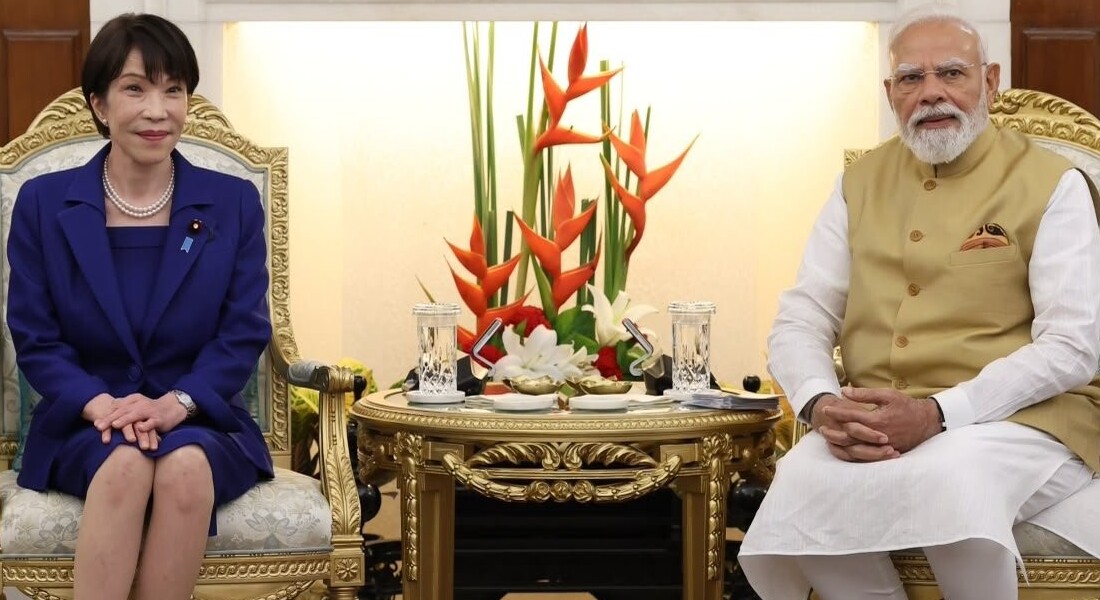
New Delhi: India and Japan on Thursday agreed to deepen cooperation in defence, economic security, clean energy, emerging technologies, and infrastructure as Prime Minister Narendra Modi and his Japanese counterpart, Takaichi Sanae, held the 16th India-Japan Annual Summit.
The two countries adopted the Joint Declaration on Economic Security Cooperation and Joint Statements on Energy Resilience and AI Cooperation, while reaffirming their commitment to a free, open and rules-based Indo-Pacific, according to an official statement.
Prime Minister Takaichi, who was on her first official visit to India from July 1 to 3, held wide-ranging talks with Prime Minister Modi. The two leaders reviewed progress since the previous summit and agreed to advance cooperation in three priority areas – defence and security, economic partnership, and people-to-people exchanges.
They said stronger bilateral ties would contribute to peace, prosperity and resilience in the Indo-Pacific and beyond.
Defence and security featured prominently during the summit. The two leaders directed their ministers to hold the fourth India-Japan 2+2 Ministerial Meeting in Tokyo before the end of this year. They welcomed the successful conduct of the JAIMEX 25 naval exercise and Japan’s participation in the International Fleet Review 2026 in Visakhapatnam.
Recognising growing geopolitical and economic uncertainties, the two countries decided to deepen cooperation on economic security. They adopted the India-Japan Joint Declaration on Economic Security Cooperation to promote project-based collaboration in semiconductors, critical minerals, information and communication technology, clean energy and pharmaceuticals.
Energy security emerged as another major outcome of the summit. The two PMs stressed the importance of secure energy supply chains and uninterrupted maritime trade, including through the Strait of Hormuz. They adopted the Joint Statement on Energy Resilience and agreed to strengthen cooperation on strategic petroleum reserves, maritime energy transport, and regional energy initiatives. Prime Minister Takaichi also reaffirmed Japan’s support for India’s membership of the International Energy Agency.
The two countries also expanded their clean energy partnership. They launched the India-Japan Cooperative Biogas for Growth Initiative to support India’s target of establishing 1,000 biogas and organic fertiliser plants. They welcomed the signing of a Memorandum of Cooperation between the concerned ministries of the two countries and reaffirmed support for the landmark clean ammonia project in Odisha.
On emerging technologies, the two PMs welcomed the inaugural India-Japan AI Strategic Dialogue and adopted the Joint Statement on AI Cooperation. They agreed to strengthen collaboration on artificial intelligence, trusted digital infrastructure and resilient AI supply chains while harnessing opportunities and appropriately mitigating related risks.
Reviewing economic ties, the leaders welcomed the steady growth of Japanese investment in India and noted progress towards the target of 10 trillion Yen set at the previous summit. They agreed to improve the investment climate through the India-Japan Industrial Competitiveness Partnership and accelerate the review of the Comprehensive Economic Partnership Agreement.
The summit also reviewed cooperation in science, technology, and education. The two countries welcomed progress in the Lunar Polar Exploration Mission, research partnerships, quantum technologies and academic exchanges. They agreed to expand student exchanges, scientific collaboration, and skill development programmes.
On regional and global issues, India and Japan reaffirmed their commitment to a free, open and rules-based Indo-Pacific and welcomed continued progress under the Quad framework. They reiterated support for ASEAN centrality and agreed to strengthen cooperation on critical minerals, regional connectivity and emerging technologies. The two leaders also expressed concern over the situation in the East and South China Seas, North Korea’s nuclear and missile programmes, the situation in Myanmar, and instability in the Middle East.
The two Prime Ministers strongly condemned terrorism and violent extremism in all their forms, including cross-border terrorism from Pakistan.