At IndiaVerve, we go beyond the noise to bring you meaningful stories of change, resilience and progress—from India to the world stage. Our mission is to bring readers credible, wide-ranging coverage across politics, business, sports, culture, society and more.

PM Modi, Russian President Putin review Indo-Russia ties at BRICS Summit

NEW DELHI: Prime Minister Narendra Modi and Russian President Vladimir Putin on Friday reviewed progress in India-Russia bilateral cooperation across political, economic, defence, energy, space, skill mobility and people-to-people domains on the margins of the 18th BRICS Summit in New Delhi.

This was the second meeting between the two leaders this year. They had earlier met in Bishkek on the sidelines of the 26th SCO Summit on August 31, according to an official statement.

The two leaders welcomed Russia’s International Industrial Exhibition “INNOPROM India”, held for the first time in India from September 9 to 11, and underscored its importance in expanding trade and industrial ties. Modi and Putin also visited the exhibition and interacted with participants.

They exchanged views on India-Russia engagement in the multilateral sphere, particularly within BRICS under India’s chairship for 2026. They also discussed key regional and global issues of mutual interest, including the conflicts in West Asia and the Black Sea region, which have affected maritime trade and the safety and security of Indian seafarers.

Modi reiterated that dialogue and diplomacy were the way forward in resolving conflicts and said India stood ready to assist in peace efforts.

The two leaders agreed to remain engaged to further strengthen the Special and Privileged Strategic Partnership between India and Russia, which continues to register significant growth and has shown resilience amid geopolitical uncertainties.

Putin invited Modi to visit Russia for the 24th India-Russia Annual Summit. Modi accepted the invitation, with the dates to be decided through diplomatic channels as per mutual convenience.

Earlier, addressing the BRICS Business Forum, Modi said BRICS had grown from four countries when it began in 2006 to a family of 21 countries when BRICS members and partners were counted together.

He said BRICS countries now represented 50% of the world’s population, 40% of global GDP and more than 25% of global trade. Modi also highlighted that while global GDP had grown roughly two-and-a-half times over the years, the combined GDP of BRICS countries had grown nearly four-and-a-half times.

According to Modi, BRICS countries were also emerging as important centres for global innovation and solutions, with new possibilities taking shape from grassroots initiatives to frontier technologies.

He said the theme of India’s BRICS chairmanship was “Building for Resilience, Innovation, Cooperation and Sustainability” and highlighted India’s efforts to build more diversified and reliable supply chains across sectors ranging from energy to technology.

Modi said India was rapidly expanding its roads, railways, ports and airports while building new capabilities in strategic sectors such as shipbuilding, semiconductors, quantum technology, critical minerals and biotechnology.

He positioned these sectors as new opportunities for global businesses and highlighted the approach of “Make in India, Innovate with India, and Scale for the World.”
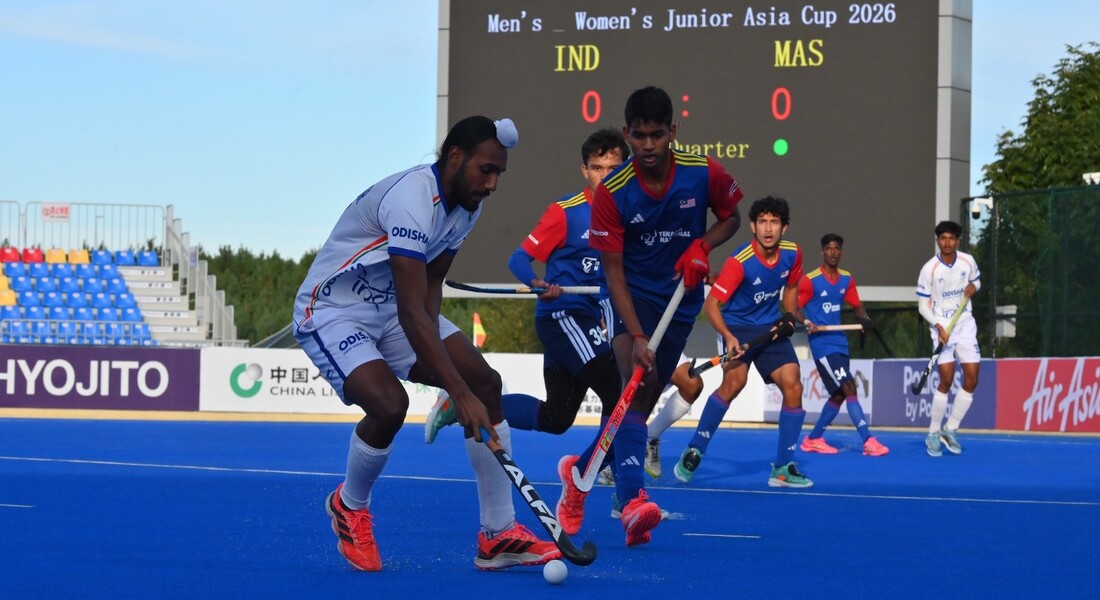
India beat Malaysia 3-1 to reach AHF Junior Asia Cup final

New Delhi: India defeated Malaysia 3-1 in the first semi-final of the AHF Junior Asia Cup 2026 on Friday to reach the final and move one win closer to successfully defending their title.

Captain and drag-flicker Anmol Ekka once again led India’s charge, scoring twice from penalty corners to take his tournament tally to 16 goals and strengthen his position at the top of the scoring charts.

Goalkeeper Vivek Lakra was equally influential for the defending champions and was named the Player of the Match after producing a series of outstanding saves, including a crucial stop from a penalty stroke.

India, who are chasing a fourth consecutive title and sixth overall crown, will face the winner of the second semi-final between Pakistan and South Korea in the final.

India started strongly and created early opportunities through Ajeet Yadav, who came close twice in the opening two minutes after getting on the end of long balls from deep defence. India earned three penalty corners early in the match, but Malaysian goalkeeper Amsyar Mohamad Adib made important saves to keep the score level.

Malaysia struggled to maintain possession during the opening five minutes, while India’s defence remained alert whenever the Malaysians moved forward. The first quarter ended goalless despite chances at both ends.

India finally broke the deadlock in the 16th minute after earning their fourth penalty corner. Anmol, positioned at the first battery, produced a hard, low flick that beat Amsyar to his right and gave India a 1-0 lead.

Malaysia responded quickly, forcing a save from Lakra in the 17th minute before earning their first penalty corner. India’s first rusher made an important block to deny the attempt.

India continued to create opportunities and earned another penalty corner in the 23rd minute, but a deflection attempt went over the Malaysian goal. The defending champions held their 1-0 advantage until half-time.

Malaysia increased the pressure after the interval, but Lakra produced a stunning double save in the 34th minute before making another stop moments later. India were reduced to 10 players after Manmeet Singh Rai received a yellow card in the 36th minute.

Malaysia earned another penalty corner in the 39th minute but failed to execute the routine cleanly. India continued to defend in an organised manner despite further pressure, while Prabhdeep Singh received a yellow card in the 41st minute, leaving India with 10 players once again.

Malaysia earned another penalty corner in the 45th minute, but their variation ended with an off-target slap-push.

India found some breathing room in the fourth quarter. After a Malaysian defensive touch denied them in the 51st minute, India immediately launched another circle entry, with Sukhvinder finishing the move to extend the lead to 2-0.

Lakra then produced another decisive save when Malaysia were awarded a penalty stroke in the 53rd minute. The Indian goalkeeper dived sharply to his left and used his glove to keep the effort out.

India quickly turned defence into attack and earned a penalty corner in the 54th minute. Malaysia challenged the decision through a video referral but lost the referral, leaving India with the penalty corner.

Anmol made no mistake, powering his flick past the Malaysian goalkeeper to make it 3-0 and score his second goal of the match.

Malaysia earned a succession of penalty corners in the closing stages, but Lakra and the Indian defence continued to withstand the pressure. Lakra made another superb diving save from a well-struck flick in the 58th minute.

Malaysia finally found a consolation goal through M Rahuul with just 24 seconds remaining after earning their eighth penalty corner.

India, however, held on for a 3-1 victory to secure their place in the AHF Junior Asia Cup final and remain on course for another title.

India remains a key global growth engine despite economic uncertainty: IMF

New Delhi: India’s economy has shown resilience amid global economic uncertainty and the energy price shock, with real GDP growth reaching 7.8% in the second quarter, the International Monetary Fund (IMF) has said.

Responding to questions on India’s economic performance, IMF Communications Department Director Julie Kozack said the 7.8% real GDP growth recorded in the second quarter was higher than both IMF staff expectations and the consensus among other observers.

She said stronger-than-expected performance was driven by robust activity in the services sector and exports.

According to Kozack, the latest growth figures underline the resilience of the Indian economy despite the energy price shock. She also reiterated that India remains a key growth engine for the global economy.

The IMF official was also asked about concerns surrounding the reporting of GDP figures in India and the integrity and transparency of the country’s GDP data.

Kozack said the latest GDP release for the second quarter incorporated a new index of industrial production and a new producer price index series.

She said these two new statistical series should help improve India’s GDP estimates. The IMF welcomed the steps being taken by India to modernise its macroeconomic statistics and encouraged the authorities to continue strengthening the statistical framework and data quality.

The discussion also focused on the impact of rising crude oil prices on India, particularly as Brent crude approached USD 100 a barrel amid the West Asia crisis.

Kozack said higher energy or oil prices can put pressure on the balance of payments of oil-importing countries and can also affect their fiscal positions, depending on the composition of government finances.

She noted that many oil-importing countries have taken measures to mitigate the impact of the energy price shock.

In India’s case, she said the shock had occurred at a time when the country was in a stronger economic position, which had contributed to its resilience.

The IMF is monitoring the impact of higher oil prices on the Indian economy. Kozack said the organisation was in the process of preparing new forecasts for India, which will be announced at the time of the October World Economic Outlook.

She added that, so far, India had demonstrated considerable resilience to the energy price shock.