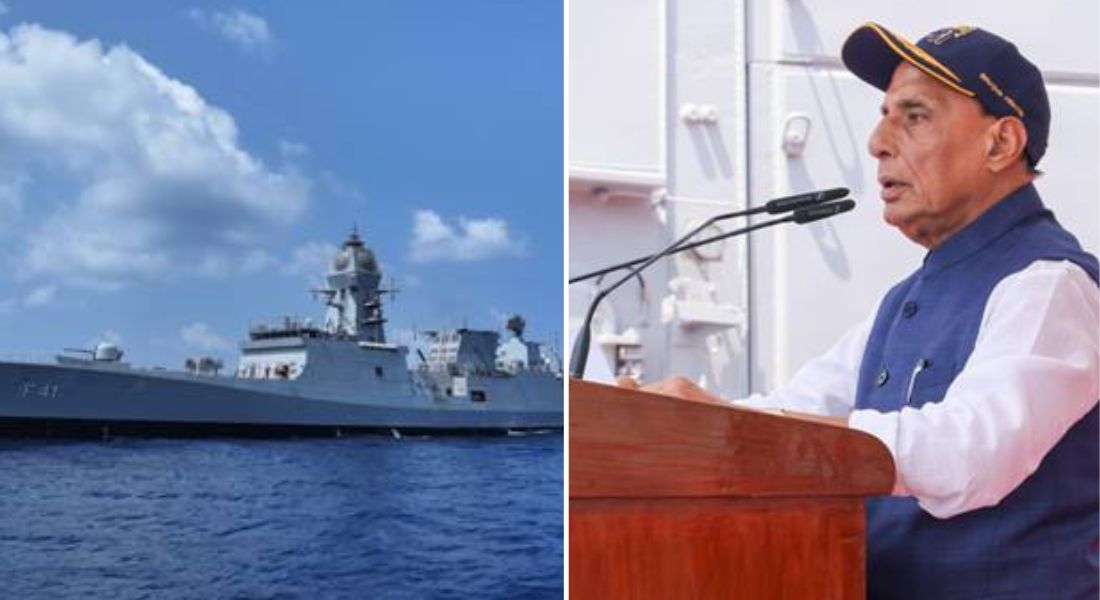

Visakhapatnam: India on Friday commissioned INS Taragiri, a stealth frigate under Project 17A, marking a significant addition to the Indian Navy’s operational capabilities and indigenous defence manufacturing ecosystem.
The warship was inducted into service in the presence of Defence Minister Rajnath Singh at Visakhapatnam. Designed by the Indian Navy’s Warship Design Bureau and constructed by Mazagon Dock Shipbuilders Limited with support from micro, small and medium enterprises (MSMEs), the vessel represents a major advancement in modern naval shipbuilding.
INS Taragiri, with a displacement of around 6,670 tonnes, incorporates advanced stealth features that reduce its radar signature, enabling it to operate effectively in contested environments. According to an official release, the ship has more than 75 percent indigenous content and has been built within a reduced timeline, reflecting growing self-reliance in India’s defence sector.
Addressing the commissioning ceremony, Rajnath Singh described the warship as a symbol of India’s technological progress and maritime strength.
“This ship is capable of high-speed transit and can remain deployed at sea for extended periods. It is equipped with systems designed to monitor enemy movements, ensure its own security, and if necessary, deliver an immediate response. It features modern radar, sonar, and missile systems, such as BrahMos and surface-to-air missiles, which further augment its operational prowess. From high-intensity combat to maritime security, anti-piracy operations, coastal surveillance, and humanitarian missions, it fits perfectly into every role, making it a unique naval platform,” the Defence Minister said.
Highlighting the strategic importance of maritime security, the Defence Minister noted that India’s long coastline and heavy dependence on sea-based trade make a strong naval presence essential. He pointed out that nearly 95 percent of the country’s trade is conducted through maritime routes, underlining the need for a capable Navy.
He further stated that the Indian Navy maintains continuous deployment across the Indian Ocean region to ensure the security of sea lanes, commercial vessels and energy supplies, particularly during periods of global uncertainty. According to him, the Navy’s role extends beyond safeguarding national interests to contributing to regional stability.
The commissioning of INS Taragiri is also being seen as part of India’s broader push towards self-reliance in defence manufacturing. The Defence Minister highlighted the growth in defence exports, which have reached Rs 38,424 crore in the financial year 2025–26, compared to around Rs 1,200 crore over a decade ago. He credited defence public sector undertakings (DPSUs) and the private sector for strengthening the country’s defence production ecosystem and supporting innovation and manufacturing.
Chief of Naval Staff Admiral Dinesh K Tripathi, speaking on the occasion, referred to the legacy of the earlier INS Taragiri commissioned in 1980, which played a key role in enhancing anti-submarine warfare capabilities. He also highlighted the evolving maritime security landscape, marked by geopolitical shifts, emerging technologies and non-traditional threats.
The new frigate, powered by a combined diesel or gas propulsion system and equipped with an integrated platform management system, is designed to undertake missions across diverse operational scenarios. It also features advanced anti-submarine capabilities and a range of weapon systems suited for modern naval warfare.
With its induction into the Eastern Fleet, INS Taragiri is expected to play a key role in enhancing India’s maritime security and operational readiness, while reinforcing the country’s position as a capable and responsible maritime power.