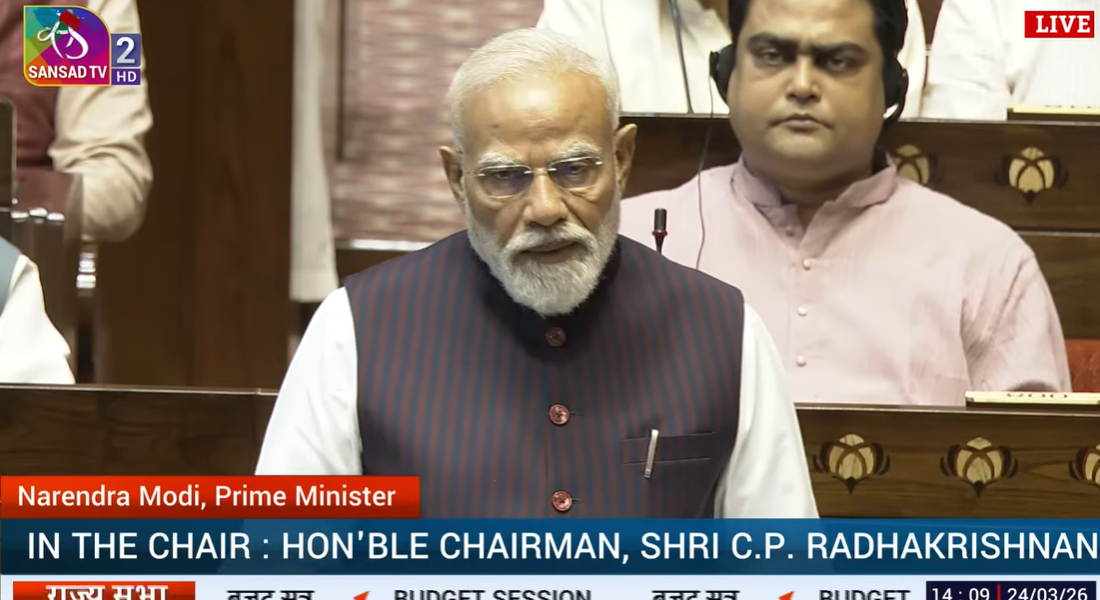

New Delhi: Prime Minister Narendra Modi addressed the Rajya Sabha on Tuesday, outlining the government’s position on the ongoing conflict in West Asia and its implications for India.
Noting that the war has been underway for over three weeks, he highlighted its role in precipitating a severe global energy crisis and disrupting India’s trade routes. Essential commodities, including petrol, diesel, gas, and fertilizers, have faced supply challenges, while the safety and livelihoods of nearly one crore Indians living and working in Gulf countries remain a key concern.
The prime minister also pointed to Indian crew members stranded aboard ships in the Strait of Hormuz. He emphasised that the Upper House must send a united message of peace and dialogue to the world, according to an official statement.
Detailing India’s diplomatic outreach, Modi stated that he has personally held two rounds of telephonic discussions with most West Asian leaders. India remains in constant contact with Gulf nations, Iran, Israel, and the US to restore peace, discuss de-escalation, and facilitate the reopening of the Strait of Hormuz.
The prime minister also made clear that attacks on commercial vessels and obstruction of international waterways are unacceptable. India has consistently opposed attacks on civilians and civil infrastructure. He underscored that threats to human life go against the interests of humanity and reiterated India’s efforts to encourage a peaceful resolution.
Highlighting the government’s priority to protect Indians at home and abroad, PM Modi reported that over 3.75 lakh Indians have been safely repatriated since the onset of the conflict, including more than 1,000 from Iran, among them 700 medical students. While all concerned countries have assured the security of Indians on their soil, the prime minister expressed deep sorrow over the loss of lives and injuries caused by the attacks, and confirmed that the government is providing full assistance to affected families and medical care for the injured.
PM Modi noted the strategic significance of the Strait of Hormuz for global trade, especially for crude oil, gas, and fertilizer transport. Despite the challenges, the government has pursued alternative pathways through diplomacy to ensure continued supplies. Ships carrying crude oil and LPG from multiple countries have reached India in recent days, he said, affirming that these efforts will continue.
Addressing long-term risks, the prime minister acknowledged that persistent global disruptions could have serious consequences for India. He stressed the acceleration of resilience-building measures undertaken over the past years. He highlighted India’s strategic preparedness over the last decade, including diversification of energy imports from 27 countries to 41 countries, the development of Strategic Petroleum Reserves exceeding 53 lakh metric tonnes, with plans to expand to over 65 lakh metric tonnes, and the strengthening of refining capacity. He assured the House that India maintains adequate crude oil storage and arrangements for uninterrupted supply.
PM Modi also outlined the government’s efforts to reduce dependence on single fuel sources. Piped Natural Gas and LPG supply systems have been expanded substantially, and domestic LPG production has been increased. He highlighted steps towards greater self-reliance, including a Rs 70,000 crore mission to build Made-in-India ships, development of shipbuilding, maintenance, and overhauling capacities, and the strengthening of the domestic defence sector. Significant progress has also been made in building a domestic API ecosystem for medicines and reducing dependence on imports of rare earth minerals.
Acknowledging the economic impact of the West Asia conflict, the PM stated that India continues to mitigate adverse effects through its strong economic fundamentals and continuous monitoring. He informed the House about the constitution of an Inter-Ministerial Group to address import-export challenges and the creation of seven new Empowered Groups, modelled on the COVID-19 pandemic approach, to ensure stability in supply chains, fuel, fertilizers, and essential commodities.
Invoking cooperative federalism, he urged States to ensure India’s growth trajectory remains intact and emphasised the need for the same Team India spirit demonstrated during the COVID-19 pandemic.