At IndiaVerve, we go beyond the noise to bring you meaningful stories of change, resilience and progress—from India to the world stage. Our mission is to bring readers credible, wide-ranging coverage across politics, business, sports, culture, society and more.

Trump launches ‘Board of Peace’ at Davos, Pakistan among founding members

US President Donald Trump has formally unveiled the first charter of his ambitious “Board of Peace”, a new international body conceived to oversee post-war Gaza and later expand into a global conflict-resolution forum, declaring it could become “one of the most consequential bodies ever created in the history of the world.”

Announced at the World Economic Forum in Davos, the initiative carries a reported $1 billion price tag for permanent membership and has drawn leaders from more than a dozen countries, including Pakistan Prime Minister Shehbaz Sharif, Argentina’s Javier Milei, Indonesia’s Prabowo Subianto, Armenia’s Nikol Pashinyan and Azerbaijan’s Ilham Aliyev.

In his opening remarks, Trump said “everybody” wanted to be part of the new body and signalled close coordination with existing multilateral institutions. “I think the combination of the Board of Peace with the kind of people we have here, coupled with the United Nations, can be something very, very unique for the world,” he said, describing it as potentially “the most prestigious board ever formed.”

The US President said the Board would begin with Gaza before broadening its remit. “I think we can spread out to other things as we succeed with Gaza… we’re going to be very successful in Gaza,” Trump declared. “Once this board is completely formed, we can do pretty much whatever we want to do.”

Trump asserted that the Gaza war was “really coming to an end,” though he cautioned that “little fires” remained. He warned Hamas to disarm, saying, “They have to give up their weapons, and if they don’t do that, it’s going to be the end of them,” adding that the group “were born with rifles in their hands.” He also insisted that the final body of a hostage must be returned to Israel.

At the ceremony, US and Palestinian officials outlined a roadmap for Gaza’s future, including an interim Palestinian-run technocratic administration and a surge in humanitarian aid. Ali Shaath, named to lead the interim administration, announced via video link that the Rafah crossing would reopen next week for two-way traffic for the first time since May 2024. Calling Rafah Gaza’s lifeline, he said, “Opening Rafah signals Gaza is no longer closed to the future or to the world.”

Trump used the platform to reiterate his claim of having ended multiple conflicts. “We put out all those fires. Most people didn’t know, including me, that some of those wars were going on,” he said, adding that another major conflict resolution was “coming pretty soon,” in an apparent reference to Ukraine.

India has not yet confirmed whether it will join the Board, though Prime Minister Narendra Modi is among several leaders invited to participate, according to media reports. The evolving composition of the forum and its sweeping ambitions are already reshaping diplomatic conversations, even as critics question how the unprecedented body will function alongside existing global institutions.

Bharat Rang Mahotsav to begin Jan 27: NSD

New Delhi: The National School of Drama (NSD) will host the 25th edition of Bharat Rang Mahotsav (BRM) 2026 from January 27 to February 20, scaling up the festival into what it calls its most expansive and inclusive edition yet.

Often billed as the world’s largest international theatre festival, BRM 2026 will unfold across 40 locations in India, with the lineup also promising at least one production from a country in each of the seven continents, underlining the festival’s growing global footprint.

This year’s programme features 277 Indian productions – including 136 selected plays and invited works – alongside 12 international productions. In a striking indicator of its linguistic sweep, NSD said performances will span 228 Indian and foreign languages and dialects, reinforcing BRM’s reputation for scale and diversity.

The selected productions were chosen after NSD screened 817 national and 34 international applications. The festival will also include 19 university productions and 14 local productions across various centres, according to an official statement.

Calling the edition a landmark for accessibility, Prof. Bharat Gupt, Vice Chairman of NSD, said the festival reflects the “democratisation and universalisation of theatre”, adding that it brings together a wide range of languages, genres, and theatrical styles from different communities and age groups.

In a major push beyond traditional hubs, NSD has added several new venues for the first time, including Ladakh, Andaman & Nicobar Islands, Lakshadweep, Daman & Diu, Aizawl (Mizoram), Tura (Meghalaya), Nagaon (Assam), Mandi (Himachal Pradesh), and Rohtak (Haryana).

NSD Director Chittaranjan Tripathy described the festival as a “Mahakumbh of theatre”, positioning it as an all-inclusive platform where regions, aesthetics, and ideologies meet through multiple forms of performance. He said BRM’s expansion into far-flung regions is aimed at taking theatre to places where such opportunities remain limited, while also giving space to underrepresented languages with strong oral and literary traditions.

NSD said BRM 2026 is being supported through partnerships with several Indian and international cultural and academic institutions. Domestic collaborators include the Maithili–Bhojpuri Academy, Hindi Academy, Garhwali–Kumaoni–Jaunsari Academy, and the Urdu Academy (Government of NCT of Delhi).

International partners include the National Polish Theatre Academy (Warsaw), National Academy of Theatre and Film Arts (Madrid) and the Russian Institute of Theatre Arts – GITIS (Moscow), apart from support from various Indian states and cultural bodies.

Army vehicle plunges into gorge in Doda; 10 killed

New Delhi: In a tragic incident, an Indian Army vehicle carrying troops for an operational task skidded off the road and plunged into a deep gorge in the general area of Doda district of Jammu and Kashmir on Thursday.

The accident occurred while the vehicle was navigating treacherous terrain amid adverse weather conditions, officials said. Ten Army personnel lost their lives, while 10 others were injured in the mishap.

The injured soldiers were promptly evacuated from the site, with air evacuation carried out to shift them to hospitals for further treatment. Their condition is being closely monitored by medical teams.

Expressing deep anguish over the incident, Defence Minister Rajnath Singh, in a post on X, said the nation stands firmly with the Armed Forces and the families of the brave soldiers in this difficult hour, and prayed for the speedy recovery of the injured.

Similarly, Jammu and Kashmir Lieutenant Governor Manoj Sinha, in a post on X, confirmed the incident and said all possible assistance is being provided to the affected personnel and their families.

Further details are awaited as authorities continue to assess the circumstances leading to the accident.

VB-GRAMG Act in Odisha: A rights-based response to Government’s defence

On 6 January 2026, Odisha Chief Minister Mohan Charan Majhi stood before the press in Bhubaneswar to defend one of the most consequential policy shifts affecting rural workers in the state—the repeal of the Mahatma Gandhi National Rural Employment Guarantee Act (MGNREGA) and its replacement with the Viksit Bharat–Guarantee for Rozgar and Ajeevika Mission (Gramin) Act (VB-GRAMGA).

Majhi argued that MGNREGA failed due to administrative shortcomings, structural weaknesses and large-scale corruption. He claimed that although MGNREGA guaranteed 100 days of work, beneficiaries received only around 50 days of work per year and that unemployment allowances were not implemented effectively. According to the CM, the new legislation VB-GRAMGA increases work provision to 125 days, harnesses technology, prioritises water security and rural infrastructure, and aligns with a vision of “Developed India by 2047.” He also defended the cost-sharing pattern of 60:40 between the Centre and states.

It is critical to assess these claims against rights, law, and Odisha’s own fiscal realities.

Legal dilution: a right, not a promise:

There are 1.9 crore MGNREGA workers in the state, belonging to 67 lakh job-card holding families. In the last four financial years, the number of families that have completed 100 days of guaranteed employment was 4.57 lakh in 2021-22, 4.16 lakh in 2022-23, 3.39 lakh in 2023-24 and only 2 lakh in 2024-25.

On the other hand, the average days of employment per household in the state was 57 days in 2021-22, 55 days in 2022-23, 56 days in 2023-24 and 51 days in 2024-25.

Both sets of data point to a sustained decline in recent years, suggesting the state’s failure to achieve even the statutory 100 days under the scheme. However, when one looks at the budget released by the Centre to the state under the scheme, it was ₹5409 crore in the financial year 2020-21 and ₹3792 crore in the year 2024-25, amounting to a 30% decline.

Another defining feature of MGNREGA was not the number of days of employment; it was the justiciable right conferred on workers. Under MGNREGA, workers could demand employment and had a statutory right to receive work within 15 days, failing which they would receive unemployment allowance, with compensation for delayed wages. These were enforceable obligations on the state. On the other hand, under VB-GRAMGA, there is no guarantee of 125 days, rather it depends upon the normative allocation by the central government.

Majhi acknowledged that MGNREGA’s guarantee on paper did not translate into real work for many. But removing the legal architecture behind this entitlement does not solve the issue. Without robust legal guarantees and an increase in budget allocation, the increase in number of days is symbolic inflation, not a substantive right.

Fiscal shift: a heavy burden on Odisha

The Chief Minister’s statement highlighted the cost-sharing formula of 60:40 between the Centre and states under VBGRAMGA. What remains under-examined is what this means for Odisha’s finances.

According to MGNREGA MIS data in FY 2024–25, a total of ₹4636 crore was spent in Odisha, out of which ₹3186 crore was on unskilled wages, entirely paid by the government of India. The rest of ₹1450 crore was spent on skilled wages, materials, and administrative cost and the Odisha government spent a total of ₹341 crore as part of its 25 percent share on these components. Odisha’s share was 7% of the total money spent in the state under MGNREGA.

If last year’s expenditure pattern applied under VB-GRAMGA, under unskilled wages the state will now have to contribute 40%, which will increase the state’s liability to ₹1274 crore, with an additional ₹580 crore on other components. That means the state’s liability would increase from ₹341 crore to ₹1854 crore.

This implies an additional burden of about ₹1,500 crore per year – more than a five-fold increase in the State’s contribution for the same scale of rural employment.

Without a budgetary commitment, the scheme becomes expensive for states to deliver, rather it is subjected to rationing through budgets, ceilings on work allocation. What was once an enforceable right is transformed into a state budget line item, vulnerable to political and fiscal cycles.

Corruption narrative and the technology turn

Majhi blamed MGNREGS’s weaknesses on corruption and weak implementation. There is no disagreement that corruption is a serious cause of concern in MGNREGA. However, VB-GRAMGA addresses it almost exclusively through technological fixes. Most of these measures, from geo-tagging to the use of mobile applications and dashboards, have been in use for some time now.

The increased use of technology in MGNREGA served to centralise control and obscure local accountability, becoming primary reasons for the exclusion of workers and the denial of wages.

Several reports and payment-tracking exercises have shown that the primary problem under MGNREGA was not insurmountable “leakage” but delayed and denied payments, and inadequate grievance redressal.

Embedding technology as a gatekeeper without legally required access, appeal rights, and offline alternatives risks exclusion of workers and leads to an increase in corruption.

Seasonal suspension: who bears the cost?

The Chief Minister justified suspending VB-GRAMGA work during sowing and harvest seasons to avoid labour shortages in agriculture and curb wage inflation.

In Odisha, a substantial share of MGNREGA workers are landless or marginal farmers for whom public employment is a fallback when agricultural work is insufficient, exploitative, or unavailable. The assumption that agriculture will absorb the majority of workers during the peak agricultural seasons does not hold, especially in the dominant tribal districts in south and north Odisha and the rainfed districts of western Odisha. It is also not clear which authority will decide the peak agriculture seasons since it varies even within districts. The tendency of the state machinery of simplifying policy is likely to to be uniform across the state without any regard for decentralised planning or the rights of the worker to demand work when they actually need.

Centralisation vs Decentralised accountability

Majhi’s press remarks underline a belief in technology and centralised frameworks as substitutes for deep decentralisation. Yet Odisha’s climate variability, cyclones, floods, droughts, and patterns of seasonal migration demand locally responsive, democratically accountable employment systems.

VB-GRAMGA’s centrally designed norms and digital systems risk diluting Gram Sabha and Panchayat oversight, making local claims harder to enforce.

Conclusion: A right under strain

The repeal of MGNREGA and replacement with VB-GRAMGA for Odisha means higher state burden, weaker guarantees, and deepening exclusion where access to work depends not on demand and entitlement, but on budgets, technology, and administrative ceilings. Unless central funding, legal enforceability, and decentralised accountability are restored, the promise of 125 days risks remaining a nominal guarantee, replacing a constitutional right.

**Sameet is a researcher working on social protection, employment guarantee programmes and welfare accountability. He has been associated with the Right to Food Campaign and LibTech India. The views expressed are personal and do not necessarily reflect those of IndiaVerve.

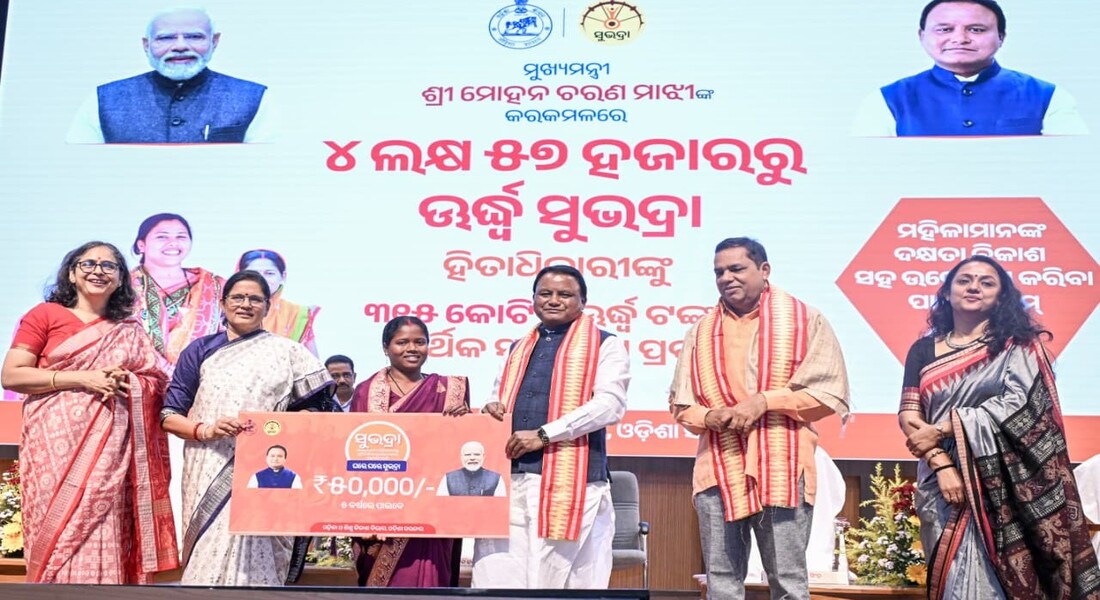
Subhadra scheme disburses Rs315cr to 4.57 lakh women

Bhubaneswar: The State government on Thursday disbursed the latest instalment of assistance under the ‘Subhadra’ scheme, transferring more than Rs315 crore directly to the bank accounts of over 4.57 lakh beneficiaries.

The disbursement was carried out during a special programme held at Krushi Shiksha Sadan, OUAT, Bhubaneswar, where Chief Minister Mohan Charan Majhi released the funds through direct benefit transfer.

Addressing a gathering, Majhi said: “The Subhadra scheme is not just a financial assistance programme – it is a new sunrise of self-reliance for the women of Odisha. Today, financial support worth Rs315 crore has been credited directly into the bank accounts of more than 4.57 lakh beneficiaries. Mothers who were earlier left out due to various technical reasons have also been included in the process today, because our government’s clear resolve is that not a single eligible beneficiary will be deprived of this scheme. This marks a new chapter in the journey of economic empowerment of Odisha’s strong and inspiring mothers and sisters.”

He pointed out women who were previously left out due to technical issues were also included in the process, underlining the government’s commitment to ensure that no eligible beneficiary is deprived of the benefits.

Describing Subhadra as more than a financial assistance initiative, the CM said the scheme is now playing a wider role in supporting women’s dreams and self-reliance across the State. Along with monetary support, beneficiaries are also being provided with skill development training and entrepreneurship-focused guidance to help them build sustainable livelihoods, according to a post on X by Majhi.

ICC keeps Bangladesh matches in India

New Delhi: The International Cricket Council (ICC) on Wednesday drew a clear line ahead of the Men’s T20 World Cup: the tournament will go ahead as planned, and Bangladesh’s matches will stay in India.

In a media release, the ICC said the call was taken after a Board meeting held via video-conference, which was convened to address the Bangladesh Cricket Board’s (BCB) request to shift its fixtures to Sri Lanka.

According to the ICC, the decision followed multiple rounds of security assessments – including independent reviews – and all reports pointed to the same conclusion: there is no credible threat to Bangladesh players, officials, media personnel or supporters at any of the tournament venues across India.

The ICC’s reasoning was as much about the bigger picture as it was about immediate logistics. It said changing venues at this stage, without a verified security concern, would be impractical and disruptive so close to the tournament.

More importantly, the governing body underlined the precedent such a move could set.

Altering the schedule under pressure, the ICC noted, could open the door for similar demands in future events – potentially weakening the integrity of ICC tournaments and raising questions about the organisation’s neutrality as a global governing body.

The ICC also revealed it attempted to break the deadlock through sustained engagement with the Bangladesh board. It said its management team held several meetings and exchanged multiple correspondences with BCB officials, sharing a detailed breakdown of the security framework in place for the tournament.

That plan, the ICC said, includes layered support from both federal and state law-enforcement agencies.

For now, Bangladesh’s fixtures will go ahead in India, and the tournament timeline remains unchanged.

Pollution bigger economic threat than tariffs, Gita Gopinath warns at Davos

Pollution poses a more serious long-term risk to India’s economy than tariff-related challenges, former IMF Chief Economist Gita Gopinath said at the World Economic Forum in Davos, urging policymakers to treat environmental degradation as a central economic concern.

Speaking at the global forum, Gopinath underlined that the costs of pollution go far beyond environmental damage, directly affecting productivity, public health and economic growth. She said the impact of degraded air, water and land is increasingly visible in economic outcomes, particularly in fast-growing countries like India.

“The real costs of pollution are not merely environmental; they are deeply intertwined with economic growth, productivity and the health of citizens,” she said, stressing that addressing pollution must become a priority for safeguarding India’s economic future.

Her remarks came amid heightened global uncertainty, with markets facing volatility and shifting trade dynamics. While tariffs and trade barriers remain relevant, Gopinath argued that environmental stress is emerging as a more persistent and systemic threat to economic stability.

The Davos discussions this year have placed strong emphasis on sustainability and climate risks, reflecting a broader consensus among economists that unchecked environmental damage can undermine development gains. Experts have long warned that climate and pollution-related shocks could have outsized economic consequences in emerging economies.

India continues to face scrutiny over air quality and rising pollution levels, which have significant public health implications and can impede growth. Global health agencies estimate that polluted air contributes to millions of premature deaths each year, with India among the most affected countries.

Gopinath cautioned that as the world navigates post-pandemic recovery, economies are likely to experience greater instability in markets, currencies and growth trajectories. She said how nations respond to environmental challenges will play a decisive role in shaping their economic futures.

India among first wave of AI nations: Ashwini Vaishnaw

New Delhi: India has positioned itself among the world’s first wave of artificial intelligence powers, with a strategy centred on large-scale adoption, economic returns and responsible governance, Union Minister for Electronics and IT Ashwini Vaishnaw said at the World Economic Forum in Davos.

Speaking at a panel on global AI dynamics, Vaishnaw said India is working across all five layers of the AI stack—applications, models, chips, infrastructure and energy—arguing that real power in AI comes from deployment and productivity gains rather than the sheer size of models. He noted that most practical use cases can be handled by mid-sized models and that enterprise adoption, not model scale, will determine return on investment.

The Minister cautioned against equating geopolitical dominance with ownership of massive AI systems, pointing out that such models can be switched off and may impose heavy economic costs on their developers. The future of what he termed the “fifth industrial revolution”, he said, lies in deploying the lowest-cost solutions that deliver the highest returns.

Drawing parallels with India’s success in building digital public infrastructure, Vaishnaw said the government is pursuing AI diffusion across the economy. A major bottleneck—access to computing power—is being addressed through a public-private partnership that has empanelled around 38,000 GPUs as a national compute facility, offering students, researchers and startups access at nearly one-third of global costs.

He outlined four pillars of India’s AI roadmap: a shared national compute platform; a free bouquet of AI models for most real-world needs; large-scale skilling to train 10 million people in AI; and enabling India’s IT sector to shift towards AI-driven productivity for global enterprises, according to an official release.

On governance, Vaishnaw stressed a “techno-legal” approach, saying regulation must be backed by technical tools capable of addressing risks such as bias and deepfakes. India, he said, is developing systems for deepfake detection, bias mitigation and safe model deployment that can withstand legal scrutiny.

The remarks underscored India’s ambition to build AI as a widely accessible economic tool rather than a concentrated technological asset, positioning the country as a major force in the next phase of global digital transformation.

Trump pauses tariffs on European nations after Greenland talks

New Delhi: US President Donald Trump announced on Wednesday that he will not proceed with new tariffs on eight European countries, which were set to take effect on February 1. He cited progress in talks with NATO Secretary-General Mark Rutte on Greenland during the World Economic Forum in Davos.

In a post on Truth Social, Trump stated that the two sides had agreed on “the framework of a future deal” related to Greenland, describing the discussions as productive. He added that the proposed arrangement would benefit the US as well as NATO allies.

“Based upon this understanding, I will not be imposing the tariffs that were scheduled to go into effect on February 1,” Trump wrote.

The tariff plan, announced just days before the Davos meeting, was set to begin at 10% on imports from France, Germany, the UK, Denmark, Sweden, Norway, and the Netherlands, with an additional European nation also included. The rates were expected to rise to 25% by June, according to the earlier announcement.

Trump said future negotiations will be led by Vice President JD Vance, Secretary of State Marco Rubio, Special Envoy Steve Witkoff, and other senior officials, who will report directly to him, according to a White House post on X.

The decision came hours after Trump’s address in Davos, where he again argued the US needs Greenland for national and global security, and suggested NATO members could support a deal that gives Washington control of the territory.

Exhibition in Bulgarian city spotlights Odisha’s Saura tribal art

Bhubaneswar: Paintings created on palm leaves, fine silk, and other materials, including Saura paintings from Odisha, are among the main highlights of the exhibition “One Region, One Product – Tribal Artifacts of India”, which opened recently in the Bulgarian city of Pernik as part of the cultural programme of the 32nd International Festival of Masquerade Games “Surva”.

The Saura paintings, a traditional tribal art form from Odisha, are known for their symbolic storytelling and depictions of everyday life. Several works on display portray scenes of agriculture, festivals, rituals, hunting, and community gatherings, reflecting the close link between indigenous traditions and living cultural heritage.

The exhibition has been organised by the Embassy of India in Sofia in cooperation with the East-West Indological Foundation, and is being hosted at the Mining Directorate building. It marks the first time the exhibition is being presented outside Bulgaria’s capital.

The exhibition was inaugurated by Soni Dahiya, Second Secretary at the Embassy of India, who thanked the Municipality of Pernik for its partnership and support.

Speaking on the occasion, she said the showcase presents the material culture of more than 700 officially recognised tribes in India, offering visitors insights into their daily lives, rituals, spirituality, and social identity.

“I thank the Municipality of Pernik for the hospitality and assistance in reaching a wider audience outside the capital. Through it, we present the wealth of the material culture of over 700 officially recognized tribes in India – their daily lives, rituals, spirituality, and social identity. Each exhibit tells a story of unique artistic traditions, languages ​, ​and customs preserved over the centuries,” Dahiya stated.

The exhibition will remain open until the end of January.