At IndiaVerve, we go beyond the noise to bring you meaningful stories of change, resilience and progress—from India to the world stage. Our mission is to bring readers credible, wide-ranging coverage across politics, business, sports, culture, society and more.

Indian Navy Training Squadron wraps up Thailand visit

New Delhi: The Indian Navy’s First Training Squadron concluded its port call at Phuket Deep Sea Port on Wednesday with a joint passage exercise alongside a Royal Thai Navy ship, marking another step in strengthening bilateral maritime cooperation between India and Thailand.

The visit, which featured INS Tir, INS Sujata, INS Shardul, and ICGS Sarathi, ended with a Passage Exercise (PASSEX) conducted with HTMS Huahin on Wednesday. During the harbour phase, personnel from the Indian Navy and the Royal Thai Navy engaged in professional exchanges, training interactions, and social activities aimed at deepening naval ties.

Senior officers of the First Training Squadron, led by Captain Tijo K Joseph, met Vice Admiral Veerudome Muangchean, Commander of the Royal Thai Navy’s 3rd Naval Area Command. The discussions focused on regional maritime security, training approaches, and opportunities for expanding joint naval training.

As part of the engagement, Indian sea trainees visited the 3rd Naval Area Command and Phang Nga Naval Port. Royal Thai Navy personnel were also hosted onboard INS Sujata, where they were briefed on the roles and operational capabilities of the First Training Squadron. These interactions helped both sides exchange best practices and enhance professional understanding, according to an official statement.

The visit also included a combined yoga session, friendly sports events, and an onboard reception jointly hosted by the Indian Embassy and the senior officer of the squadron. Senior Royal Thai Navy officials, diplomats, and members of the Indian community attended the event.

The successful visit reaffirmed the strong friendship between the two navies and highlighted the Indian Navy’s commitment to regional maritime cooperation under the MAHASAGAR vision for shared security and growth.

India submits Meghalaya cultural landscape to UNESCO

New Delhi: India has formally submitted the nomination dossier of the “Jingkieng Jri / Lyu Chrai Cultural Landscape” in Meghalaya to UNESCO, marking a major step towards securing World Heritage status for an Indigenous living cultural landscape shaped by Khasi and Jaintia traditions.

The nomination was submitted by India’s Permanent Representative to UNESCO, Vishal V. Sharma, to the Director of UNESCO’s World Heritage Centre for consideration during the 2026–27 evaluation cycle. The proposed site spans the Khasi and Jaintia Hills of Meghalaya and reflects centuries-old cultural practices rooted in harmony between people, nature, and spirituality, according to a media release.

The cultural landscape showcases traditional systems of land use, community governance, and ecological care maintained by Indigenous Khasi and Jaintia communities. Central to this heritage is the worldview of Mei Ramew or Mother Earth, which emphasises respect, reciprocity, and collective responsibility towards nature.

During the submission, Sharma acknowledged the support of Prime Minister Narendra Modi, Union Culture Minister Gajendra Singh Shekhawat, Meghalaya Chief Minister Conrad K Sangma, and state and central institutions, including the Archaeological Survey of India and the Ministry of External Affairs. He also credited local communities for safeguarding the site and its traditions.

In a post on X, Sangma expressed delight at the development and said: “We are hopeful that the Living Root Bridges will be inscribed this year, ensuring that the indigenous communities, the true guardians of this living heritage, receive the global recognition they so richly deserve.”

The nomination underlines India’s broader commitment to protecting cultural and natural heritage and promoting Indigenous knowledge systems through international platforms such as UNESCO.

Chinese president warns against unilateralism

New Delhi: China-UK strategic partnership talks gained focus on Thursday as President Xi Jinping met UK Prime Minister Keir Starmer in Beijing. Both leaders discussed multilateralism, free trade, and ways to strengthen bilateral cooperation. President Xi warned that unilateralism, protectionism, and power politics threaten global stability.

Xi made these remarks during his meeting with UK Prime Minister Keir Starmer in Beijing. He stressed that international law can work only when all nations respect it. Major powers, he said, must lead by example to prevent a return to “the law of the jungle”.

Both leaders underlined their shared support for multilateralism and free trade. Xi further said China and the UK should jointly promote genuine multilateralism. He added that global governance must become more just and equitable. The Chinese leader also called for an equal and orderly multipolar world and inclusive economic globalisation.

The meeting took place during Starmer’s official visit to China. Both sides agreed to work towards a long-term and consistent comprehensive strategic partnership. The leaders said stronger cooperation could bring mutual benefits despite existing differences, according to a post on X by Mao Ning, spokesperson of the Ministry of Foreign Affairs of China.

President Xi said China is ready to work with the UK with a broader historical perspective. He urged both countries to respect each other and rise above disagreements. He added that the untapped potential of bilateral cooperation should translate into real outcomes.

For his part, Starmer said growth at home is closely linked to engagement with major global powers. He described the talks with President Xi as constructive and forward-looking. The two leaders, he said, reaffirmed their commitment to a long-term strategic partnership.

Starmer also noted that both sides agreed to maintain frank and open dialogue on areas of disagreement. He further said his government would always act in the interests of the British people while pursuing stable international relations.

India’s GDP growth seen at 7.4% in FY26

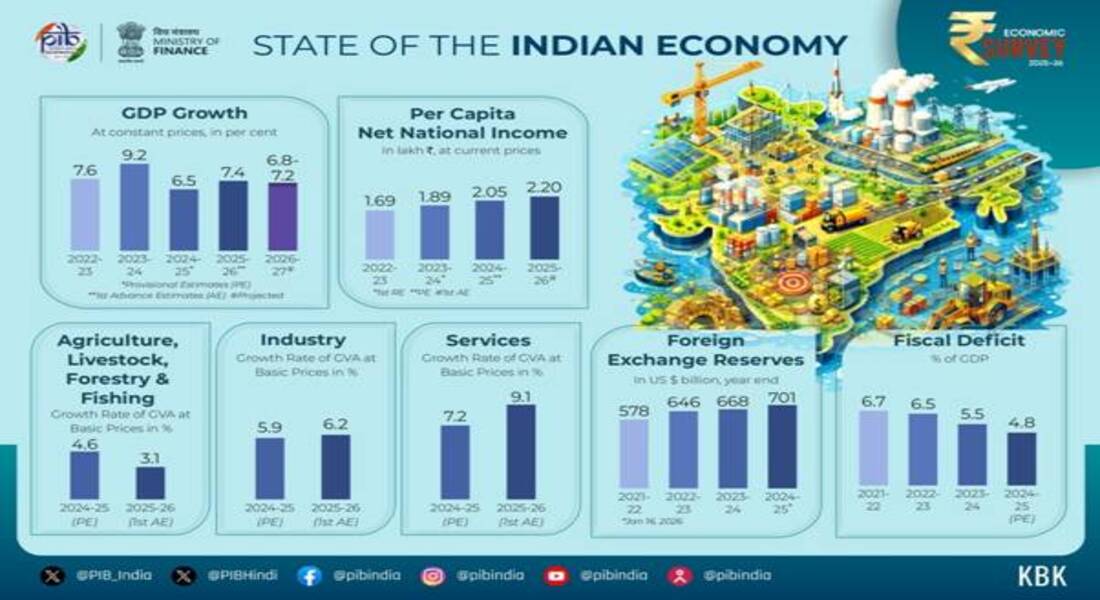
New Delhi: India’s GDP growth for FY26, as outlined in the Economic Survey 2025–26, is estimated at 7.4%, driven by strong domestic consumption and steady investment. The Survey, tabled in Parliament by Finance Minister Nirmala Sitharaman on Thursday, reinforces India’s position as the fastest-growing major economy for the fourth consecutive year.

Looking ahead, the Survey projects real GDP growth of 6.8 to 7.2% in FY27. It also places India’s long-term potential growth close to 7%, reflecting stable macroeconomic fundamentals.

Domestic demand continues to anchor growth in FY26. Private consumption has gained further strength during the year. The First Advance Estimates show that private final consumption expenditure now accounts for 61.5% of GDP. This rise reflects low inflation, stable job conditions, and improving real incomes.

Rural demand has remained firm due to a strong agricultural performance. At the same time, urban consumption has shown a gradual improvement. Tax rationalisation across direct and indirect taxes has supported spending momentum. The Survey notes that consumption growth remains broad-based across regions and income groups, according to an official statement.

Investment has also played a critical role in supporting economic expansion. Gross fixed capital formation stands at 30% of GDP in FY26. During the first half of the year, investment grew by 7.6%. This pace exceeded last year’s growth and stayed above the pre-pandemic average. Public capital expenditure and improved private sector confidence continue to support this trend.

Growth in agriculture and related activities is likely to reach 3.1% during FY26. A favourable monsoon helped farm activity during the first half of the year. Agricultural GVA rose by 3.6% during this period, higher than last year’s growth. However, it stayed below the long-term average.

Allied sectors such as livestock and fisheries maintained steady growth of around 5 to 6%. Their rising share has helped reduce volatility in overall farm output.

The industrial sector has shown visible improvement. Manufacturing expanded by 8.4% in the first half of FY26, beating earlier estimates. Construction activity remained resilient, supported by infrastructure spending and ongoing projects. The sector’s real output share stayed stable, signalling sustained production levels.

High-frequency indicators point to further industrial momentum. Manufacturing PMI, IIP data, and e-way bill generation indicate strong demand. Steel consumption and cement output also recorded steady growth.

The Survey expects industry growth to improve to 6.2% in FY26, helped by GST rationalisation and a positive demand outlook.

On the supply side, services continue to drive growth. Services GVA rose by 9.3% in the first half of FY26. Growth for the full year is estimated at 9.1%. Most service segments have crossed 9% growth. Trade, hospitality, and transport remain slightly below pre-pandemic averages but continue to recover.

BSF, counter intelligence foil cross-border smuggling bid in Punjab

New Delhi: Counter-intelligence Faridkot, in close coordination with the Border Security Force (BSF), on Wednesday night foiled a major cross-border smuggling attempt along the Indo-Pakistan border in Punjab’s Fazilka district.

The operation was carried out near Border Out Post GG-3 in Teja Rahela village, under Sadar police station. Security agencies recovered a large consignment of heroin, arms, and ammunition during a joint search operation.

According to officials, the seized items include one Ghaffar security pistol of MP-5 type, 20 pistols, 39 magazines, and 310 live 9 mm rounds. Security forces also recovered two backpacks and 2.160 kilograms of heroin from the area.

Preliminary investigation indicates the involvement of Pakistan-based smugglers, who crossed the zero line and operated close to the border fence. They allegedly tried to exploit darkness and dense fog to push arms and narcotics into Indian territory.

Alert BSF personnel noticed suspicious movement and fired warning rounds to prevent the breach. This was followed by a coordinated search operation by BSF and counter-intelligence teams, which led to the recovery of the consignment, according to a post on X by DGP Punjab Police.

Punjab Police said the successful operation reflects strong inter-agency coordination and constant surveillance along the international border. Authorities reiterated their zero-tolerance policy against cross-border crimes and said efforts will continue to safeguard the state’s security.

Odisha signs key aviation, drone MoUs at Wings India 2026

New Delhi: Odisha has taken a significant step towards emerging as a hub for aviation and drone technology with the signing of two key Memoranda of Understanding (MoUs) at the ongoing Wings India 2026.

The agreements, signed by the government of Odisha during the civil aviation event, focus on skill development, innovation, and employment generation for the state’s youth.

As part of the initiative, a Flying Training Organisation will be set up at Dandbose Airport in Mayurbhanj. The facility will train 50 commercial pilots every year, creating new career pathways in the rapidly expanding aviation sector.

In another first for the state, Odisha will establish its maiden UAV (drone) Training and Testing Centre at the Rangeilunda Airstrip in Ganjam district. The centre is expected to train more than 100 UAV pilots annually. These skills will support critical sectors such as agriculture, infrastructure development, logistics, and disaster management.

Officials said the projects aim to strengthen Odisha’s aviation ecosystem and equip young professionals with future-ready technical skills. The State government believes these initiatives will also boost local employment and attract investment in emerging technologies.

In a post on X, Chief Minister Mohan Charan Majhi said: “We remain committed to building a skilled, self-reliant, and aspirational Odisha.”

With these developments, Odisha is positioning itself as an important contributor to India’s technology-driven growth, while advancing its goal of building a skilled and self-reliant workforce.

Ajit Pawar laid to rest in Baramati, probe begins into fatal plane crash

Baramati: Maharashtra bade farewell to Deputy Chief Minister Ajit Pawar on Thursday as his sons, Jay and Parth Pawar, performed his last rites in Baramati, a day after he died in a tragic plane crash. The funeral was held at the Vidya Pratishthan ground, where thousands of supporters gathered to pay their respects.

Jay and Parth lit the funeral pyre amid emotional scenes, surrounded by family members, party colleagues and local residents. Ajit Pawar was accorded a state funeral. Chief Minister Devendra Fadnavis, Deputy Chief Minister Eknath Shinde, Union Home Minister Amit Shah, Union Minister Nitin Gadkari and BJP national president Nitin Nabin were among the senior leaders present.

Ajit Pawar, 66, was travelling in a Learjet 45 from Mumbai to Baramati on Wednesday morning. He was scheduled to address a series of rallies for the upcoming Zilla Parishad elections. The aircraft took off at 8.10 am and reached the Baramati region within minutes.

During the first landing attempt, the pilot aborted the descent after failing to establish clear visibility of the runway. The aircraft circled back and prepared for a second landing at around 8.43 am. Within a minute, air traffic control noticed flames near the runway as the jet veered off course. The aircraft crashed and caught fire almost instantly.

Five people lost their lives in the accident. Besides Ajit Pawar, the victims included his personal security officer Vidhit Jadhav, pilot-in-command Sumit Kapur, first officer Shambhavi Pathak, and cabin crew member Pinky Mali. The aircraft, registered as VT-SSK, was operated by Delhi-based VSR Ventures Pvt Ltd.

The government said on Thursday that the black box of the crashed aircraft has been recovered. According to an official statement, teams from the Aircraft Accident Investigation Bureau (AAIB) and the Directorate General of Civil Aviation (DGCA) reached the site on January 28. The Director General of the AAIB also visited the crash location the same day.

A black box records key flight data and cockpit conversations and is vital for determining the cause of an accident. Authorities said the investigation is progressing swiftly and will follow all laid-down procedures.

The Ministry of Civil Aviation said that all response and investigative mechanisms were activated immediately after the crash. It added that the probe would be thorough, transparent and time-bound, and would be conducted under the provisions of the AAIB Rules, 2025.

Flight tracking data showed that the jet followed a largely straight path towards Baramati, climbing to about 19,000 feet and maintaining that altitude while crossing the Western Ghats before beginning its descent.

As Baramati mourns its tallest leader, attention now turns to the investigation that will seek answers to one of Maharashtra’s most tragic aviation disasters in recent memory.

BMC unveils Rs1,050cr budget

Bhubaneswar: The Bhubaneswar Municipal Corporation (BMC) on Wednesday presented its Rs1,050 crore draft budget for the 2026‑27 financial year at the 38th general council meeting. The budget includes Rs300 crore from BMC’s own revenue and Rs750 crore from government grants.

Mayor Sulochana Das presided over the meeting, where councillors approved measures aimed at strengthening city sanitation, waste management, and public health. The budget focuses on improving cleanliness in public areas and boosting civic infrastructure.

The council also passed a key decision to strictly enforce the ban on gutkha (chewing tobacco). Any sale at BMC vending zones or OMFED booths will face strict penalties. Civic authorities will intensify enforcement across the city to stop illegal sales, according to a post on X by BMC.

Officials confirmed that gutkha-related hoardings will be removed, and those installing advertisements will face penalties. These steps aim to improve public health and reduce tobacco consumption.

Mayor Das emphasized the need to strengthen the BMC’s internal revenue systems and urged officials to ensure the timely collection of own-source funds. The budget also plans for the construction of new ward offices in all city wards by the end of next year.

The council reaffirmed its commitment to sanitation, public well-being, and civic development. Officials said the administration will continue programmes to improve cleanliness in markets, streets, and parks across Bhubaneswar.

Iran reaffirms peaceful nuclear stance

New Delhi: Iran’s Foreign Minister Seyed Abbas Araghchi on Wednesday reiterated the country’s commitment to a peaceful nuclear programme. He stressed that Iran does not seek nuclear weapons and wants a fair, mutually beneficial nuclear deal.

At the same time, Araghchi said lessons from the 12-Day War have strengthened Iran’s ability to respond quickly and decisively to any aggression against its land, air, or sea.

In a post on X, he highlighted that Iran supports a nuclear agreement based on equality and respect, without coercion or intimidation. Such an agreement would allow Iran to develop nuclear technology for peaceful purposes only.

Araghchi’s statement came hours after US President Donald Trump renewed threats of a military strike against Iran. Trump warned that a “massive armada” is heading to Iranian waters and is “ready, willing, and able” to act with speed if necessary.

In a post on his Truth Social platform, Trump added that he hopes Iran will negotiate a “fair and equitable deal – no nuclear weapons – one that benefits all parties.” He emphasized urgency, saying, “Time is running out. Make a deal!”

Tensions between the two countries have risen due to Iran’s crackdown on anti-government protests and the ongoing disputes over its nuclear program.

Enterprise Odisha 2026 marks major industrial boost in Rourkela

Bhubaneswar: Enterprise Odisha 2026 reached a major milestone on Wednesday as the silver jubilee edition opened in Rourkela, reinforcing the State’s push for industrial growth and job creation. Chief Minister Mohan Charan Majhi led the event and highlighted Odisha’s ambition to become a key driver of India’s economic expansion.

During the programme, the CM inaugurated and laid foundation stones for 20 industrial projects with a combined investment of ₹8,800 crore. These projects are expected to generate 6,832 direct employment opportunities for youth across the state.

The event also saw strong investor interest. Odisha signed 22 memorandums of understanding and received five major investment proposals on the same day. Together, these commitments are projected to bring ₹52,026 crore in fresh capital investment and create 20,427 new jobs.

In a post on X, the CM said: “The government reiterated its focus on balanced industrial development. Along with large industries, it aims to strengthen MSMEs and local entrepreneurs to ensure inclusive growth.”

Officials emphasized that this approach will help build resilient supply chains and support local employment.

Majhi further said policy stability, administrative reforms, and a skilled workforce have given Odisha a distinct place on the global manufacturing map. He added that the State continues to move forward on the path of self-reliance through sustained industrial expansion.

The programme also highlighted the growing role of Western Odisha as an emerging industrial hub. The region is expected to serve as a key engine of economic transformation in the years to come.

Aligned with Prime Minister Narendra Modi’s Purvodaya vision, the State government aims to position Odisha as a preferred destination for business, investment, and improved quality of life. The long-term goal remains to build a prosperous and empowered Odisha by 2036, according to the CM.