At IndiaVerve, we go beyond the noise to bring you meaningful stories of change, resilience and progress—from India to the world stage. Our mission is to bring readers credible, wide-ranging coverage across politics, business, sports, culture, society and more.

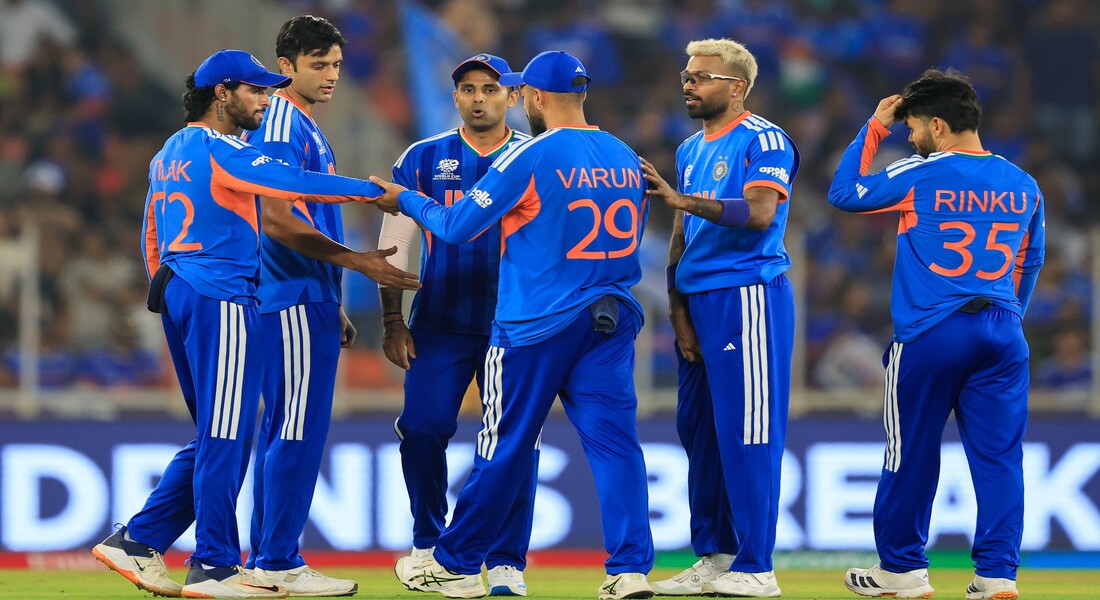
Dube’s blitz, Varun’s spell keep India unbeaten in T20 World Cup

Ahmedabad: India extended their T20 World Cup winning streak to 12 matches with a hard-fought 17-run victory over the Netherlands, powered by Shivam Dube’s explosive half-century and Varun Chakravarthy’s decisive spell on a demanding surface.

Batting first on a sluggish back-soil pitch, India faced early resistance from the Dutch attack. Off-spinner Aryan Dutt set the tone in the powerplay, bowling with pace and accuracy to trouble India’s left-hand-heavy top order. Abhishek Sharma’s difficult tournament persisted as he fell for his third duck, while Dutt’s disciplined lines also accounted for Tilak Varma. Ishan Kishan, who had been among India’s more consistent batters, was undone by an awkward deflection that rolled back onto the stumps.

With the scoring rate contained and boundaries hard to come by, India needed acceleration through the middle overs. Suryakumar Yadav provided a stabilising presence with a brisk 34, rotating strike and finding timely gaps. The innings, however, transformed when Shivam Dube launched a calculated assault. Using his reach to counter the lack of pace, Dube struck 66 off just 30 deliveries, shifting momentum with clean hitting down the ground and over the leg side. His late burst lifted India to a competitive total that appeared slightly above par given the conditions.

The Netherlands’ bowlers executed their plans effectively for long periods. Fast bowlers mixed their lengths cleverly, while Dutt’s spell stood out for its control. Van Beek also made key breakthroughs, helping restrict India’s run flow until Dube’s surge.

Chasing 194, the Netherlands approached the task with intent and composure. Max O’Dowd and Bas de Leede kept the innings afloat with proactive strokeplay, refusing to let the asking rate spiral out of control. De Leede’s knock anchored the chase, and a series of partnerships kept India under pressure well into the second half.

India’s bowlers, though, found answers at critical moments. Varun Chakravarthy once again demonstrated his value on a slow track, weaving through the middle order with subtle variations in pace and trajectory. His three-wicket spell dented the Netherlands’ momentum just as they threatened to close in. Dube added to his all-round impact by picking up two wickets, breaking partnerships that could have tilted the contest.

Despite losing wickets, the Netherlands remained competitive, pushing India deep into the innings. Their batters adapted smartly, and the required rate stayed within reach until the closing overs. However, disciplined execution at the death, supported by Chakravarthy’s breakthroughs, sealed India’s win.

While the margin suggested a comfortable defence, the Netherlands’ performance reflected resilience and tactical discipline. They matched India for long stretches, with only brief lapses proving decisive.

India, meanwhile, reinforced their credentials as tournament favourites. The ability to post a strong total on a difficult pitch and defend it under pressure highlighted both batting depth and bowling versatility.

Brief Scores: India 193/6 (Shivam Dube 66, Suryakumar Yadav 34; Aryan Dutt 2/19, van Beek 3/56) beat Netherlands 176/7 (Bas de Leede 33; Varun Chakravarthy 3/14, Shivam Dube 2/35) by 17 runs

T20 World Cup: Pakistan, South Africa storm into Super Eights

Colombo/New Delhi: Pakistan and South Africa registered commanding victories on Wednesday to book their places in the Super Eights, with Pakistan overpowering Namibia and South Africa completing the group stage without a defeat.

In Colombo, Pakistan produced a dominant all-round display, built around Sahibzada Farhan’s unbeaten century and a decisive spin effort. Batting first in a must-win fixture, Pakistan recovered from an uneasy start to post 199 for 3. Farhan, after a cautious beginning, shifted momentum with authoritative strokeplay despite battling a leg niggle that restricted his running.

Salman Agha’s brisk cameo helped lift the tempo before his dismissal, while a late unbeaten stand between Farhan and Shadab Khan ensured a strong finish. Farhan brought up his hundred in the closing stages, and Shadab’s late hitting pushed Pakistan close to the 200-run mark.

Namibia’s response faltered early. Pakistan’s spinners applied sustained pressure, exploiting turn and bounce to derail the chase. Mohammad Nawaz and Shadab Khan struck key blows through the middle overs, while Usman Tariq’s incisive spell — featuring sharp variations and a double-wicket maiden — sealed Namibia’s fate. Bowled out for 97, Namibia suffered a 102-run defeat as Pakistan cruised into the next round.

Brief Scores: Pakistan 199/3 (Sahibzada Farhan 100*, Salman Agha 38) beat Namibia 97 all out (Louren Steenkamp 23; Usman Tariq 4-16, Shadab Khan 3-19) by 102 runs.

In Delhi, South Africa wrapped up their group campaign with a comfortable six-wicket win over UAE, finishing unbeaten. Despite resting several frontline bowlers, South Africa delivered a disciplined performance to restrict UAE to 122 for 6. Corbin Bosch led the attack with a sharp three-wicket haul, while Anrich Nortje’s pace and George Linde’s control kept UAE from building partnerships.

Muhammad Waseem provided early aggression for UAE but fell attempting to counter spin. Alishan Sharafu top-scored yet struggled to accelerate consistently, as wickets at regular intervals limited UAE to a modest total.

South Africa’s chase was swift and assured. Aiden Markram set the tone with a rapid burst of boundaries, while Ryan Rickelton and Dewald Brevis contributed briskly to keep the required rate well in check. The target was reached with 40 balls remaining, underlining South Africa’s composure and batting depth.

The Proteas’ only concern came in the field, where multiple dropped catches offered UAE brief reprieves. However, the lapses proved inconsequential in an otherwise clinical outing.

Brief Scores: UAE 122/6 (Alishan Sharafu 45; Corbin Bosch 3-12) lost to South Africa 123/4 (Dewald Brevis 36, Ryan Rickelton 30) by six wickets.

Both Pakistan and South Africa now carry strong momentum into the Super Eights, while Namibia and UAE bow out after disappointing campaigns.

Rajya Sabha polls for 37 seats scheduled on March 16

New Delhi: Biennial elections to the Rajya Sabha for 37 seats across 10 states will take place on March 16. Announcing the schedule on Wednesday, the Election Commission of India (ECI) said that counting will be held on the same day.

According to an official statement, notifications for the elections will be issued on February 26. The last date for filing nominations is March 5, and scrutiny will be carried out on March 6.

The schedule released by the ECI showed that candidates may withdraw their nominations until March 9. Polling will take place from 9 am to 4 pm on March 16, with counting beginning at 5 pm. The ECI said that the election process will be completed by March 20.

Elections will be held in the following states: Odisha (4), Tamil Nadu (6), Maharashtra (7), West Bengal (5), Assam (3), Bihar (5), Chhattisgarh (2), Haryana (2), Himachal Pradesh (1), and Telangana (2). These Rajya Sabha seats will be vacated in April 2026.

The ECI has instructed that only the integrated violet sketch pen of the prescribed specification, supplied by the Returning Officer, must be used to mark preferences on the ballot paper. The use of any other pen for marking preferences in these elections will not be permitted.

Some of the well-known members who will retire include Union Minister Ramdas Athawale, Sharad Pawar, Congress leader Abhishek Manu Singhvi, Rajya Sabha Deputy Chairman Harivansh Narayan Singh, and Trinamool Congress leader Saket Gokhale.

In the 2020 biennial elections, the BJP and its allies secured a majority share in states such as Assam, Bihar, Haryana, and Himachal Pradesh.

In Odisha, the tenures of four Rajya Sabha MPs – Sujeet Kumar, Muzibulla Khan, Mamata Mohanta, and Niranjan Bishi – will end on April 2, 2026.

Global leaders, Sundar Pichai meet PM Modi on AI Summit sidelines

New Delhi: A series of high-level diplomatic and industry engagements marked the sidelines of the India AI Impact Summit 2026, with Prime Minister Narendra Modi holding today bilateral meetings with leaders from Spain, Serbia and Finland, alongside a key interaction with Google CEO Sundar Pichai.

President of Spain Pedro Sánchez met Modi in New Delhi, where discussions focused on strengthening India–Spain cooperation across defence, security, and technology. The two leaders also highlighted the decision to mark 2026 as the India–Spain Year of Culture, Tourism and AI, an initiative aimed at enhancing cultural exchanges, travel partnerships and collaboration in emerging technologies.

In a post on X, Modi described the interaction as “productive,” noting that the initiative would deepen people-to-people ties. He also welcomed the presence of a large Spanish university delegation in India, emphasising the role of academic collaboration in building long-term partnerships. Referring to the recently concluded free trade agreement with the European Union, the Prime Minister said it would positively impact economic engagement with Spain and create new opportunities for businesses and citizens of both countries.

On the summit’s sidelines, Serbia’s President Aleksandar Vučić met Modi to review avenues for expanding bilateral cooperation. According to official updates, the leaders discussed collaboration in defence, manufacturing, digital public infrastructure (DPI), fertilisers and infrastructure development. Modi underlined the long-standing relationship between India and Serbia, expressing confidence that ties would gain further momentum.

Finland’s Prime Minister Petteri Orpo also held extensive talks with Modi in Delhi. The leaders set an ambitious target of doubling bilateral trade, while exploring cooperation in next-generation sectors including 6G, innovation, clean energy, biofuels and the circular economy.

Modi thanked Orpo for his support for the India–EU Free Trade Agreement, calling it a step that ushers in a “golden era” in India–Europe relations.

Prime Minister of Croatia, Mr. Andrej Plenković also met his Indian counterpart on the sidelines of the AI Impact Summit. Both leaders discussed bilateral partnerships in areas such as technology, innovation, shipbuilding, blue economy and boosting connectivity through the IMEEC corridor.

“Held fruitful discussions with the Prime Minister of Croatia, Mr. Andrej Plenković. We discussed how to add momentum to our bilateral partnership in areas such as technology, innovation, shipbuilding, blue economy and boosting connectivity through the IMEEC corridor. Also expressed gratitude for his personal support to the India-EU FTA, which will bring unprecedented progress for people in India as well as Europe,” Modi wrote on X.

Earlier in the day, technology and innovation remained a central theme as Google CEO Sundar Pichai met Modi. The interaction centred on India’s progress in artificial intelligence and potential areas of collaboration between Google and India’s student and professional communities.

“It was a delight to meet Mr. Sundar Pichai on the sidelines of the AI Impact Summit in Delhi. Talked about the work India is doing in AI and how Google can work with our talented students and professionals in this field,” Modi said in a social media post.

The meetings come a day after Modi’s bilateral engagement with French President Emmanuel Macron in Mumbai, reflecting the summit’s broader role as a platform for diplomatic dialogue, technology partnerships and global collaboration on AI and digital transformation.

The India AI Impact Summit 2026 has drawn participation from world leaders, policymakers, industry executives and researchers, positioning the event as a key forum for discussions on responsible AI, technological innovation and cross-border cooperation.

India pushes responsible AI adoption, sets Guinness record at AI Summit

New Delhi: India’s artificial intelligence ambitions took centre stage at the India AI Impact Summit 2026 with the government highlighting both sectoral priorities and citizen engagement in responsible AI practices. Two major announcements by Union Minister for Electronics and Information Technology Ashwini Vaishnaw today underscored the country’s twin focus on industrial transformation and ethical AI adoption.

Chairing a high-level industry–academia convening, Vaishnaw outlined India’s AI priorities for the Manufacturing Engineering Technology (MET) ecosystem. The session, curated by NAMTECH under the Ministry of Electronics and Information Technology (MeitY), brought together leading voices from global academia and major technology and industrial firms.

Participants, according to an official release, included experts from the Massachusetts Institute of Technology (MIT), IIT Madras, and senior executives from companies such as Microsoft India, Dell Technologies, Cisco India, Hitachi India, Tata Electronics, Rockwell Automation, Palo Alto Networks, PayPal, and Intel.

At the meeting, the minister launched the White Paper Concept on “AI for Manufacturing Engineering Technology (AI-MET)”. The framework aims to guide the integration of AI across manufacturing and associated value chains to improve productivity, sustainability, and global competitiveness. It also seeks to establish coordinated pathways for collaboration among industry, academia, and policymakers.

Describing AI as a foundational pillar in India’s journey towards “Viksit Bharat @2047”, Vaishnaw stressed that AI deployment must translate into measurable outcomes. He emphasised inclusive growth, noting that enterprises and MSMEs alike should benefit from AI-driven productivity gains. The minister also urged NAMTECH to leverage the initiative to develop next-generation talent capable of supporting India’s emergence as a global hub for precision equipment manufacturing.

Global academic leaders echoed the importance of moving from AI capability to real-world application. MIT’s Prof. Eric Grimson said the next phase of India’s AI journey would depend on embedding AI across enterprises, investing in skills at scale, and ensuring innovation remains inclusive. Industry leaders from Microsoft India, Cisco India, Palo Alto Networks, and Rockwell Automation highlighted the need for shop-floor adoption, workforce upskilling, and robust cybersecurity frameworks as AI becomes integral to modern manufacturing systems.

In a parallel milestone, Vaishnaw announced that India had secured a Guinness World Records title for the “Most pledges received for an AI responsibility campaign in 24 hours.” The nationwide AI Responsibility Pledge campaign, launched under the IndiaAI Mission in collaboration with Intel India, recorded 250,946 valid pledges between February 16 and 17.

Verified by an official Guinness World Records adjudicator at Bharat Mandapam, the achievement far exceeded the campaign’s initial target. The pledge initiative invited citizens—particularly students—to commit to the ethical and responsible use of AI, with participants reflecting on principles such as data privacy, accountability, transparency, and combating misinformation. Those completing the pledge received digital badges and access to AI learning pathways.

Addressing the media, Vaishnaw credited Prime Minister Narendra Modi’s vision of promoting responsible AI adoption among the youth. He described the overwhelming participation, largely driven by students, as a proud moment for the nation and a sign of growing awareness about ethical technology use.

Meanwhile, IT Secretary S. Krishnan announced that the Summit’s expo has been extended by one day, until Saturday (February 21, 2026). Speaking at a press conference on Wednesday, Krishnan said the decision was taken to allow attendees to visit the exhibition with more flexible security arrangements once the multilateral events at the venue conclude. He added that the extension would particularly benefit students and working professionals who were unable to attend during weekdays.

Officials said the record-setting response to the AI Responsibility Pledge demonstrates strong public engagement and reinforces India’s commitment to shaping global AI discourse around trust, inclusion, and responsible innovation. Together, the AI-MET White Paper Concept, the Guinness record, and the extended expo highlight India’s strategy of aligning policy, industry, and citizens in building a scalable and ethical AI ecosystem.

Angul Forest Division conducts successful combing operations

Bhubaneswar: Combing operations under the Jibedaya Programme were successfully conducted across all ranges of the Angul Forest Division on Tuesday. The initiative was overseen by Nitish Kumar, Divisional Forest Officer (DFO), and Sidharth Jain, IFS (P), supported by dedicated field staff.

The operation saw active participation from range officers, foresters, forest guards, squad members, and Gaja Mitra volunteers, the DFO Angul said in a post on X.

Field staff from Satkosia Wildlife Division and Dhenkanal Divisions also joined, ensuring thorough coverage of all forest areas.

The primary objectives of the combing operation were monitoring wildlife activity, preventing illegal hunting and encroachment, detecting unauthorized logging, and identifying potential environmental threats, including disease outbreaks.

Data collected during the operation will help maintain ecological balance, conserve natural habitats, and safeguard the rich biodiversity of the Angul Forest Division for future generations.

Officials emphasized that such initiatives reflect the Angul Forest Division’s ongoing commitment to wildlife protection and forest conservation, highlighting the importance of community involvement through programs like Gaja Mitra.

Harichandan says timely completion of projects key to development

New Delhi: Minister of Law, Works & Excise, Prithiviraj Harichandan, on Tuesday emphasized the need to accelerate the State’s development by completing infrastructure projects within the stipulated timeframe and preparing plans for new initiatives.

In a post on X, he highlighted that in the past year, the Works Department achieved a milestone by completing projects on schedule and utilizing budget funds efficiently.

In a meeting held at the Lok Seva Bhavan conference hall, the minister reviewed project-wise expenditures and assessed the Department’s performance in the current year in the field of infrastructure development.

During the session, Harichandan instructed officials to expedite ongoing projects while ensuring strict quality checks. He specifically directed the quick completion of new road development and expansion projects under the Department, including Ekamra and Samlei, along with various roads, culverts, and bridges.

The meeting was attended by top departmental officials.

Minister Harichandan reiterated that timely completion, budget efficiency, and project quality are crucial for Odisha’s rapid infrastructure growth and overall development.

Does the Gaza Board of Peace undermine UN peacebuilding architecture?

Amid sustained criticism of the failure of multilateralism, the first quarter of the 21st century has seen multilateral organizations expand in both scope and mandate. The Gaza Board of Peace (BoP), touted by the US administration as an international organization, was announced, signed, approved, and ratified at Davos on January 22 to support the reconstruction of post-conflict Gaza.

Although the BoP signing ceremony did not mention the UN mandate, the US Secretary of State, in a January 28 deposition before the Senate Committee, stated that the UN had established the BoP. The speed, secrecy, and strategies employed by the Trump administration to prepare, substantiate, and disseminate the Gaza BoP as an international organization require scrutiny, particularly from the democratically elected governments that are signatories. 

At the very least, the Gaza Board of Peace, as it is promoted, does not comply with the basic tenets of an international organization, in letter and in spirit.

From the outset, can the Gaza BoP be classified as an international organization? If so, could it sideline or overshadow the UN Peacebuilding Commission? Let’s examine the genesis and characteristics of the Gaza BoP so far.

With considerable hype, the announcement and signing of the Gaza BoP at a business jamboree in Davos revealed its initial intent: whether it was a temporary business project or a permanent international entity, and whether the BoP represents the intent to address the social, economic, and political rights of Gaza’s destitute. Imitating the UN logo, while substituting the olive branch with the laurel, the Board of Peace logo features a map of the Western Hemisphere with the U.S. as the pivot. In fact, the laurel branch is the symbol of victory. Is Gaza geographically or economically situated in the Western Hemisphere? Surprisingly, the U.S. Patent and Trademark Office had sought trademark protection for the BoP emblem before the Davos signing ceremony.    

The US president described the BoP as ‘the greatest and most prestigious Board ever assembled at any time, any place’. The Gaza BoP was first conceived by the Trump administration in the Comprehensive Plan to end the Gaza conflict (29 September 2025). The BoP, chaired by President Trump and comprising other members and heads of state, was proposed as an international transitional oversight body for the reconstruction and rebuilding of Gaza.  With BoP, an apolitical and technocratic transitional Palestine committee and a temporary International Stabilisation Force (ISF) were to be formed for Gaza.

Consequently, on 17 November 2025, the UNSC adopted a resolution establishing the Gaza BoP, as proposed in the Comprehensive Plan, and designating it as a transitional international, independent entity to oversee efforts to rebuild Gaza until December 2027. The UNSC is mandated to extend the BoP beyond 2027. Despite its status as an independent international entity, the Gaza BoP shall report to the UNSC every six months after its establishment.

However, such a pity that the charter of the calibre of Gaza BoP has not been in the public domain, neither in the US nor in the signatory countries, including Indonesia. The deliberations/commentaries to date are based on a single source (The Times of Israel, 18 January, 2026) of the so-called Charter of the BoP. If that is the Charter we are going to abide by, which is global in scope, not confined to Gaza, it includes the accumulation of immense power of appointing and firing members or executive staff by the self-appointed Chairman, the US President Trump (Canada was the first exemplary victim of denial of membership), and a high membership fee.  

As a result, there is confusion regarding its geographical scope, timeline, and membership criteria. It should be noted that President Trump will vacate the White House at the end of his second term in 2028; therefore, the timeline for BoP membership is 3 years, and the cost for permanent membership is 1 billion USD. Will the Gaza BoP continue after 2028 without UNSC approval and after the Trump presidency? Are these criteria for an international organisation? Has the Charter or draft Charter of the BoP been shared with signatory countries in advance?

It’s reported that the Charter has been sent to the heads of government as an attachment to the invitation letter to join the BoP a few days before Davos. Indeed, there have been no consultations with countries that have signed so far, not even with Capitol Hill, the Senate and Representatives in the US, as found out in the Senate Committee hearing on 28 January. A fundamental feature of an international organisation is that the Charter is prepared collectively. If the BoP is the same as that adopted in the UNSC Resolution (2025), it has not yet been qualified as an international organisation, as claimed by the Trump administration.   

Surprisingly, besides the US and Bahrain, the four permanent members and nine non-permanent members of the UNSC, who voted and adopted the UNSC Resolution, have not signed the charter of the Gaza BoP in Davos. The majority of the members were signed without knowing their roles, functions, or terms of engagement. While it’s being promoted that participation is only by invitation to the BoP, other varied reasons that cannot be ruled out are: a) threat of unilateral trade tariffs, b) aligning trade potential with the US, c) domestic compulsions, and d) a faint ambition of becoming a regional power. It is reported that 63 countries were sent notice, not an invitation, as announced by the President of the US, to join the Gaza BoP in Davos. While 20 countries signed during the signing ceremony, more than a dozen countries expressed their intent to join the BoP. 22 countries, including India and European countries, received invitations but didn’t respond before the signing in Davos. Although Canada was invited, the invitation was later withdrawn by the US. 12 EU member states declined the invitation.  Is this the UNSC-sponsored independent transitional legal entity?  

If one closely decodes the Davos signing ceremony, it was the self-appointed Chairman, Trump, of the Gaza BoP, who literally ‘paraded’ the leaders invited to the signing ceremony. When Chairman Trump entered the podium, the leaders seated and waiting there had to stand and clap as vassal states. This is not a democratically representative and equally shared forum aimed at rebuilding Gaza. Even the US Secretary of State, in his speech at Davos, mentioned that many Christian and Muslim countries are part of this BoP. Is it a criterion for the reconstruction mission in Gaza?    

While the UNSC mandated a US-led Gaza BoP to consolidate financial commitments and address security concerns in Gaza as an independent transitional entity, the UN Peacebuilding Commission (PBC), a 31-member intergovernmental advisory body, continues to play an advisory role in reconstruction and rebuilding in post-conflict areas worldwide. The PBC was established in 2005 by the UN General Assembly and Security Council to collectively arrange resources and advise on integrated strategies for post-conflict peacebuilding and recovery. The 31 members are elected from the UNSC, UNGA, and the Economic and Social Council (ECOSOC). The PBC, or, for that matter, any UN-backed collective peace efforts, have their own limitations, including a lack of funds, delayed decisions and ground actions, and are embroiled in power politics. But these collective peace efforts are democratically arrived at.     

The Gaza BoP, in its present form, must not replace the UN-backed peace-building efforts across the globe. Neither the BoP is qualified as an international organisation with a global mandate. At best, it seems a board for profit. Despite its transitional, transactional, and temporary nature, a transparent, shared, and inclusive Gaza BoP fulfils the aspirations of the people of Gaza.

**
Dr Avilash Roul is a Senior Fellow at the Society for the Study of Peace and Conflict (SSPC), New Delhi. This article is republished from SSPC under a mutual content sharing collaboration. Read the original article here. The views expressed are personal and do not necessarily reflect those of IndiaVerve.

Kuno National Park welcomes three new cheetah cubs

New Delhi: Kuno National Park, situated in the Gwalior-Chambal region of Madhya Pradesh, celebrated the birth of three healthy cheetah cubs on Tuesday, born to Gamini, the South African cheetah and a second-time mother.

This birth marks the ninth successful cheetah litter in India, increasing the number of surviving Indian-born cubs to 27. With these additions, India’s total cheetah population now stands at 38, highlighting the country’s ongoing commitment to wildlife conservation.

Union Cabinet Minister for Environment, Forest & Climate Change, Bhupender Yadav, shared the news on his X handle.

The arrival of the new cubs coincides with the third anniversary of the cheetahs from South Africa to Kuno National Park. Each birth strengthens the foundations of Project Cheetah, reflecting the tireless dedication of field staff and veterinary teams who have nurtured this historic conservation effort.

The park’s team expressed their joy at the milestone, emphasizing that every cub is a step closer to reviving the cheetah population in India. Gamini and her three cubs are expected to thrive under careful monitoring, contributing to India’s growing pride in its wildlife restoration initiatives.

“A moment of pride for Kuno, and for India – may Gamini and her three little sprinters grow strong and carry the nation’s cheetah revival story forward with speed and grace,” Yadav said in the post on X.

Rare Irrawaddy dolphins spotted at Rushikulya, boosting Odisha’s coastal biodiversity

Berhampur: The mouth of the Rushikulya River in Ganjam district—best known as a mass nesting ground for endangered Olive Ridley turtles—has now emerged as a potential habitat for the critically endangered Irrawaddy dolphin.

Forest officials recorded a group of 13 Irrawaddy dolphins near Bateshwar under the Khallikote forest range during a three-day dolphin census conducted from January 20 to 22. According to media reports, the dolphins were seen surfacing and moving in coordinated groups, suggesting active use of the estuarine waters. The census findings indicate a healthy dolphin presence along the Purunabandh–Prayagi stretch, officials said.

The Irrawaddy dolphins, which are more commonly associated with Chilika Lake, may have expanded their range towards the Rushikulya river mouth. Previous surveys in the area have also documented other dolphin species, including bottlenose and humpback dolphins.

The estuary is internationally recognised as a major rookery for the Olive Ridley sea turtle, with thousands arriving annually for mass nesting, typically in February. It also serves as a seasonal habitat for several migratory birds, including the Bar-headed goose.

Wildlife experts say the sighting strengthens the ecological significance of the Rushikulya estuary as a biodiversity hotspot and underscores the need for enhanced conservation measures. Forest authorities have been conducting awareness campaigns among local fishing communities to promote the protection of marine species beyond turtles, encouraging broader stewardship of the coastal ecosystem.