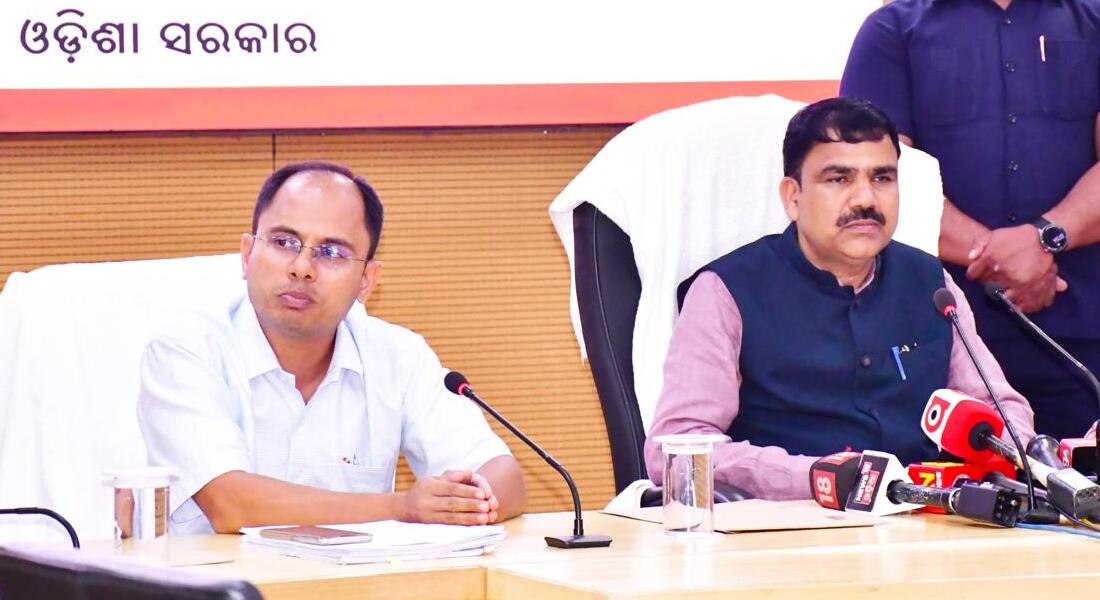
New Delhi: The Central government on Friday held the third inter-ministerial media briefing at the National Media Centre to update the media on the evolving situation in West Asia.
Earlier briefings were held on March 11 and March 12 to inform the public about preparedness measures taken by various ministries.
Senior officials from the Ministry of Petroleum and Natural Gas, the Ministry of External Affairs, the Ministry of Ports, Shipping and Waterways, and the Ministry of Information and Broadcasting participated in the briefing. They shared updates on energy supply preparedness, maritime safety, welfare of Indian nationals in the region, and monitoring of essential supplies, according to an official statement.
Energy supply and fuel availability: Officials said India’s refining capacity stands at about 258 million metric tonnes per annum, making the country the fourth largest refining hub globally. India remains self-sufficient in the production of petrol and diesel and does not require imports to meet domestic demand. Refineries across the country are operating at high levels and maintain adequate crude oil inventories through diversified import sources and shipping routes.
The government issued a Natural Gas Control Order on March 9 under the Essential Commodities Act to protect supplies to priority sectors. Officials said Piped Natural Gas (PNG) and Compressed Natural Gas (CNG) supplies continue without cuts, while supplies to industrial and commercial consumers are regulated at around 80%.
More than 1.5 crore households currently receive PNG connections across the country. Consumers who have access to PNG but continue to use LPG cylinders have been advised to consider switching to PNG in order to conserve LPG for areas without pipeline connectivity.
Officials said the government has asked city gas distribution companies to expand PNG connections for commercial and industrial users. Local authorities and state governments have also been requested to speed up approvals for pipeline laying.
Fuel retail and LPG supply: The government said no fuel shortages have been reported at the country’s nearly one lakh retail fuel outlets operated by oil marketing companies. Citizens have been advised not to panic-buy petrol or diesel as adequate stocks are available.
Authorities recently suspended fuel sales at one retail outlet in Tamil Nadu after petrol was reportedly sold in loose containers. The public has been advised not to seek fuel in containers as it is unsafe and violates regulations.
Officials said there have also been no dry-out situations at the country’s 25,000 LPG distributorships. However, LPG bookings have risen sharply due to panic buying. Daily bookings increased from an average of 55.7 lakh to around 76 lakh recently.
Oil marketing companies continue to deliver nearly 50 lakh LPG cylinders every day. Authorities have urged consumers to book cylinders only according to their normal household requirements.
The government said action is underway to curb hoarding and black marketing of LPG cylinders. Enforcement actions in different states have led to the recovery and seizure of hundreds of cylinders in places including Uttar Pradesh, Karnataka, and Madhya Pradesh.
Additional measures: Officials said the government’s top priority is to ensure uninterrupted LPG supplies to households and essential sectors such as hospitals and educational institutions. Domestic LPG production at refineries has increased by more than 30% compared to earlier levels.
Additional allocations of kerosene have been made to states and union territories to manage supply requirements. The government has also allowed alternative fuel options such as kerosene and coal for certain sectors for a limited period.
Consumers have been advised to book LPG cylinders through authorised digital platforms, including IVRS calls, SMS, WhatsApp, and mobile applications of oil marketing companies.
Maritime safety and shipping operations: The Ministry of Ports, Shipping, and Waterways said 24 Indian-flagged vessels with 668 Indian seafarers are currently operating in the Persian Gulf. Another 76 Indian seafarers remain on three vessels east of the Strait of Hormuz.
Around 23,000 Indian seafarers are working on merchant, harbour, and offshore vessels across the Gulf region. Directorate General of Shipping continues to coordinate with ship owners, recruitment agencies, and Indian missions.
Since the activation of a 24-hour control room, authorities have handled more than 2,425 calls and 4,441 emails and helped repatriate over 223 stranded Indian seafarers.
Port operations across India remain stable. Authorities have issued standard operating procedures for major ports and maritime boards. Priority berthing is being provided for LPG vessels, and additional cargo storage facilities have been arranged.
Officials said three Indian seafarers have died during the ongoing crisis and one remains missing. Four injured seafarers have received treatment and have been discharged.
Safety of Indian nationals: The Ministry of External Affairs said India continues to engage with countries in West Asia regarding the evolving situation.
Prime Minister Narendra Modi held a telephone conversation with Masoud Pezeshkian, the President of Iran, and discussed the safety of Indian nationals and the need for uninterrupted transit of energy and goods.
External Affairs Minister S. Jaishankar also spoke with Iranian Foreign Minister Seyed Abbas Araghchi to discuss bilateral and regional issues.
The MEA control room set up on March 4 has received more than 900 calls and over 200 emails so far. Indian missions in the region continue to assist citizens through round-the-clock helplines.
Officials said flights are operating from the United Arab Emirates, Qatar, Oman, and Saudi Arabia. Travel from Bahrain, Kuwait, and Iraq is being facilitated through Saudi Arabia due to airspace restrictions.
An attack in Sohar city in Oman early Thursday killed two Indian nationals. Of the 11 injured, 10 are Indians. Five have been discharged, while five remain under treatment with no serious injuries reported.
Authorities said five Indian nationals have died so far in the conflict, and one person remains missing.
Following an attack on the vessel Safesea Vishnu in Iraqi waters on March 11, 15 Indian crew members were safely evacuated and are currently in Basra. Efforts are underway to repatriate them and transport the mortal remains of the deceased Indian national.
Public communication: Officials from the Ministry of Information and Broadcasting urged citizens to rely on official sources for information and avoid panic buying. The government said it continues to monitor developments in West Asia and coordinate across ministries to ensure energy security, maritime safety, and the welfare of Indian nationals.