Updated at 10:40 Hrs
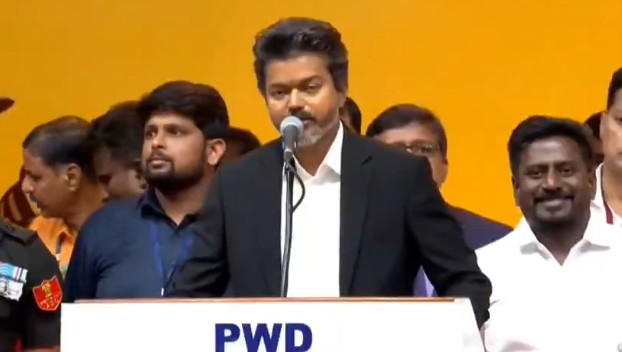
Channai: Actor-turned-politician Vijay on Sunday took oath as the new Chief Minister of Tamil Nadu, formally marking the beginning of a new political chapter in the state after his party Tamilaga Vettri Kazhagam (TVK) scripted a stunning electoral breakthrough in the Assembly elections
Tamil Nadu Governor Rajendra Vishwanath Arlekar administered the oath of office to Vijay at a grand ceremony held around 10 am at the Jawaharlal Nehru Indoor Stadium in Chennai. The development marks the first time since 1967 that a non-Dravidian party has formed the government in Tamil Nadu, ending decades of political dominance by the DMK and AIADMK.
Vijay was sworn in along with a nine-member cabinet comprising senior TVK leaders, first-time legislators and professionals from diverse backgrounds. Notably, all ministers in the first list are from TVK, with no Congress leader included despite the party’s support to the government during the post-poll negotiations.
The cabinet includes TVK General Secretary Anand, party strategist and former national-level basketball player Aadhav Arjuna, former Indian Revenue Service officer KG Arunraj, chief coordinator KA Sengottaiyan and advocate as well as party treasurer P Venkataramanan. Other ministers include R Nirmalkumar, who handled the party’s IT and social media operations, Propaganda Secretary and Egmore MLA Rajmohan, dentist-turned-politician Dr T.K. Prabhu and Virudhunagar MLA Selvi S. Keerthana, who at 29 is set to become the youngest minister in the new cabinet.
Vijay set to script new political chapter in Tamil Nadu as TVK prepares to form government
May 10, 2026 | 6:30 Hrs
Chennai: Vijay is set to usher in a new political era in Tamil Nadu as the actor-turned-politician prepares to take oath as Chief Minister following one of the most dramatic and closely watched government formation battles in the state’s recent history.
The rise of Vijay and his Tamilaga Vettri Kazhagam (TVK) has effectively ended decades of uninterrupted dominance by the DMK-AIADMK political order that shaped Tamil Nadu politics since 1967. According to multiple media reports, Vijay will become the first leader outside the traditional Dravidian formations to head the state government in nearly six decades.
TVK emerged as the single-largest party in the 234-member Assembly after the 2026 election, securing 108 seats in its electoral debut. While the result was widely seen as a political earthquake in Tamil Nadu, the party initially fell short of the majority mark of 118, triggering days of intense negotiations, political uncertainty and speculation over possible rival realignments.
The uncertainty deepened after Governor Rajendra Vishwanath Arlekar repeatedly sought clarity from TVK regarding its support numbers before formally inviting Vijay to form the government. Reports suggested the Governor was unwilling to proceed solely on verbal assurances and wanted documentary support from alliance partners.
What followed was a high-stakes political contest involving backchannel negotiations, alliance-building efforts and fears of possible defections. During the deadlock, speculation intensified over a potential understanding between arch-rivals Dravida Munnetra Kazhagam (DMK) and All India Anna Dravida Munnetra Kazhagam (AIADMK) to prevent Vijay from assuming power. Reports also indicated that several AIADMK legislators had been moved to resorts in neighbouring Puducherry amid fears of political poaching.
The deadlock eventually broke after a series of smaller parties extended support to TVK. The Congress had initially backed Vijay, but the decisive breakthrough came after support from the Viduthalai Chiruthaigal Katchi (VCK), CPI, CPI(M) and later the IUML, helping TVK cross the majority threshold.
According to reports, the final tally supporting the TVK-led formation crossed 120 MLAs, allowing Vijay to formally stake claim to form the government. Governor Arlekar subsequently handed him the appointment letter clearing the way for the swearing-in ceremony.
Political observers view Vijay’s rise as one of the most significant disruptions in Tamil Nadu politics since the emergence of M. G. Ramachandran in the 1970s. Unlike earlier actor-politicians who entered politics through established party structures, Vijay built a new political platform and directly challenged the state’s entrenched political order.
The scale of TVK’s breakthrough has also surprised analysts because the party contested its first full-fledged Assembly election only two years after its formal launch. According to reports, TVK crossed the 50 lakh vote mark in its debut election, becoming one of the most successful first-time entrants in Tamil Nadu’s electoral history.
Another striking feature of the new Assembly is the large number of first-time legislators elected on the TVK ticket. Reports indicate that over 90 TVK MLAs are first-time legislators, reflecting the party’s appeal among younger voters and new political entrants.
The coming days, however, are expected to test Vijay’s political and administrative abilities beyond electoral popularity. The new government will have to manage a diverse coalition arrangement while also navigating resistance from entrenched political rivals.
TVK will also face the challenge of transforming a personality-driven electoral movement into a functioning governing structure capable of delivering on campaign promises related to employment, governance reforms, education and welfare.
Yet, for supporters of Vijay, the moment represents far more than a routine transfer of power. For many, it signals the arrival of a new political force that has altered the grammar of Tamil Nadu politics and broken the long-standing monopoly of the two dominant Dravidian parties.