At IndiaVerve, we go beyond the noise to bring you meaningful stories of change, resilience and progress—from India to the world stage. Our mission is to bring readers credible, wide-ranging coverage across politics, business, sports, culture, society and more.

Rajnath Singh says roads and tunnels remain key to national security

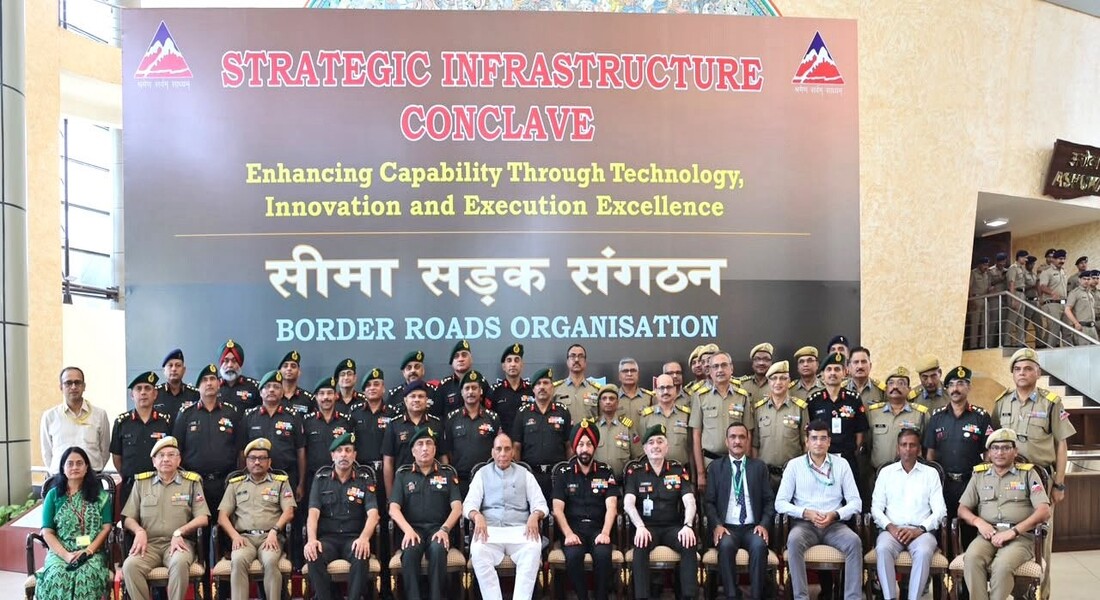
New Delhi: Defence Minister Rajnath Singh on Thursday said strategic infrastructure such as roads, tunnels, ports and airfields will continue to play a vital role in national security despite the rapid evolution of modern warfare and the induction of advanced military technologies.

Addressing the Border Roads Organisation (BRO) Strategic Infrastructure Conclave in New Delhi, Singh said military strength and precision capabilities are essential in war, but robust infrastructure remains the backbone of successful military operations.

“Sometimes, the first front of a war is not at the border itself, but on the road that leads our soldiers to the frontline. Therefore, the person who builds that road is as vital a guardian of national security as the soldier who stands at the border,” he said.

The minister praised the BRO for adopting advanced technologies and building strategic infrastructure in some of the country’s most challenging terrains.

He said the organisation has evolved over the past six and a half decades from a road construction agency into one of the world’s most respected strategic infrastructure organisations.

Singh highlighted landmark projects such as the Atal Tunnel, Umling La Pass and Sela Tunnel as examples of BRO’s engineering excellence and dedication. He said these achievements reflect the organisation’s ability to overcome extreme geographical and weather challenges.

Describing BRO as a frontline organisation in adopting modern technologies, Singh said tunnelling technology has transformed infrastructure development from metro construction in cities to highway projects in mountainous regions.

He added that the speed at which BRO builds roads and highways across some of the world’s toughest terrains reflects the combined strength of technology and human resolve.

The minister further said connectivity through roads, rail, air and digital infrastructure is essential for national development. He added that the government is committed to ensuring people living in remote border areas remain connected to the national mainstream.

He also highlighted the Vibrant Village Programme, under which border villages are being developed as the country’s “first villages” instead of being viewed as its last.

According to Singh, the infrastructure being built today will shape India’s future for generations and support the vision of Viksit Bharat by 2047.

Urging greater collaboration, Singh said infrastructure development is a collective responsibility. He called on industries to innovate, academia to strengthen research, engineers to develop new solutions, and administrators to ensure effective implementation.

Speaking at the same venue, Director General Border Roads Lt Gen Harpal Singh said strategic capability is no longer measured only by what is built, but also by intelligent planning, rapid execution, effective monitoring and sustainable maintenance of infrastructure assets.

He said the BRO is undergoing organisational transformation through digital planning, AI-enabled solutions, mechanisation, modern construction methods and stronger collaboration with industry and academia to build resilient and future-ready strategic infrastructure.

Puri Rath Yatra in full fervour amid massive crowds and tight security

Lakhs of devotees throng the holy city as Lord Balabhadra’s chariot begins its journey to Gundicha Temple; elaborate security and crowd management measures remain in place.

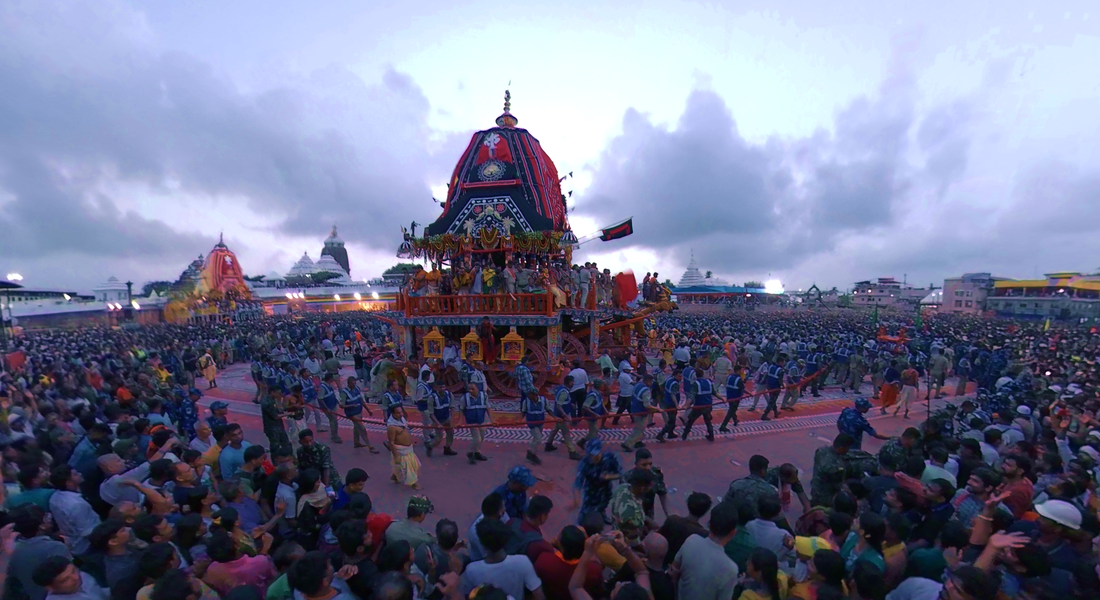
Puri: The annual Jagannath Rath Yatra is being celebrated with immense religious fervour in Odisha’s holy city of Puri on Thursday, with lakhs of devotees from across India and abroad participating in the world-famous chariot festival amid unprecedented security arrangements.

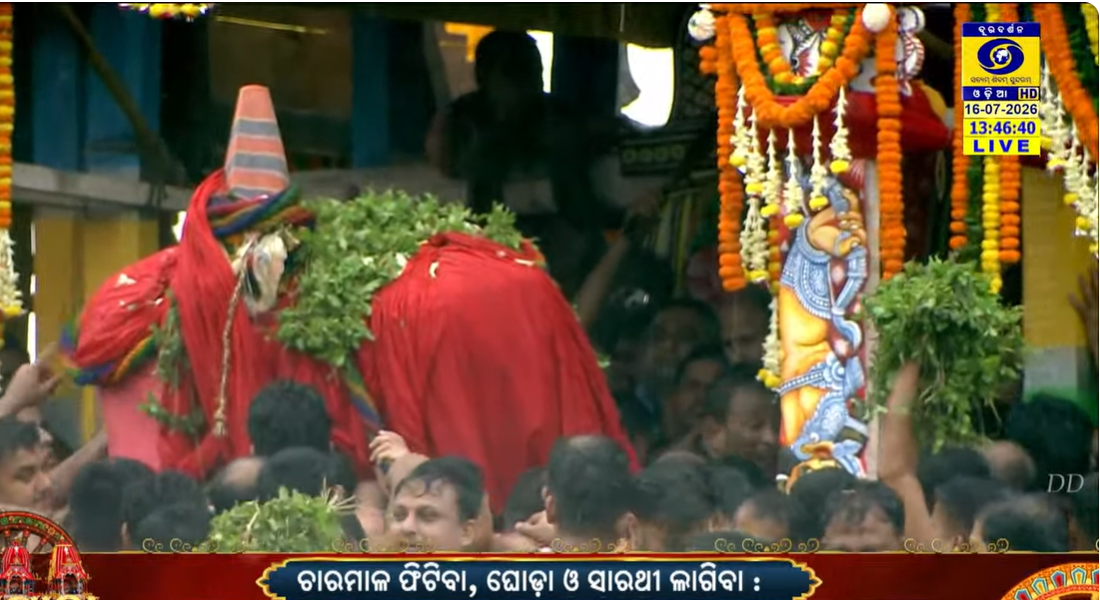
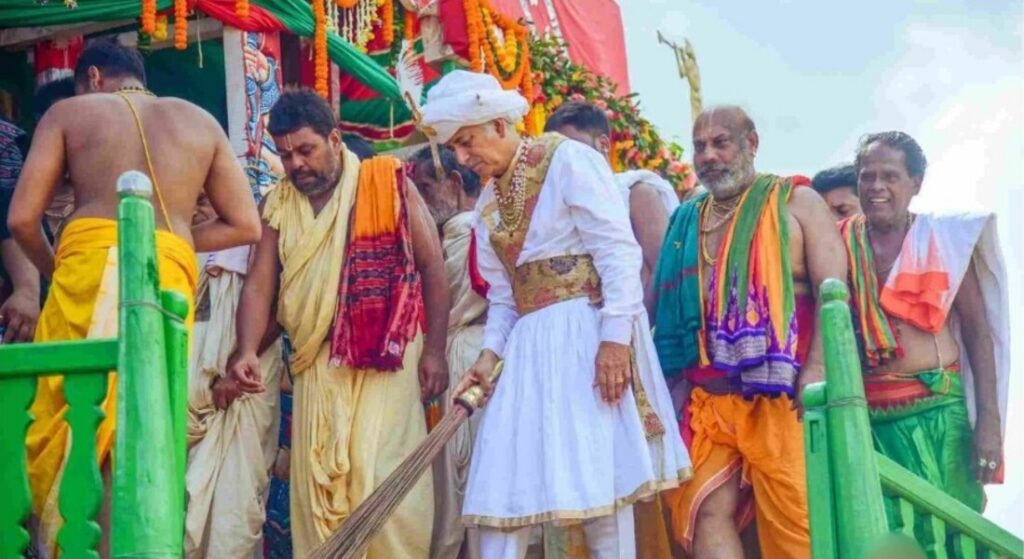
The pulling of Lord Balabhadra’s Taladhwaja chariot began on Thursday afternoon after the completion of all key rituals, including the ceremonial Chhera Pahanra performed by Gajapati Maharaja Divyasingha Deb.

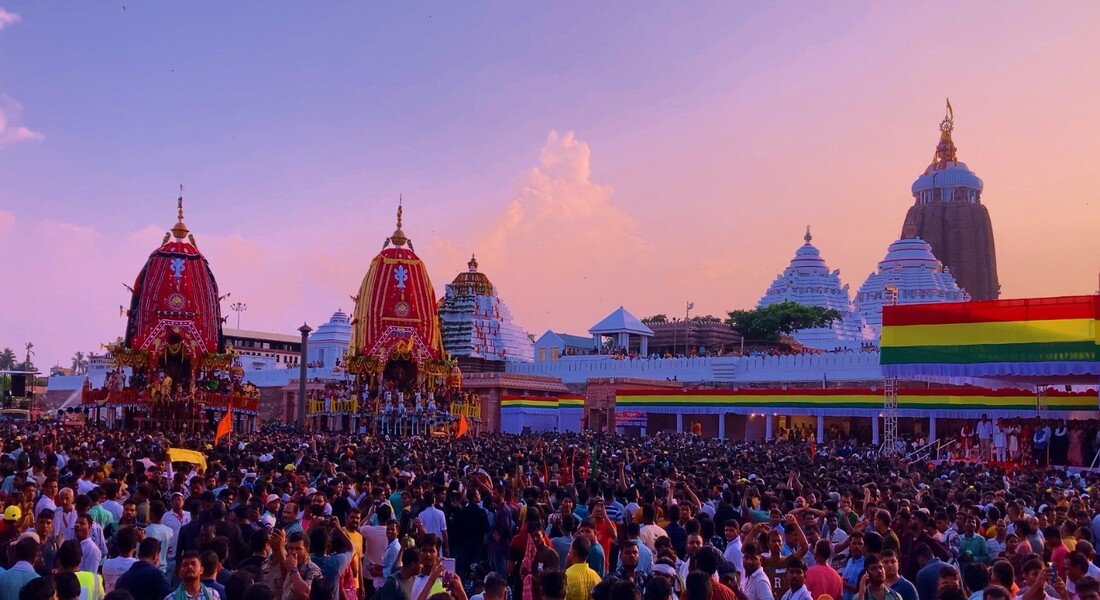
Devotees lined the Grand Road (Bada Danda), chanting “Jai Jagannath” as the massive wooden chariot started its journey towards the Shree Gundicha Temple. The chariots of Devi Subhadra and Lord Jagannath followed the chariot of their elder brother in the traditional sequence.

The festival also witnessed the presence of several top dignitaries in Puri, reflecting the significance of the annual celebration. Odisha Chief Minister Mohan Charan Majhi, Deputy Chief Ministers Kanak Vardhan Singh Deo and Pravati Parida, Governor Hari Babu Kambhampati, several state ministers, senior bureaucrats and top police officials were in the pilgrim town to oversee arrangements and participate in the rituals.

Earlier in the day, the CM inaugurated a distribution centre for the traditional ‘Tanka Torani’ near the Singhadwara of the Shree Jagannath Temple and personally served the refreshing traditional drink to devotees arriving for the Rath Yatra.

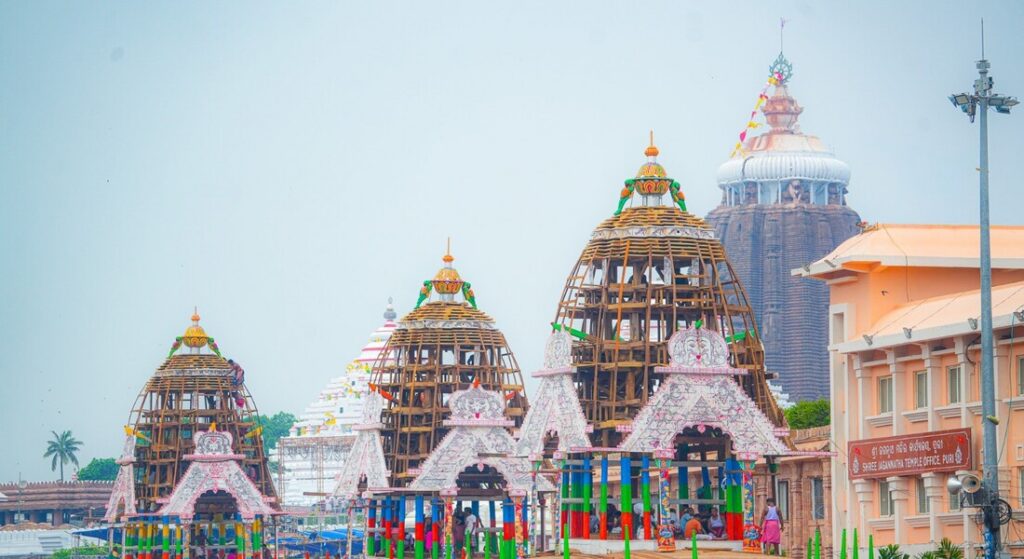
The centuries-old Festival of Chariots marks the ceremonial journey of Lord Jagannath, Lord Balabhadra and Goddess Subhadra from the Shree Jagannath Temple to the Shree Gundicha Temple. During the annual festival, the sibling deities emerge from the temple sanctum to bless devotees in a rare public procession, allowing millions to have darshan of the deities.

The day’s rituals began with the sacred Pahandi procession, during which the deities were ceremonially carried from the sanctum sanctorum to their respective chariots amid the blowing of conch shells, beating of gongs, and chants of devotion.

Earlier, the Ajnamala, symbolising the deities’ divine command to commence the journey, was brought to the chariots positioned outside the Singhadwara of the temple.

The week-long festival will continue with a series of traditional rituals. Hera Panchami will be observed on July 20, followed by the Bahuda Yatra (return car festival) on July 24. The deities will adorn the golden attire during Suna Besha on July 25, followed by Adhara Pana on July 26 and Niladri Bije on July 27, marking their return to the Jagannath Temple.

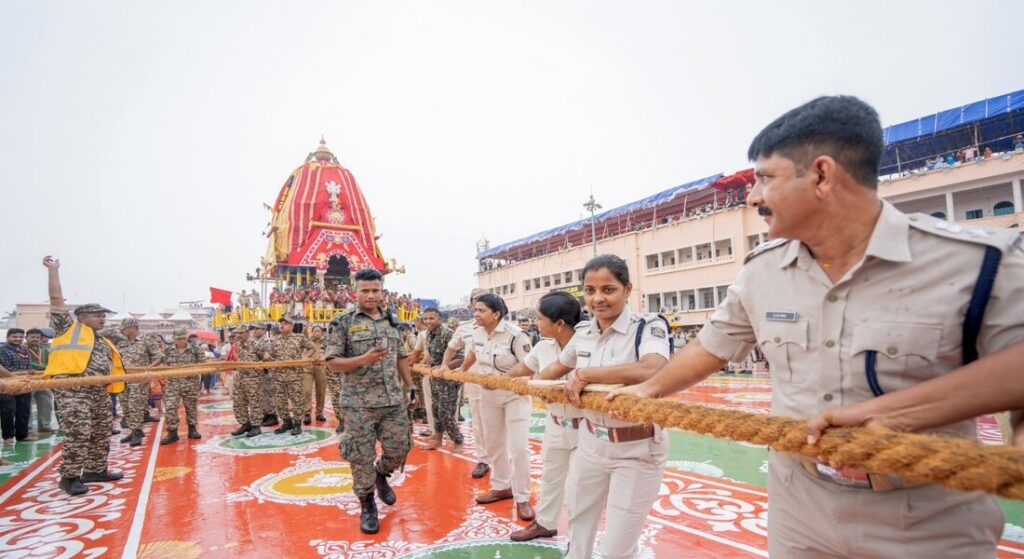
The Odisha government has deployed one of the largest security arrangements for the annual festival. Director General of Police Yogesh Bahadur Khurania had earlier announced the deployment of 19 IPS officers and nearly 13,000 police personnel across Puri.

Fifteen companies of Central Armed Police Forces, including the CRPF, BSF, RAF and NSG, have also been stationed at strategic locations. Advanced surveillance systems, drones, AI-enabled CCTV cameras, integrated traffic management and emergency response teams have been pressed into service to ensure the smooth conduct of the festival.

In the run-up to the Rath Yatra, Odisha Police conducted extensive mock drills, dummy chariot-dragging rehearsals and lifeguard briefings to strengthen crowd management, emergency response and inter-agency coordination. Authorities also created additional parking facilities, reinforced traffic regulations, and established control rooms to handle the expected surge of pilgrims.

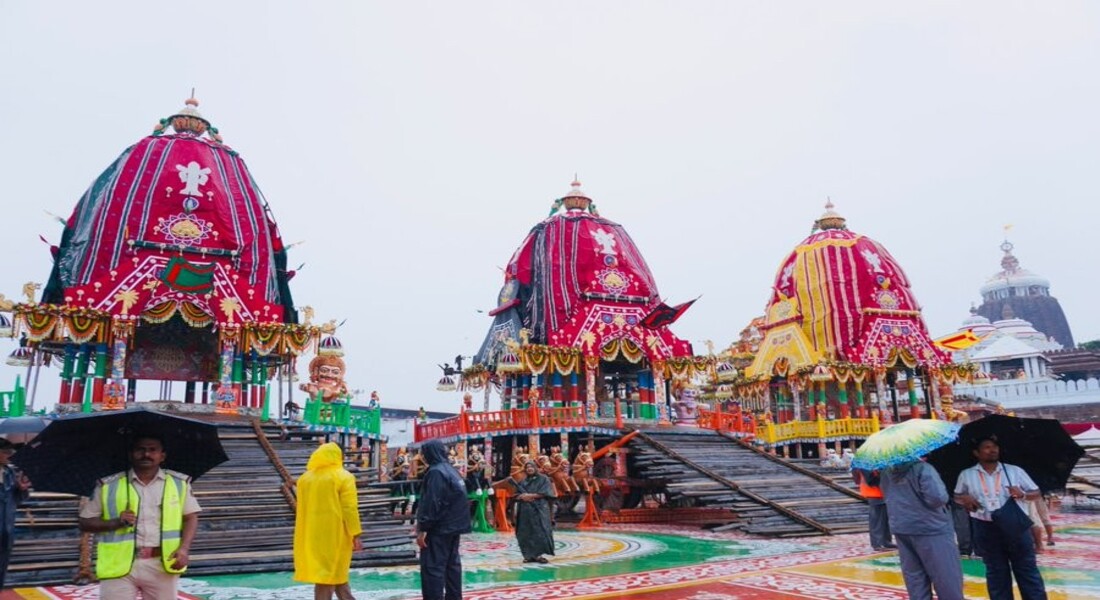
Despite intermittent monsoon showers, devotees continued to gather in large numbers along the Grand Road to witness the sacred spectacle. Officials said elaborate arrangements had been made to prevent waterlogging and facilitate the smooth movement of pilgrims and chariots.

However, according to media reports, a stampede-like situation during the festival led to the death of one devotee, while more than 100 others reportedly fainted and required medical attention. Authorities have intensified crowd-control and emergency-response measures as the procession continues.

Delhi High Court directs Centre to ensure medical care for Sonam Wangchuk amid hunger strike

New Delhi: The Delhi High Court on Thursday directed the Centre to ensure all necessary medical intervention to protect the life of activist Sonam Wangchuk, who has entered the 19th day of his indefinite hunger strike demanding the resignation of Union Education Minister Dharmendra Pradhan over alleged irregularities in the NEET examination.

A bench of the Delhi High Court observed that every citizen’s life is precious and ordered the authorities to take whatever medical steps were necessary to safeguard Wangchuk’s health.

“We note that the life of any citizen is precious and all efforts ought to be made by authorities to save the same,” the court reportedly observed while hearing a public interest litigation seeking urgent intervention.

The petition, filed a day earlier, claimed that the 59-year-old activist had lost around 8.5 kg during the fast and warned that he might not survive beyond 48 hours if he continued without medical intervention. It sought directions for the government to shift Wangchuk to a hospital and provide essential nutrition through medical supervision.

During the hearing, the court reportedly questioned the Centre over the absence of continuous monitoring by government doctors. Solicitor General Tushar Mehta informed the court that Wangchuk was undergoing daily medical examinations, although some of the doctors conducting the check-ups were from private hospitals.

The bench then directed that Wangchuk should undergo regular daily medical examinations by government doctors and that authorities should immediately provide treatment or medication whenever required based on their assessment.

According to media reports, the court stressed that preserving life should remain the foremost priority and instructed the authorities to intervene promptly whenever Wangchuk’s medical condition warranted it.

Hours before the hearing, Wangchuk released a video message saying his condition remained stable for someone observing a prolonged fast. However, he ruled out ending his hunger strike without a response from the government, saying doing so would send the “wrong message.”

He instead appealed to supporters, particularly students, to participate in a protest planned by the Cockroach Janta Party (CJP) at Delhi’s Jantar Mantar on July 20, saying the issue should be taken up with Members of Parliament.

The CJP, led by Abhijeet Dipke, has been spearheading protests demanding the resignation or removal of Education Minister Dharmendra Pradhan over alleged question paper leaks in several competitive examinations, including NEET-UG.

Leaders extend Rath Yatra greetings, pray for peace, prosperity and unity

Bhubaneswar: As millions of devotees celebrated the annual Rath Yatra of Lord Jagannath on Thursday, top leaders of the country extended greetings.

They prayed for peace, prosperity, unity, and the well-being of all.

Prime Minister Narendra Modi described the Rath Yatra as a radiant expression of India’s timeless spiritual and cultural heritage.

In a post on X, he said the centuries-old traditions associated with the festival have inspired generations across India and the world, embodying the values of humility, collective participation and selfless service.

Praying for the well-being of all, the PM also wished that Mahaprabhu Jagannath bless everyone with good health, happiness, and prosperity. He also expressed hope that the Lord’s divine grace would give people strength in all their endeavours and further strengthen the spirit of togetherness in society.

Similarly, President Droupadi Murmu conveyed her greetings to devotees of Lord Jagannath living in India and abroad. Describing the Rath Yatra as a unique festival symbolising the union between the devotee and the deity, she said Mahaprabhu Jagannath, along with Lord Balabhadra, Devi Subhadra and Chakraraj Sudarshan, comes out among devotees during the sacred procession.

The president also prayed to Lord Jagannath for the happiness, prosperity, and well-being of the nation and its people.

Vice President C. P. Radhakrishnan said the sacred Rath Yatra reflects the values of faith, devotion, equality and collective harmony, bringing people together beyond all differences.

In a post on X, he described the festival as a vibrant celebration of India’s rich civilisational ethos and enduring spiritual traditions.

He prayed that the blessings of Mahaprabhu Jagannath inspire everyone to follow the path of righteousness while strengthening peace, unity and collective resolve across the country.

Odisha Governor Hari Babu Kambhampati also extended his greetings to devotees, saying the holy chariot festival reinforces the ideals of faith, unity, equality, brotherhood and humanity. He prayed for happiness, peace, prosperity, and the well-being of all through the blessings of Mahaprabhu Jagannath.

Odisha Chief Minister Mohan Charan Majhi greeted the people of Odisha and devotees of Lord Jagannath across the world on the sacred occasion. Calling Mahaprabhu Jagannath the ultimate symbol of universal brotherhood and equality, he said the Rath Yatra transcends barriers of caste, creed, religion and discrimination, bringing people together in devotion.

The CM also prayed that, with the blessings of the presiding deity of Odisha, the state continues on the path of progress while every citizen is blessed with happiness, peace and prosperity.

BJD President and former Chief Minister Naveen Patnaik also extended his greetings on X, wishing that Lord Jagannath’s blessings fill every home with happiness, peace and prosperity.

‘I Will Go To The Sacred Land’

Saṁpūrṇa Jagadeva Nandanavanam Sarvepi Kalpadrumāḥ
Gāṅgam Vāri Samasta Vāri Nibhahā Puṇyā Samastāḥ Kriyāḥ
Vācaḥ Prākṛta Saṁskṛta Śrutigiro Vārāṇasī Medinī
Sarvāvasthitirasya Vastuviṣayā Dṛṣṭe Paraṁbrahmaṇi

“When the Supreme Brahman is beheld, the entire world becomes the celestial forest of Nandanavana, and every tree becomes the wish-fulfilling Kalpavriksha. All bodies of water become the sacred waters of the Ganges, and all actions become holy deeds. Every spoken word, whether in vernacular or Sanskrit, becomes a Vedic chant, and the entire earth becomes the sacred land of Varanasi.”

These very words naturally flowed from the lips of Adi Shankaracharya upon beholding the Blue Jewel of Nilachala – Lord Jagannath seated on the jewelled throne (Ratnasimhasana) upon the hundred-petaled lotus inside the conch-shaped sanctum within the cave of the Blue Mountain (Niladri). After witnessing the Supreme Brahman, Adi Shankaracharya felt that the entire world was Nandanavana (the celestial garden) and all trees were Kalpadruma (the wish-fulfilling trees). Every drop of water in this holy land was the water of the Ganges, and every word spoken here was a Vedic chant. Every action performed here was a virtuous deed, and the land itself was as sacred as Varanasi.

Yes, this is that very land (Kshetra), which some call Srikshetra and others call Purushottama Kshetra. For some, it is the Patitapavana Kshetra (the land that redeems the fallen), and for others, it is Shankha Kshetra. But for the soul seeking liberation and salvation, completely immersed in the love of Jagannath, this is simply ‘The Kshetra’ (The Sacred Land). In every atom of the soil of this land lies the profound fulfilment of realizing God. Rolling in its dust brings the extraordinary experience of liberation from the cycle of birth and death. Stepping onto this land makes one forget all the struggles, pain, and suffering of a lifetime. Here, the mind has no other thought but to be completely absorbed in Jagannath.

Amidst the hustle and bustle of life’s worldly entanglements, the inner voice constantly cries out, “O Mahabahu (The Mighty-armed One), O Baliyarabhuja (The Strong-armed One), O Artatran (The Savior of the distressed), O Patitapavana (The Redeemer of the fallen), beckon me with a wave of Your hand, O Lord! Bring this humble, destitute soul to Your Kshetra. Grant me a fleeting glimpse of Your divine self. Pour the soothing waters of Your blessings onto my tormented soul, Lord. Free me from the shackles of life’s struggles, O Lord!” Lord, for ages, this Kshetra has beckoned the poor, the sorrowful, and the destitute with open arms. The sick, the seekers, and the ascetics. The poets, the writers, and the dreamers. The kings and the beggars. The sinners, the virtuous, the seekers, and the spiritually enlightened. The lovers, the spirited, the wealthy, and the inquisitive.

O Lord! Now the Ashadha sky is draped in dark, heavy clouds. The deafening, deep roar of the thunder-drum, the dazzling streaks of lightning, the newly risen sun, and the vibrant colors of the rainbow—all are for You. Everyone is headed towards the Kshetra, Lord. Everyone now stands on Your Grand Road (Bada Danda). With longing eyes, they all gaze at You, Lord. Come… come, O Lord, descend carefully from that mountain cave. Just once, turn Your unblinking round eyes upon us, Lord. See how, carrying the agony of lifetimes on our shoulders like Kubuja, we gaze at You with unblinking eyes, like the Chakora bird waiting for the moon.

Yes Lord, today is indeed Ashadha Shukla Dwitiya… Have You forgotten? You had promised that You would come to Sharadhabali. You would grace the Grand Road with a festive crowd. You would grant Your vision to the sinners. You would redeem the fallen, Lord. But why such a delay, O Kalia Saante (Dark Lord)? You are indeed the one who encompasses this entire moving and unmoving universe. After claiming heaven, earth, and the netherworld in just three steps, what else remains? O Trivikrama in the form of Vamana (the dwarf incarnation), I have heard from the wise that beholding You on the chariot frees one from the cycle of rebirth.

Dole Ca Dola Govindaṁ, Cāpe Ca Madhusūdanam
Rathe Tu Vāmanaṁ Dṛṣṭvā Punarjanma Na Vidyate

“Beholding Govinda on the swing (Dola Yatra), Madhusudana on the boat (Chapa Yatra), and Vamana on the chariot (Ratha Yatra)—one shall never be reborn.”

That is why I have come to the Kshetra today, Lord. I have smeared the dust of Your sanctified land upon my forehead. I am only waiting for the moment when You will descend the twenty-two steps (Baisi Pahacha) to the Grand Road. Taking Your brother and sister along, You will proceed to the Janmabedi (birth altar). And upon receiving Your divine vision, this sinful soul will be thrilled. The tormented heart will find solace. But what is this, Lord… why such a delay? Look, Lord, the day is slipping away. Waiting in front of Your palace are Nandighosa, Taladhwaja, and Darpadalana (the three chariots). The Vishwakarmas (artisans) have spent many days crafting Your chariots. Waiting on the chariots are the sages, the guardian deities, the charioteers—Daruka, Arjuna, and Matali—the horses, and the chariot ropes, which are none other than Nagaraja (the Serpent King) himself.

Lord, the Grand Road is now a sea of heads—a great surge of humanity. To have the Lord of millions of hearts close, to embrace Him, and to make Him their own forever, everyone stands with raised hands. Not just from Kanyakumari to the Himalayas, but the entire world—from the lowest to the highest, young and old alike—awaits You today, Lord. The living, the departed, and all souls of the moving and unmoving universe yearn for Your sight today. With the hope and faith that a single moment’s vision will bring liberation from millions of births, this ocean of humanity waits.

For Your nine-day journey, devotees have rushed here from different countries and distant islands. See, Lord, long queues stretch in all directions. Some hold hands, some carry children in their arms, and others ride on their fathers’ shoulders, pressing forward into this crowd. Everyone is headed towards the Kshetra, Lord. Everyone has but one desire—to catch a glimpse of You on the chariot, to touch the chariot rope even for a moment, to lose themselves in this ocean of humanity on the Grand Road, and to lose their own identity in Your divine presence. Delay no more, Lord. Descend from the blue cavern (Nilakandara).

What is this? The sound of gongs, cymbals, mridangas, and kirtan chants is reverberating even more loudly in this ocean of humanity. Look there! The Dark Lord (Kalia Saanta) is descending from Niladri. Foremost is Chakra Raja Sudarshana, followed by the elder brother Balabhadra, and behind him, reassured by her brother’s protection, comes the gold-nosed Subhadra. After they have boarded their respective chariots, swaying and swinging, comes the Black Elephant, the Black Lord (Jagannath). The four directions tremble with the sounds of ‘Haribol’ and ‘Hulahuli’ (ululation). What a wondrous sight! Tears in everyone’s eyes… everyone standing with hands raised. Everyone is grateful to have Your vision today, Lord. You are not just seated on the chariot, Lord—You have taken Your seat on the Nandighosa of my mind. You are the charioteer of my life’s chariot. What a humble creature am I, when the sovereign of Utkal, the Gajapati himself, is Your servant! He, who acknowledges his servitude before the entire universe, sweeps the chariots with a golden broom. My eyes feel sanctified today, Lord. As Your Nandighosa rolls forward on the Grand Road with a deep rumbling sound, beholding Your Trivikrama form upon it makes my birth meaningful. My journey to Srikshetra bears fruit…

***
Dr. Nahak currently serves as Professor and Director of PR & Media Communication at Manipal University Jaipur (MUJ), Rajasthan. He can be reached out at drfmnahak@gmail(dot)com. The views expressed are personal and do not necessarily reflect those of IndiaVerve.

FIFA World Cup: Argentina to face Spain in final

Holders Argentina came from behind to defeat England 2-1 in Atlanta and reach the FIFA World Cup 2026 final.

Lionel Messi once again played a crucial role in Argentina’s victory.

The first half failed to produce a single goal despite a couple of scoring opportunities for both sides.

Anthony Gordon’s 55th-minute goal gave England a 1-0 lead, sending England fans into a frenzy. Argentina continued to pile on the pressure despite trailing 1-0 and finally levelled the scores, thanks to Enzo Fernández’s stunning strike in the 85th minute.

Messi’s perfectly weighted right-footed cross helped Lautaro Martínez score Argentina’s winning goal in added time.

Argentina will take on Spain in the final on Sunday in New Jersey.

Messi was named the Michelob Ultra Superior Player of the Match for his outstanding performance.

Later, speaking to reporters, Messi said: “No words, no words. A joy for our country, for our people. The other day, I said this group never stops surprising me. And I’ll tell you the truth, we’re going to try to win, we’re going to leave everything out there, but after this it’s very difficult to get people to understand what these players are showing. It’s incredible. We are unique, truly, and it’s not arrogance, it’s from the heart. We are unique. These people today carried us to win the match, so I’m grateful.”

Beyond the Chariots: Why Jagannath Rath Yatra still inspires the world

Every year, millions of people gather in the holy city of Puri, Odisha, to witness one of the world’s oldest and most spectacular religious processions—the Jagannath Rath Yatra. But this is much more than a grand festival filled with massive wooden chariots, devotional chants, and endless crowds. It is a celebration of equality, compassion, renewal, and togetherness—values that are perhaps more relevant today than ever before.

Believed to have its origins in ancient Hindu scriptures known as the Puranas, the Rath Yatra marks the annual journey of Lord Jagannath, his elder brother Balabhadra, and his younger sister Subhadra from the Jagannath Temple to the Gundicha Temple, which is lovingly regarded as their aunt’s home. For nine days, the deities leave the sanctum of the temple and come among the people, reminding devotees that divinity belongs to everyone.

A God who welcomes everyone

One of the reasons Lord Jagannath holds such a special place in the hearts of millions is his uniqueness. Unlike many Hindu deities depicted with perfect human features, Jagannath, Balabhadra, and Subhadra have simple wooden forms with large, round eyes that seem to embrace everyone without judgment.

Their appearance sends a powerful message: spirituality is not about perfection; it is about acceptance. In today’s fast-paced world, where people often feel pressured to fit into certain standards, Lord Jagannath reminds us that everyone is welcome just as they are.

The festival that breaks every barrier

Rath Yatra is often called the “Festival of Oneness,” and rightly so.

According to Odia tradition, Queen Gundicha requested King Indradyumna to organise this procession so that even those who were not allowed inside the temple – including people from different religions who were unable to have darshan in the sanctum – could have the opportunity to receive the blessings of Lord Jagannath. The tradition continues to symbolise inclusiveness and equal access to the divine.

Another powerful moment comes during the ritual of Chhera Pahanra, when the Gajapati King of Puri sweeps the chariots with a golden broom. The message is timeless: before God, not just every individual is equal, regardless of wealth, position, or social status, but also it conveys that true greatness comes from humility and devotion rather than a crown.

A tradition rebuilt every year

One of the most fascinating aspects of the Rath Yatra is that the three magnificent chariots are built entirely from scratch every year.

Using sacred wood from Odisha’s forests, hereditary craftsmen follow centuries-old traditions and measurements passed down through generations instead of modern engineering drawings. Nandighosa, Taladhwaja, and Darpadalana—each with its own distinctive colours, size, and symbolism—are rebuilt annually before carrying the deities through the streets of Puri.

This tradition teaches a profound life lesson. Nothing is permanent—not even the chariots that carry the gods. Renewal is essential. Every year offers a fresh beginning, a chance to rebuild, improve, and move forward with renewed faith and purpose.

Faith that moves mountains—and chariots

Each chariot weighs hundreds of tonnes, yet thousands of devotees pull them together using thick ropes. It is not simply an act of physical strength; it is a symbol of collective effort.

The image of countless hands pulling in one direction reflects a truth that extends far beyond religion. Families, communities, organisations, and even nations move forward when people work together with a shared purpose.

In a world increasingly divided by differences, the Rath Yatra demonstrates the extraordinary power of unity.

The message the modern world needs

Today’s society faces many challenges – social divisions, climate crises, stress, isolation, and growing inequality. The Jagannath Rath Yatra quietly offers solutions rooted in timeless values.

It reminds us to embrace diversity, serve others with humility, respect traditions while adapting to change, and recognise that no one is above another. It celebrates community over individuality, compassion over discrimination, and hope over despair.

Perhaps that is why the Rath Yatra continues to attract not only devotees but also scholars, travellers, photographers, and people from different faiths across the globe. They come to witness not just a religious event, but a living tradition and the asmita or identity that celebrates humanity itself.

As Lord Jagannath leaves the temple and comes to the streets, he sends a simple yet profound message: the divine is never distant. It walks beside the people, embraces everyone equally, and reminds us that life’s greatest journey is not measured by the distance travelled but by the hearts we bring together along the way.

Devi Prasad Mahapatra is a development communication expert with over 25 years of experience and serves as Knowledge Management & Communications Specialist at the International Rice Research Institute (IRRI) in Odisha, specializing in strategic communication, development storytelling, and knowledge sharing. He can be reached at devimahapatra@gmail(dot)com. The views expressed are personal and do not necessarily reflect those of IndiaVerve.

Jagannath Rath Yatra 2026 begins in Puri; lakhs of devotees gather amid tight security

Puri: The annual Jagannath Rath Yatra, one of India’s largest and most revered religious festivals, commenced in Odisha’s holy city of Puri on Thursday, drawing lakhs of devotees from across the country and abroad.

The centuries-old Festival of Chariots marks the ceremonial journey of Lord Jagannath, Lord Balabhadra and Goddess Subhadra from the Shree Jagannath Temple to the Shree Gundicha Temple. During the festival, the sibling deities leave the temple sanctum to bless devotees in a rare public procession.

The rituals began with the arrival of the Ajnamala, the sacred garland symbolising the deities’ command to begin the journey. The three towering wooden chariots were then positioned before the Singhadwara of the Jagannath Temple, facing the Shree Gundicha Temple, ahead of the ceremonial pulling of the chariots.

Video courtesy: YT/GovernorOdisha

Thursday schedule: 9:30 am Pahandi begins; 12:30 pm Pahandi concludes; 12:30 pm – 1:00 pm Madanmohan Bije; 1:30 pm – 2:00 pm Chitalagi; 1:30 pm – 2:30 pm Besha Sesha; 2:00 pm – 3:00 pm Chhera Pahanra; 3:00 pm – 4:00 pm Chara Phita & Ghoda Sarathi Lagi; 4:00 pm Chariot pulling begins.

The week-long festival will continue with a series of traditional rituals. Hera Panchami will be observed on July 20, followed by the Bahuda Yatra, or return journey, on July 24. The deities will adorn the golden attire during Suna Besha on July 25, followed by Adhara Pana on July 26 and Niladri Bije on July 27, marking their return to the temple.

Meanwhile, the Odisha government has put in place elaborate security arrangements to ensure the smooth conduct of the festival.

Odisha Director General of Police (DGP) Yogesh Bahadur Khurania said 19 IPS officers and nearly 13,000 police personnel have been deployed across Puri. Fifteen companies of Central Armed Police Forces, including the CRPF, BSF, RAF and NSG, have also been stationed at key locations.

The DGP said comprehensive security and traffic management measures have been implemented as lakhs of devotees continue to arrive in Puri for the annual pilgrimage.