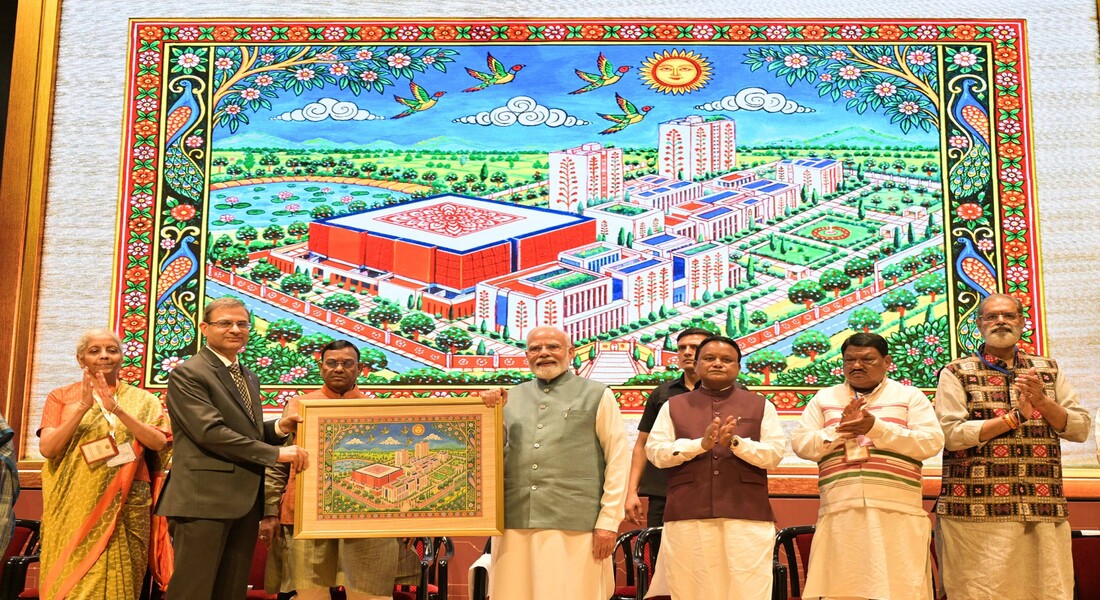

Bhubaneswar: Prime Minister Narendra Modi on Sunday inaugurated the Reserve Bank of India’s (RBI) newly established Data Centre and Cybersecurity Training Institute in Bhubaneswar, Odisha, highlighting their importance in strengthening India’s financial infrastructure and cybersecurity preparedness.
Invoking the blessings of Mahaprabhu Jagannath, Modi congratulated the RBI and everyone involved in launching the two facilities. He said the new institutions would benefit the people of Odisha and the country.
Addressing the gathering, the PM said the inauguration reflected a fundamental shift in India’s approach to governance, with greater emphasis on prioritising development, expanding its scale and ensuring last-mile delivery.
He outlined the government’s focus on pro-people and proactive good governance, balanced regional growth, dignity for the poor, and ensuring that no citizen was left behind, according to an official statement.
Citing examples of this approach, Modi referred to expressways connecting smaller towns, the expansion of AIIMS institutions across states, medical colleges opening in smaller towns, nearly 1.75 lakh Ayushman Arogya Mandirs established in villages and the expansion of digital connectivity in remote areas. He said improving citizens’ lives and creating new opportunities for their aspirations had become the central purpose of governance.
The Prime Minister highlighted the transformation of India’s banking system, noting that despite the nationalisation of banks in the 1960s and 1970s, more than half of the population remained outside the banking ecosystem until 2014.
He said bank loans had remained difficult to access for the middle class and were largely beyond the reach of small farmers, landless people and women. According to Modi, the expansion of digital banking had since connected people across the country to round-the-clock banking services.
He said the opening of nearly 60 crore Jan Dhan accounts had helped ensure that government assistance reached beneficiaries directly, with every rupee disbursed by the Centre reaching the beneficiary’s account without leakage.
Modi also highlighted the expansion of formal credit to people without collateral, including small entrepreneurs, traditional artisans, street vendors and workers in the unorganised sector.
He said 13 crore people had become first-time entrepreneurs under the Pradhan Mantri Mudra Yojana. He also referred to formal credit extended to street vendors through PM SVANidhi and skilled artisans through PM Vishwakarma.
The Prime Minister further noted that Self-Help Groups representing 10 crore rural women had received thousands of crores of rupees in bank assistance, expanding their access to formal financial services.
He also highlighted the spread of RuPay debit and credit cards, noting that such facilities, once largely accessible to the wealthy, had become available to citizens across the country. He credited the RBI, commercial banks and banking employees for their contribution to the expansion of financial inclusion.
Modi said the expansion of social security programmes had accompanied financial inclusion, guided by the principle of Nagrik Devo Bhava.
He noted that the Atal Pension Yojana covered 9 crore citizens, including 38 lakh people in Odisha.
He also highlighted the Pradhan Mantri Suraksha Bima Yojana, which provides accident insurance cover of Rs 2 lakh for an annual premium of Rs 20, and the Pradhan Mantri Jeevan Jyoti Bima Yojana, which offers life insurance cover for an annual premium of less than Rs 450.
According to the Prime Minister, these schemes had made insurance accessible to poor and middle-class families. He added that more than Rs 25,000 crore in insurance claims had been disbursed to families during difficult times, citing the payouts as an example of good governance.
Turning to the newly inaugurated facilities, Modi said the past decade had focused on bringing people into the banking system, while the coming decade would concentrate on making banking more efficient and reliable.
He said the new Data Centre and robust computing systems would support this next phase of development.
The Prime Minister also warned that modern warfare increasingly targeted economies through evolving cyber threats. He stressed the need to protect India’s financial system from cybercriminals and cyberterrorists, highlighting the importance of modern training infrastructure and skilled human resources in addressing emerging risks.
He said the new Cybersecurity Training Institute would play a crucial role in strengthening the country’s preparedness against such threats.
The Prime Minister highlighted eastern India’s role as a growth engine for a developed India and pointed to the momentum of development in Odisha under the state’s current government.
He said Odisha was combining its traditional mineral-based industries with emerging sectors such as semiconductors, electronics, data centres and advanced computing.
Modi expressed confidence that these new sectors would create significant opportunities and help fulfil the aspirations of Odisha’s youth. He said the state was poised to shape a new future through its transition from mines to microchips.
Concluding his address, the Prime Minister extended festive greetings and chanted Jai Jagannath.