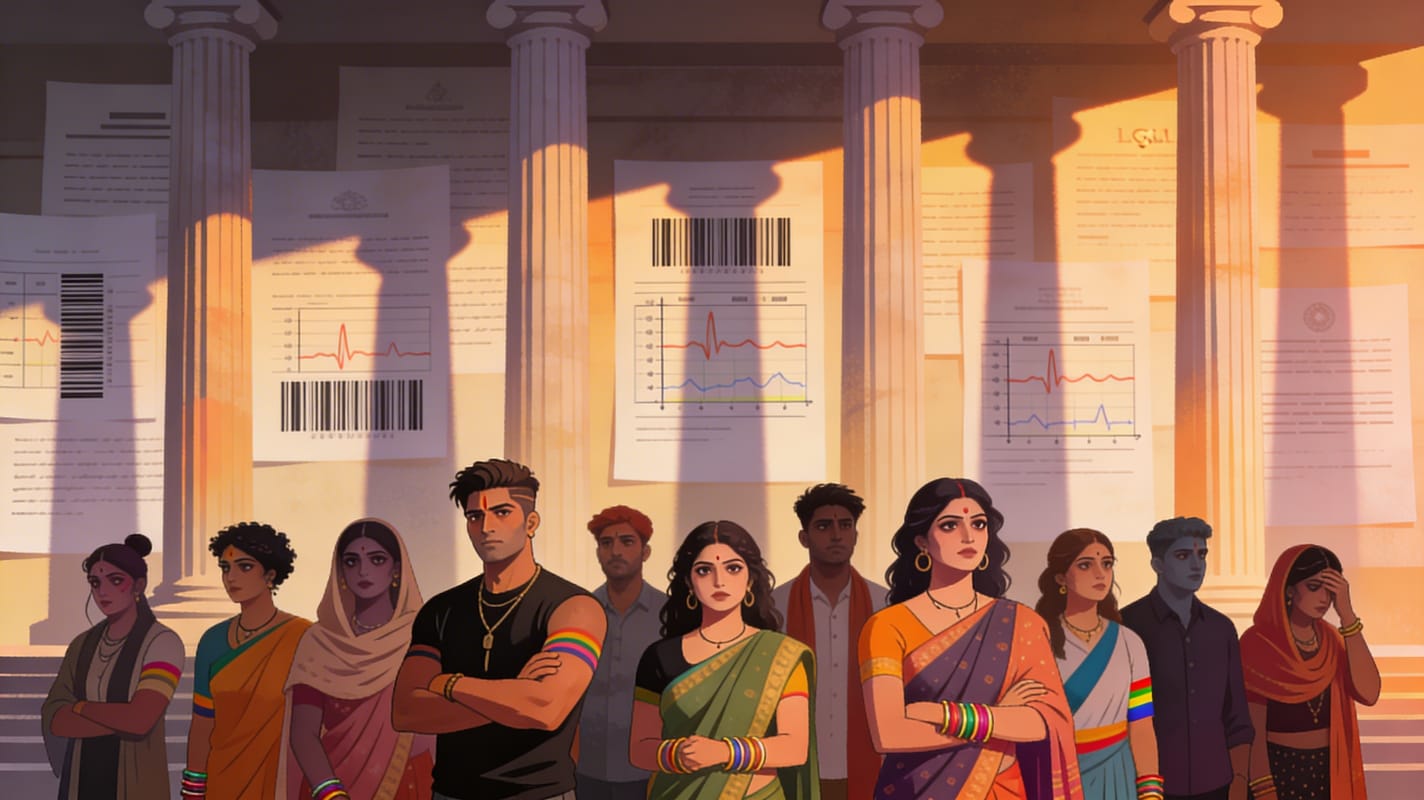

New amendments to India’s trans law raise concerns over autonomy, identity, and mental health, as experts warn of a shift from rights-based protection to state-led control
India’s latest amendments to the Transgender Persons (Protection of Rights) Act feel less like a course correction and more like a legal regression to colonial times, when the Criminal Tribes Act persecuted transgender people for being who they are. From a rights-based, queer-affirmative mental health perspective, this is not a technical policy tweak; it is an assault on autonomy, dignity, and the fragile sense of belonging that many trans and gender-diverse people have painstakingly built since NALSA.
The promise of NALSA, and how far we’ve drifted
In 2014, the Supreme Court in NALSA judgement W.P.(C) No. 400/2012[1] recognised something both simple and profound: that each person has the right to self-identify their gender, not a favour from the state but a constitutional guarantee of equality, free expression and the right to life with dignity. Self-identification was at the heart of this judgment; it was understood as an anchor for psychological well-being, not just a bureaucratic category. The Court also called for reservations, welfare measures and protection from discrimination, trying to move trans lives from the margins to the mainstream of citizenship.
The 2019 Transgender Persons (Protection of Rights) Act was already a partial betrayal of that promise[2]. It framed discrimination as unlawful and spoke the language of welfare, but then inserted a humiliating certificate regime and lighter punishments for violence against trans persons compared to cis women. As a mental health practitioner, I remember how often clients spoke about the dread of having to “prove” themselves to a District Magistrate, of being made legible to an indifferent state before they could become legible to employers, landlords or schools.
Even so, the 2019 law still carried the words “self-perceived gender identity” and an inclusive definition that mentioned trans men, trans women, and genderqueer persons. That language was a slender, but crucial, bridge between constitutional ideals and everyday reality. The new amendments burn that bridge.
First, they narrow the definition of who is legally “transgender,” removing explicit mention of trans men, trans women and genderqueer people, while centring “eunuch,” specific hijra-like socio-cultural identities, and intersex variations. On paper, this looks like a recognition of long-marginalised hijra communities and of intersex children. In practice, it fragments the community and plunges anyone who doesn’t fit these boxes into legal limbo. The trans man in a small town, forced to hide himself for his survival; the non-binary young person who has never belonged to a gharana; the trans woman who is not seen as hijra—where do they stand now?
Second, the law deletes the explicit right to self-identification and makes gender recognition contingent on medical boards. These boards will decide whether someone “qualifies” as transgender or intersex for an identity certificate. Let’s remember, transgender identity was long pathologized by these same medical institutions. In 2013 The American Psychiatric Association’s DSM-5 replaced “Gender Identity Disorder” with “Gender Dysphoria,” focusing on the distress rather than the identity itself being a disorder. On paper Transgender identity was formally depathologized globally when the World Health Organization (WHO) officially adopted the 11th revision of the International Classification of Diseases (ICD-11), which took effect on January 1, 2022. This removed “gender identity disorder” as a mental illness.
As a psychologist, I cannot overstate how psychologically violent it is to medicalise gender. It requires people of an already misunderstood community to depend on medical validation. Many trans people already fear healthcare spaces because of misgendering, pathologisation, and histories of coercive treatment. Making these same institutions the gateway to legal existence cements that fear into law.
Third, while the amendments dramatically increase penalties for trafficking, forced begging, mutilation, and exploitation of transgender persons, they do so without addressing the earlier disparity in punishments for sexual and physical violence against trans persons versus cis women. The message is dehumanizing: you are considered important enough to face heavy penalties in some cases, but not important enough to receive equal protection when you are assaulted.
In mental health terms, this is structural gaslighting. The state says: “We are protecting you,” while simultaneously undermining your ability to say who you are and to be believed when harmed. Over time, such contradictions corrode trust—not only in institutions, but in one’s own sense of reality.
Safety and security: when protection becomes surveillance
The amendments’ harsh sentences for forced castration, trafficking and exploitation address very real forms of violence that hijra and trans communities have faced for centuries. It is understandable that many people outside the community see this and feel reassured. But from a rights-based lens, we must ask: protection for whom, and at what cost? Additionally, where is the research and data that contextualises and differentiates forced castration from a transgender person accessing gender affirmative medical support?
When legal recognition is narrowed and medicalised, “protection” becomes surveillance. Police, bureaucrats, and even families may feel further empowered to demand proof: certificates, medical opinions, board clearances. Trans people already navigate constant questioning—“What are you really?”—in public spaces, workplaces, hospitals. Embedding that suspicion into the legal architecture will intensify the mental load of simply existing.
For those already on the edge—people involved in sex work, begging, or informal labour—the combination of aggressive anti-trafficking provisions and weak housing, employment and labour rights increase vulnerability. Raids and “rescues” conducted in the name of protection often separate people from their chosen families and support systems, which are critical buffers against mental distress. When the law reads community spaces primarily as sites of exploitation, it risks destroying the very networks that enable survival.
Safety requires secure housing, income, and relationships where one’s identity is affirmed. On all these fronts, the amendments are lacking. Without robust anti-discrimination enforcement, affirmative housing and job schemes, and protection of chosen families, the new punitive teeth will bite the wrong people.
Belongingness, identity and the mental health toll
Queer-affirmative practice starts from the premise that people are the experts on their own gender and sexuality. The therapeutic task is to create space where that self-knowledge can be explored safely, not adjudicated or certified. The amendments invert this logic. They tell trans and gender-diverse people: “Your self-knowledge is insufficient; you will be validated only if certain experts agree.” Needless to say, just like the people who made the amendments, the “experts” will also not be from the transgender population.
This has predictable mental health consequences:
- It reinforces minority stress: the chronic expectation of rejection and invalidation based on identity.
- It deepens shame and internal conflict: if the law says you are not “really” trans, many will turn that accusation inward.
- It raises barriers to help-seeking: people who fear their gender will be pathologised by doctors are less likely to access mental healthcare or medical services generally.
- It reduces access: doctors may not prescribe necessary hormone replacement medicines to trans men and non-binary people. Gender-affirming surgery will be perceived as a threat to the livelihoods of doctors and surgeons who can offer it.
Community belonging—which research consistently shows as protective against depression, anxiety, and suicidality—is also at risk. When the law prioritises certain identities and pathways (such as specific “traditional” categories and medicalised routes) over others, it can break solidarity. Trans men might feel even more excluded from policy discussions; non-binary and genderfluid people might vanish from official narratives altogether. Within families, unsupportive relatives can now say, “Even the law doesn’t recognise what you’re saying you are,” weaponizing legislation in everyday power struggles.
For a young queer or trans person, especially outside big cities, this can be devastating. Legal recognition is not a magic cure, but it sends a powerful message: you exist, you are legitimate, your future is imaginable. Rolling that back is not neutral. It tells a generation: your existence is negotiable, conditional and contestable.
How India is drifting away from global best practice
Globally, many jurisdictions have shifted toward self-identification and depathologisation. Countries like Argentina, Ireland, Malta, Norway, and others permit legal gender changes based on self-declaration, often through straightforward administrative procedures without medical gatekeeping. International health organisations have moved away from viewing gender diversity as a disorder and now focus on frameworks that emphasise autonomy, informed consent, and access to affirming care.
These developments are not just symbolic; they are rooted in evidence that legal recognition and self-determination correlate with better mental health outcomes, reduced suicidality and increased access to education and work. In that global conversation, India’s move to medical boards and narrowed recognition reads as a regression toward older, pathologising models.
A different path: what a queer-affirmative, rights-based law would do
From a rights-based and queer-affirmative mental health standpoint, an inclusive approach would look very different:
- It would restore and strengthen self-identification, including explicit recognition of non-binary and gender-diverse identities.
- It would abolish or strictly limit compulsory medical gatekeeping, keeping any medical input voluntary, supportive, and centred on informed consent.
- It would equalise punishments for violence against trans persons with those for comparable offences against cisgender women.
- It would move beyond abstract anti-discrimination promises to concrete affirmative action: reservations, targeted housing, livelihood schemes, and protection of chosen families.
- It would invest in trans-led mental health and community support services, acknowledging that community spaces are vital sites of healing, not problems to be policed.
Crucially, such a law would be written with trans communities at the centre—not as objects of compassion or morality tales about exploitation, but as rights-bearing citizens and co-authors of the social contract. For those of us working in mental health, it is an essential condition for any meaningful reduction in distress, isolation and suicide.
The question now is whether India has the courage to listen to the communities most affected and rewrite this law in a way that honours both NALSA’s constitutional vision and the lived realities of trans and gender-diverse people.
***
Pompi Banerjee is a psychologist, policy researcher and founder of Bodhicitta Consulting. She works at the intersection of mental health, social justice and community-based care. Her practice centres trauma-informed, queer-affirmative, rights-based approaches to healing for LGBTQIA+ individuals and their support systems.
The views expressed are personal and do not necessarily reflect those of IndiaVerve.
[1] https://indiankanoon.org/doc/193543132/
[2]https://en.wikipedia.org/wiki/Transgender_Persons_(Protection_of_Rights)_Act,_2019#Criticism_and_reactions