
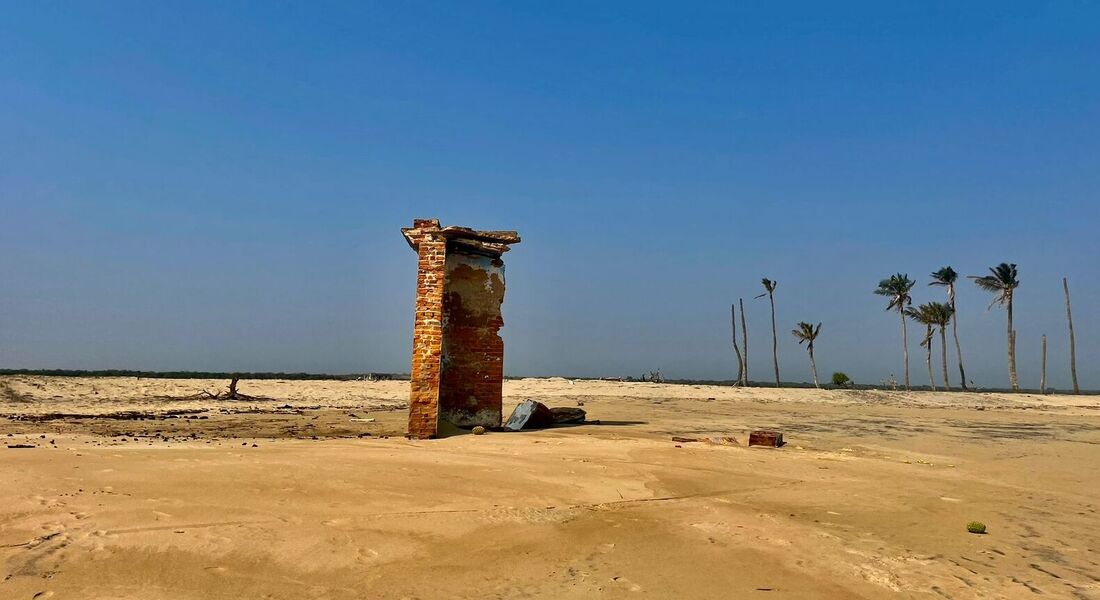

The Panchu Varahi Temple in the Kendrapara district of Coastal Odisha is unique in India for enshrining five Varahi idols, collectively worshipped, and dated by scholars to the 11th century CE based on iconographic features. Initially situated in the now-eroded village of Satabhaya, the temple succumbed to coastal degradation and sea-level rise, prompting the community to relocate the deities to a safer site at Bagapatia.
The last remaining wall of the Maa Panchu Varahi temple collapsed into the sea the previous week, underscoring the continuing threat posed by coastal erosion and climate change to Odisha’s coastal heritage. Odisha, also known as Kalinga, has an extensive coastline of 574 kilometers and has enjoyed a rich maritime history with other countries, particularly in South and Southeast Asia, in ancient times. These overseas adventures fostered the growth of maritime deities and coastal shrines. As part of tangible heritage, these temples remained integral features of coastal culture. Odia folk literature references the sea-faring communities, who place their faith in deities to save them from shipwrecks or other accidents. These coastal shrines, still located near the banks of the river and the sea in Odisha, have endured through the ages and continue to be revered by the communities and their custodians.
Relocation of Villagers of Satabhaya
The long stretch of coastline in Satabhaya, in Rajanagar block of Kendrapara district, which once housed hundreds of families, is now engulfed by the sea and appears desolate. The Satabhya cluster of hamlets comprising Mohanpur, Satabhaya, Kualiora, Kanhupur, Kharikula, Sadanandpur, and Govindpur has been in the news for the last few decades because of the sea’s aggressive intrusion into the landmass. The region has faced a series of cyclones, notably in 1962, 1967, 1971, 1982, 1999, 2002, 2014 and 2019. With each cyclone, the sea advanced approximately 30-40 feet towards the inhabited area. The cyclone that struck in 1971 was particularly devastating, resulting in the deaths of around 800 -1000 people. [1] According to the Revenue Department, during the 1930 settlement, the Satabhaya region covered an area of 320 square kilometres, but by 2000, the region had been reduced to 155 square kilometres.[2] The Odisha government relocated the villagers to nearby Bagapatia, twelve kilometres away.
The effort for resettlement began approximately 40 years ago, with a few villagers or residents initiating the campaign from the very beginning. The villagers were presented with a few options before finalizing Bagapatia for relocation. The foundation stone of the Satabhaya Resettlement and Rehabilitation Yojana at Bagapatia was laid on 8th June 2011. [3] During the interview, Kalindi Behera/villagers said that each family was allotted 10 decimals of land and Rs. 1.5 lakh to construct a house. While at Satabhaya the villagers depended on fishing for their livelihood, at Bagapatia they had to fend for themselves. As of now, around 500-700 people from Bagapatia work outside the state, mostly in Kerala as laborers.
Relocation of Maa Panchu Varahi Temple
The cult of Panchu Varahi flourished only in Odisha. [4] The temple has many interesting legends. One popular legend about the goddesses’ origin is that the Sadhavas (merchants) brought them by boat during trade. The Sadhavas were believed to be seven brothers, and Satabhaya was a hamlet of seven villages. Varahi is prominently worshipped in Kendrapara district, situated at the confluence of the Brahmani, Baitarani, and Mahanadi rivers, positioning it as a hub for maritime activities. The temple at Satabhaya, which got merged with the sea was a later structure but stylistically the deities ( Janjali, Kamalai, Bimalai, Batakumari and Panchu Varahi) are placed to the 11th century by scholars.[5]
The temple was central to the community’s culture and religious sentiment, and played a prominent role in the relocation. Along with their own relocation, the villagers made considerable efforts to shift the temple of Maa Panchu Varahi, to a safer place at Bagapatia. The villagers sought assistance from the Archaeological Survey of India (ASI) in Bhubaneswar, which in turn referred it to the endowment section of the Kanika Temple Trust, responsible for all temples in the region.
Since the designated place already had an ongoing land dispute, the villagers were asked to choose an alternative site. However, the villagers insisted that their mother goddess remain in the same village. In due course, disputes were resolved with the support from the Raja of Kanika.

The goddess was successfully relocated in 2018, following the local tradition that states the goddesses were originally brought to the village by fishermen in a boat.
The villagers said the relocation process turned out to be even more difficult than securing land for the temple. Communication was limited, and the main concern was moving the deities from the old temple to the new one. Renowned sculptor Prabhakar Maharana was brought in to handle the technical challenges of transporting the deities. A team of seven, made up of prominent villagers and a few experts, was formed for this task. Each of the stone idols had varying weights, which created significant challenges, especially due to the absence of proper roads. In a record time of about one month the road was completed.
With great care and expert supervision, the idols were removed one by one and transported by vehicle, then by boat, on April 20, 2018. This date is now celebrated as Pratistha Divas (Foundation Day) for the new abode of Maa Panchu Varahi. The deities were lifted onto five respective vehicles by male priests. The long-standing tradition of the deities of the goddesses being worshipped by female priests was broken that day, as the male priests were given to handle the transplantation of the deities from their old to new temple to save the deities from the unavoidable natural disaster.
The vehicles with the deities were then transported by boat across the river and taken to Bagapatia, covering a distance of twelve kilometers. Throughout the journey, the villagers stood beside their mother goddess, singing in praise of the goddesses and dancing in ecstasy along the way, as after a long time their dream of securing a safe haven for their goddesses was about to come true. They followed prescribed rituals while reinstating the deities at their new abode.

Conclusion
Climate change is a worldwide issue that impacts every facet of our lives, including cultural heritage- both tangible and intangible forms. Extreme weather poses significant threats to these vital aspects of our cultural identity. It is crucial to tackle these threats to safeguard important sites for future generations. The effects of climate change on cultural heritage gained attention at the United Nations Climate Change Conference in Madrid in 2019 (COP25) and have become more prominent at later conferences. The current Work Plan for Culture (2023-2026) addresses this issue with a comprehensive approach, emphasising ‘risk preparedness in cultural heritage and enhancing its resilience to climate change.’ It underscores that cultural heritage serves as a valuable source of best practices and insights for climate adaptation and highlights the role of culture in inspiring climate action.
The Satabhaya resettlement process and the community initiative, which takes into consideration their age-old cultural beliefs, have set a trendsetting example against the looming threat of the climate crisis—a true story of resilience in which people had to leave behind their fertile lands, ancient houses, belongings, and natural surroundings to settle in an unknown land. However, they have retained hope and ensured the company of their guardian protector, Maa Panchu Varahi. They compromised their livelihood but not their religious traditions. Resettlement has both positive and negative aspects. The loss of a viable substitute for livelihood, lack of fair compensation, and the forced abandonment of their ancestral homeland represent the negative consequences. The resettlement of villagers of Satabhaya and assigning the new abode to the deities will remain to tell the tale of the devotion and pursuance of the villagers to give a respectable shelter to their goddess, keeping aside their personal ambition.
The new abode of Maa Panchu Varahi at Bagapatia has better access, and it has witnessed a surge of visitors and devotees from the nearby areas in the past few years. It is time to develop the area as a potential destination for religious tourism.
***
Deeti Ranjita Ray is a cultural heritage professional with over two decades of experience across government and private cultural institutions, with a focus on cultural research and documentation. This article is part of her coastal shrines mapping project under the Tagore Research Scholarship, IGNCA, Ministry of Culture.
[1] As responded by villagers during a discussion on site visit in April 2025.
[2] Changing Climate, (2022) Report by Indo-Global Social Service Society, Accessed from https://igsss.org/wp-content/uploads/2022/06/Changing-Climate-3.pdf on 15 June 2025. P.16
[3] Das,K.C. ( 2023) A tale of Climate Refugees: Pushed by the Sea from Satabhaya to Bagapatia accessed from https://ecsfindia.org/wp-content/uploads/2023/12/Climate-Change-Disaster-Resilience-and-Human-Wellbeing-8-9-23-add-folio-1_231009_104047.pdf on 15 June 2025 p. 29
[4] Das, H.C. (2009) Cult of Varahi in Orissa, Bhubaneswar: Orissa Review. September. Accessed on 13 June 2025 from https://magazines.odisha.gov.in/Orissareview/2009/September/engpdf/80-84.pdf p. 84
[5] Das, H.C. (2009) Ibid


