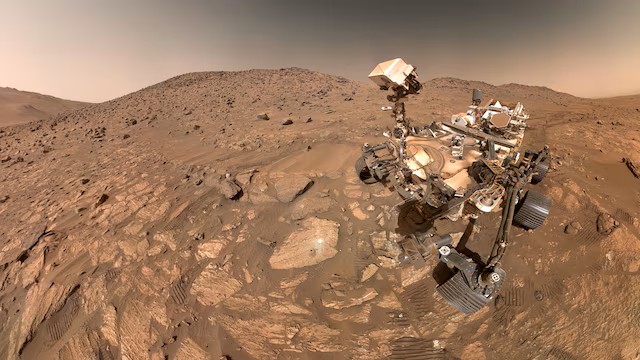

Fresh evidence is strengthening the case that water once flowed abundantly on Mars, after scientists uncovered an ancient river delta hidden deep beneath the planet’s surface. The breakthrough discovery was made by NASA Perseverance Rover, which detected the formation more than 35 meters below ground inside Jezero Crater.
Launched in 2020, the rover has been exploring the Martian terrain since its landing in February 2021, with a primary mission to search for signs of ancient microbial life. Jezero Crater—about 45 kilometers wide and formed nearly 4 billion years ago by an asteroid impact—was selected due to strong indications that it once hosted water. In particular, a region known as the Margin Unit contains carbonate-rich rocks, which on Earth typically develop in calm, water-filled environments like lakes and shallow seas.
The latest findings, published in Science Advances, are based on extensive data collected during 78 rover traverses between September 2023 and February 2024.
Using its advanced instrument, the Radar Imager for Mars’ Subsurface Experiment (RIMFAX), Perseverance was able to scan nearly twice as deep as earlier radar investigations. Researchers, led by Emily Cardarelli from the University of California, Los Angeles, combined radar readings with satellite imagery and rover navigation data to construct a detailed 3D map of subsurface layers.
The radar revealed multiple clinoforms—sloping sedimentary layers that are strong indicators of delta formations. These structures typically form when rivers deposit sediment into standing bodies of water, such as lakes. Scientists estimate that this buried delta dates back between 3.7 billion and 4.2 billion years, making it older than the visible Western Delta on the crater floor.
The discovery points to the existence of an even earlier river system in the same location, suggesting that Mars may have supported flowing water for a longer period than previously believed. This extended timeline significantly boosts the possibility that the planet once harbored conditions suitable for life.
Researchers note that uncovering such ancient environments increases the chances of finding preserved biosignatures—chemical or structural traces of past life—within Martian rocks. As Perseverance continues its mission, scientists are hopeful that these hidden layers could hold vital clues about the Red Planet’s distant, water-rich past.