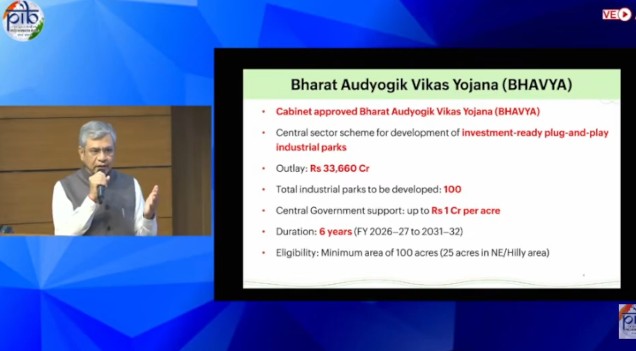

New Delhi: In a major push to accelerate manufacturing-led growth, the Union Cabinet has approved the Bharat Audyogik Vikas Yojna (BHAVYA), a Rs 33,660 crore scheme to develop 100 plug-and-play industrial parks across the country.
The scheme aims to create world-class industrial infrastructure with pre-approved land, ready utilities, and streamlined clearances, enabling industries to move quickly from investment decisions to production. The parks, ranging from 100 to 1,000 acres, will be developed in partnership with states and private players.
According to an official release, BHAVYA will significantly improve ease of doing business by reducing entry barriers for investors, while also promoting cluster-based industrialisation. The initiative is expected to generate large-scale employment and attract both domestic and global investments, strengthening supply chains and boosting manufacturing competitiveness.
Alongside industrial expansion, the Cabinet has approved Rs 1,718.56 crore in Minimum Support Price (MSP) funding for the 2023–24 cotton season to support farmers. The funding will be routed through the Cotton Corporation of India (CCI) to ensure direct price support and protect farmers from distress sales when market prices fall below MSP.
Cotton remains a key cash crop, supporting nearly 60 lakh farmers and millions more across allied sectors. For the 2023–24 season, cultivation covered 114.47 lakh hectares, with production estimated at 325.22 lakh bales—around a quarter of global output.
CCI, the nodal agency for MSP operations, will continue to procure fair average quality cotton without any quantity limit. It operates over 508 procurement centres across 152 districts in 11 major cotton-growing states to ensure seamless access for farmers.
In the renewable energy sector, the Cabinet has also approved the Small Hydro Power (SHP) Development Scheme with an outlay of Rs 2,584.60 crore for the period 2026–27 to 2030–31. The scheme targets the installation of around 1,500 MW capacity through small hydro projects.
The initiative will support projects in the 1–25 MW range, particularly in hilly and northeastern regions, with higher financial assistance for projects in border areas. The government expects the scheme to attract investments of about Rs 15,000 crore and generate over 51 lakh person-days of employment during construction.
Officials noted that small hydro projects, being decentralised and environmentally sustainable, will promote clean energy generation in remote areas while reducing transmission losses and minimising ecological impact.
The Cabinet has also approved the construction of a 4-lane access-controlled National Highway (NH-927) from Barabanki to Bahraich in Uttar Pradesh at a cost of Rs 6,969 crore. The 101.5-km project, to be developed under the Hybrid Annuity Model, aims to ease congestion, improve road safety, and cut travel time to about one hour, while enhancing connectivity to key economic and logistics hubs, including cross-border trade routes with Nepal
Together, the four decisions signal a coordinated policy push to accelerate industrial growth, strengthen farmer welfare, expand renewable energy capacity, and enhance transport infrastructure. The newly approved highway project is expected to further boost regional connectivity and trade, complementing broader efforts to build a resilient, efficient, and self-reliant economy.