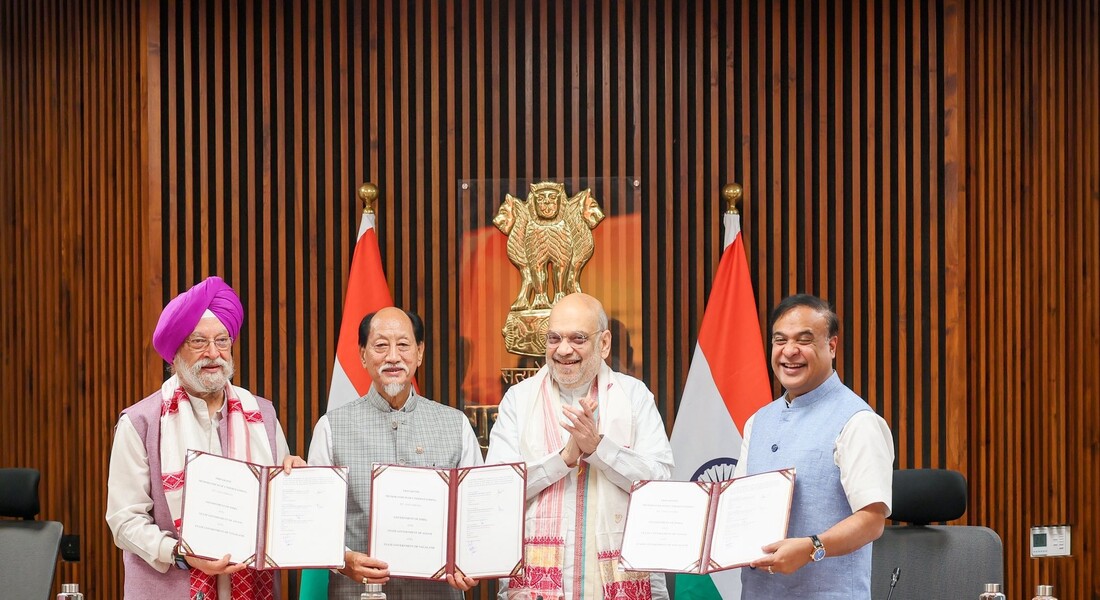

NEW DELHI: A tripartite Memorandum of Understanding (MoU) was signed on Thursday between the Centre, Assam, and Nagaland to facilitate mineral oil operations in the Assam-Nagaland boundary areas, a move that the government said would boost energy exploration and economic development in the Northeast.
The agreement was signed in the presence of Union Home Minister Amit Shah in New Delhi, according to an official statement.
Union Petroleum and Natural Gas Minister Hardeep Singh Puri, Assam Chief Minister Himanta Biswa Sarma, and Nagaland Chief Minister Neiphiu Rio were also present.
Describing the pact as a historic moment, Shah said the agreement would open up new opportunities for oil and natural gas exploration as well as mineral mining. He said it had removed a major hurdle in realizing Prime Minister Narendra Modi’s vision of a prosperous Northeast.
According to Shah, both Assam and Nagaland agreed not to allow obstacles to India’s oil exploration efforts and would instead work in a spirit of cooperation, considering the resources as national wealth.
The home minister said Nagaland had agreed to allow oil exploration across the state, beyond the six designated fields. He added that Assam was also in agreement with the arrangement, calling it a win-win situation for all stakeholders.
Shah said the tripartite agreement would pave the way for mineral exploration and mining across the Northeast. He noted that the region possesses vast reserves of oil, gas, and minerals and said the current extraction capacity of 1,000 to 1,500 barrels per day could increase more than tenfold following the agreement.
He expressed confidence that the development of oil and gas resources in Nagaland would help reduce India’s dependence on foreign sources. He also said that longstanding issues had affected the economic development of both states, and the agreement would now create new growth opportunities.
Calling the pact a strong example of cooperative federalism, Shah said the Modi government had kept the Northeast at the centre of its development agenda. He noted that 12 agreements had been signed in the region since 2019, helping reduce violence by around 80% and supporting infrastructure growth.
The home minister also said tourism, investment, and private sector participation had increased in the Northeast due to improved peace and stability. He added that more than 80% of the region had been freed from the Armed Forces (Special Powers) Act and expressed hope that AFSPA would be withdrawn from almost the entire Northeast by next year.
Referring to ongoing global tensions involving the US, Iran, and Israel, Shah said energy security remained critical for India’s development. While the immediate impact of the agreement could not be predicted, he said the pact would strengthen the country’s self-reliance over time.
He added that the agreement had expanded the scope of oil and mineral exploration across Nagaland and would bring prosperity to both states while fostering harmony and development in the region.