
New Delhi: Defence Minister Rajnath Singh has called for deeper industrial and strategic cooperation between India and Germany.
He stressed that India’s defence transformation under the leadership of Prime Minister Narendra Modi is opening new avenues for co-development, co-creation, and co-innovation in advanced technologies.
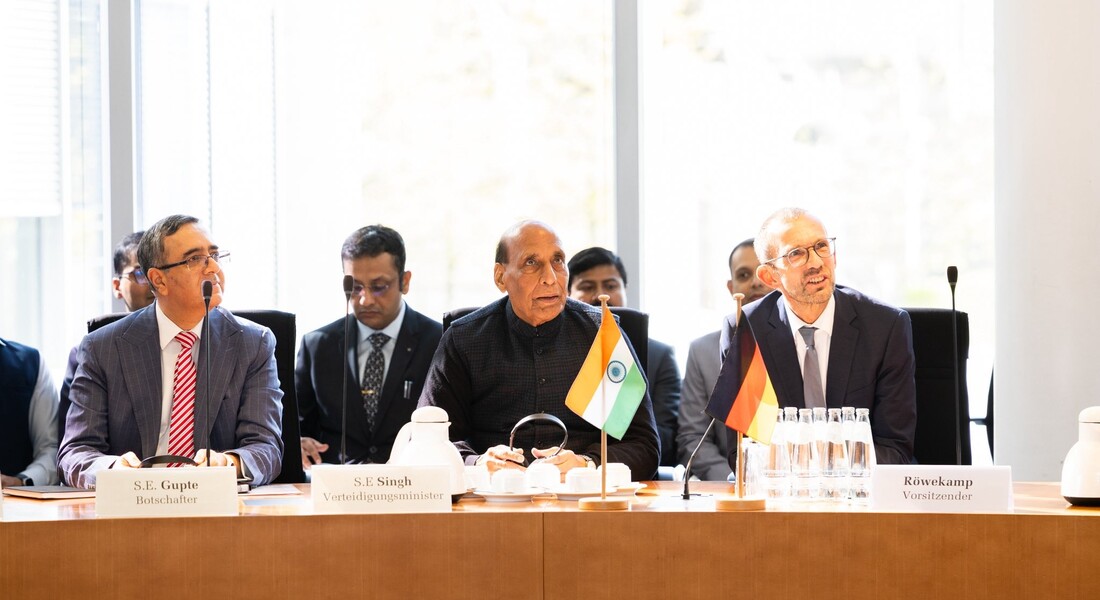
During his address to members of the German Parliament’s Standing Committee on Defence and Security in Berlin on Tuesday, Singh conveyed that India’s “Aatmanirbhar Bharat” initiative should be understood as a collaborative framework rather than a procurement programme alone. According to him, it is designed to encourage joint innovation and shared development between partner nations.
He noted that the global security environment is undergoing rapid change, driven by technological shifts and emerging threats, making adaptability and coordinated international responses increasingly necessary, according to an official statement.
Highlighting the evolving defence landscape in India, the minister pointed to growing participation from both established defence companies and emerging start-ups. He observed that India’s industrial ecosystem is expanding in a way that complements Germany’s strengths, particularly its major industrial firms and its network of small and medium-sized enterprises known for innovation in advanced technologies.
Singh further underlined that defence cooperation between India and Germany has natural synergies and can be significantly strengthened through deeper industry-to-industry partnerships, according to an official statement.
He also said that coordination at a broader geopolitical level has gained importance amid global uncertainty. He referred to growing alignment between India, Germany, and the European Union in expanding strategic engagement, including through the India–EU defence and strategic partnership framework.
Describing India and Germany as stable democracies with strong industrial and technological capabilities, Singh noted that both countries share common values and a commitment to innovation-led growth. He added that sustained parliamentary and institutional engagement would play a key role in shaping the future of bilateral defence cooperation.
Addressing global instability, the minister said current geopolitical disruptions can no longer be viewed as isolated regional issues, as they increasingly affect energy security, food supply chains, inflation, and global economic stability. He specifically pointed out that disruptions in regions such as West Asia have direct consequences for India’s energy security due to its dependence on imported fuel.
He also informed the parliamentary committee that India has established an inter-ministerial group to continuously monitor developments in West Asia and recommend timely policy responses. This mechanism, he said, focuses on safeguarding energy supplies, ensuring availability of essential goods, managing inflationary pressures, and protecting both citizens and industry from external shocks through coordinated governance.
The interaction was hosted by Member of Parliament and Committee Chairman Thomas Roewekamp. Earlier in the day, Singh paid tribute to Gurudev Rabindranath Tagore at Humboldt University in Berlin, reflecting the cultural and intellectual ties between India and Germany.