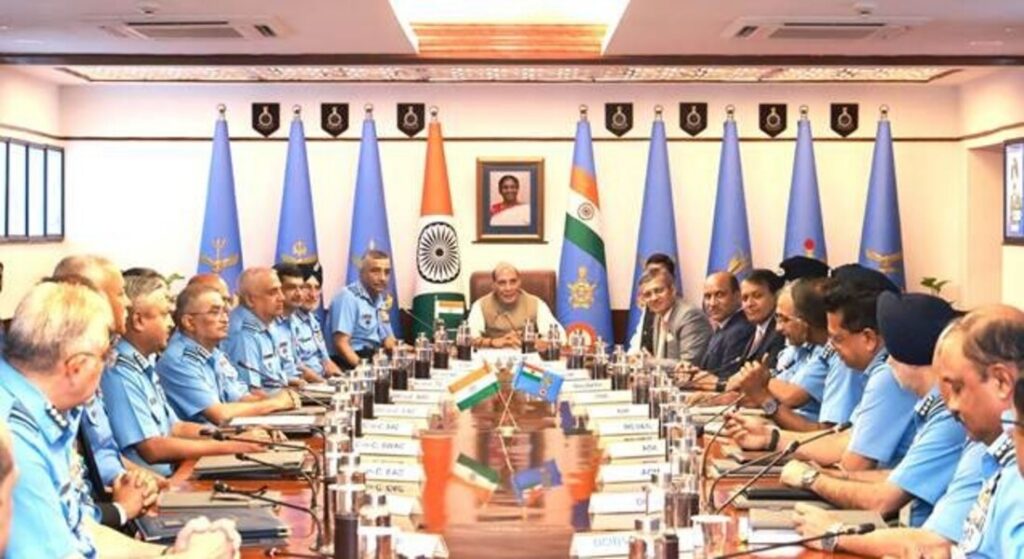
New Delhi: Defence Minister Rajnath Singh said Defence Research and Development Organisation (DRDO)-industry collaboration should no longer be limited to production and must extend across research, design, testing, certification and manufacturing to transform India into a global hub for defence manufacturing.
Addressing ‘VIMARSH’, a DRDO-Industry Synergy Meet in New Delhi on Tuesday, Singh unveiled key policy initiatives aimed at lowering technical and financial entry barriers for MSMEs and deep-tech start-ups.
The initiatives provide for direct funding, incubation support and dedicated access to DRDO testing facilities, according to an official statement.
The government also launched a standardised, secure framework for sharing DRDO-developed software source code with licensee industries. The framework is aimed at accelerating software-defined defence capabilities and addressing obsolescence management.
Nine Licensing Agreements for Transfer of Technology were handed over to 13 manufacturing partners in the presence of the minister, enabling commercial production of state-of-the-art systems.
Strategic Memoranda of Understanding were also formally exchanged with the Society of Indian Defence Manufacturers and Laghu Udyog Bharati to expand industry outreach and encourage grass-roots participation.
DRDO also signed a contract with the Quality Council of India for the System for Advance Manufacturing Assessment and Rating version 2.0. The system will help benchmark the manufacturing maturity of domestic defence enterprises.
Singh said the combined strengths of DRDO, industry, start-ups and the country’s youth could accelerate India’s defence capabilities. He noted that DRDO brings knowledge and technology, industry provides scale and manufacturing capability, start-ups contribute innovation and agility, while the youth carry the vision of a New India.
The minister also said the goal of Viksit Bharat was not limited to building an economically strong nation, but also included technological self-reliance, social inclusiveness, environmental sustainability and strategic security.
He further said India must achieve self-reliance in critical technologies by 2047, substantially increase indigenous content, achieve multi-fold growth in defence exports and establish a robust presence in global supply chains.
Singh also highlighted reforms undertaken in the defence sector under Prime Minister Narendra Modi, including the Positive Indigenisation Lists, Make in India initiative, iDEX, ADITI and the decision to allocate 25% of the defence R&D budget to the private sector.
He said these measures were aimed at reducing import dependence and advancing self-reliance.
He noted that start-ups were receiving grants through the Technology Development Fund and that several technologies had already reached the production stage.
He also highlighted the role of iDEX in creating a defence innovation ecosystem in which start-ups develop solutions based on actual operational requirements.
Describing start-ups and MSMEs as new flag-bearers of innovation, Singh said they play a pivotal role in achieving Aatmanirbhar Bharat by developing components, sub-systems and advanced technologies for major defence systems.
He stressed the need to integrate them into the defence supply chain alongside large industries.
The new policy initiatives, according to Singh, focus on industry-led R&D, funding and mentorship for start-ups and MSMEs, academia-industry collaboration and investment in futuristic technologies such as artificial intelligence, quantum computing, hypersonics and directed energy.
Singh said India’s transition from a defence importer to an exporter offered significant opportunities for MSMEs and start-ups in areas including drone technology, AI and cyber security.
He stressed that MSMEs must maintain a consistent focus on quality, delivery, innovation and global standards while expanding partnerships with large companies.
He further said that technological self-reliance must become an integral part of India’s character and approach. Companies investing in emerging technologies today, he added, would be positioned to become tomorrow’s leaders, as technological leadership would determine strategic advantage in future warfare.
Speaking at the same venue, Defence Secretary and Secretary, Department of Defence R&D and Chairman, DRDO Rajesh Kumar Singh said VIMARSH 2026, themed ‘Varta se Vikas’, had been designed to align cutting-edge commercial innovation with national defence readiness and systematically integrate private-sector capabilities into the defence ecosystem.