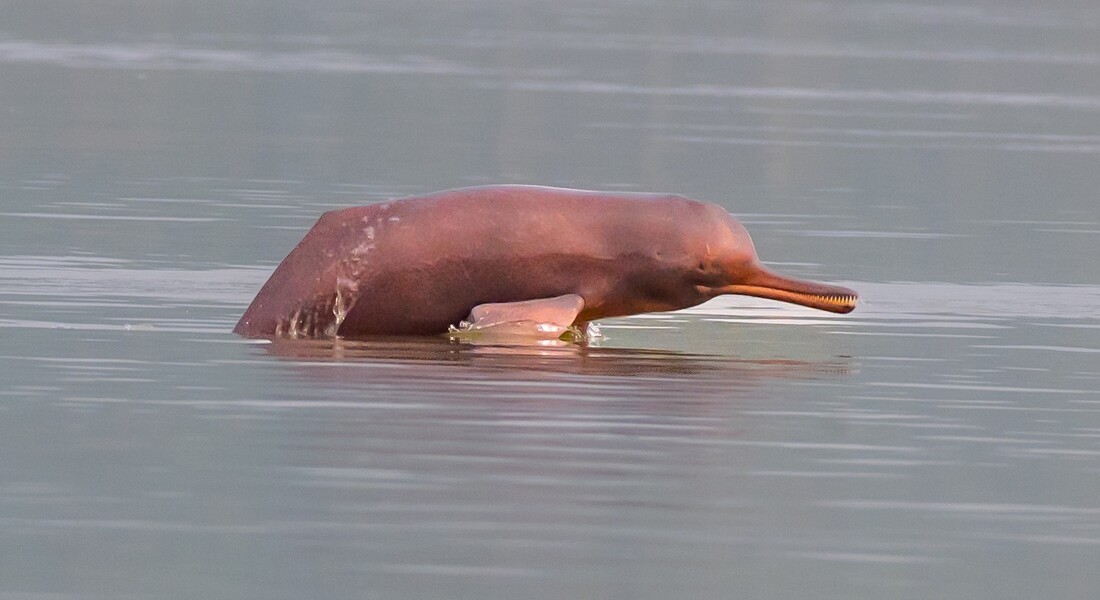

New Delhi: The Gangetic river dolphin, India’s national aquatic animal, is a rare freshwater species known for its unique adaptation of navigating entirely through sound. Often described as blind, it relies on echolocation to survive and cannot thrive in waters where fish populations decline or pollution levels rise significantly. This makes it one of the most reliable biological indicators of river health.
The findings come from India’s first large-scale Ganga Dolphin Survey, the results of which were released in March 2025, followed by the launch of a second nationwide survey in January 2026. The study represents the country’s most extensive acoustic census of river dolphins, covering more than 8,500 kilometres of river systems. Researchers used hydrophones to record echolocation clicks to estimate population numbers, the National Mission for Clean Ganga said in a lengthy post on X.
The survey estimates a total of 6,327 Gangetic river dolphins in Indian waters. A major concentration was recorded in Uttar Pradesh, Bihar, and West Bengal. Uttar Pradesh reported 2,397 dolphins, Bihar 2,220, and West Bengal 815. Together, these three states account for approximately 5,432 dolphins, nearly 86% of the total recorded population.
According to the findings, 3,275 dolphins inhabit the main stretch of the Ganga, while 2,414 were identified across tributaries, including the Yamuna, Ghaghara, and Gandak rivers.
Scientists describe the Gangetic dolphin as a bioindicator species, meaning its presence reflects the ecological condition of river systems. The species is highly sensitive to pollution, declining fish populations, and habitat disruption. Its slow reproductive cycle – typically producing one calf every two to three years – limits rapid population recovery in degraded environments.
While the results highlight strong populations in certain stretches, challenges such as untreated sewage discharge, industrial pollution, and riverine habitat stress continue to persist across the Ganga basin.
However, conservation initiatives such as Namami Gange and Project Dolphin are believed to have contributed to improved monitoring, protection measures, and gradual ecological stabilisation in parts of the river system.
The survey findings suggest that the distribution of Gangetic dolphins reflects ongoing ecological changes in India’s river systems, with the species continuing to serve as a key indicator of river health and restoration progress.