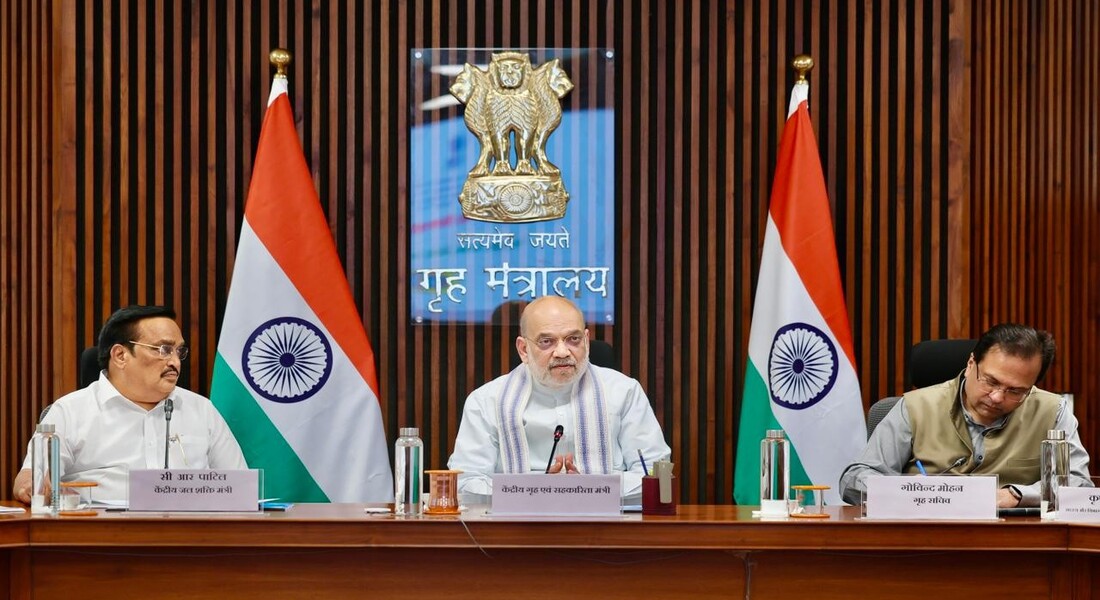

New Delhi: Union Home Minister Amit Shah on Sunday directed authorities to strengthen India’s disaster preparedness framework with a sharper focus on integrated flood forecasting, climate-linked risks, and zero-casualty disaster management during a high-level review meeting in New Delhi.
The meeting reviewed the country’s preparedness to tackle floods, heat waves, and other weather-related disasters ahead of the monsoon season, according to an official statement.
A key focus of the review was the development of an early warning system for high-risk glacial lakes in the Himalayan regions. Shah said at least 60 lakes should be brought under the monitoring plan, expanding the existing proposal covering 30 high-risk lakes in Jammu & Kashmir, Ladakh, Uttarakhand, Himachal Pradesh, Arunachal Pradesh, and Sikkim, with support from the National Disaster Management Authority (NDMA).
The home minister also called for the creation of an integrated flood forecasting system linking both the Centre and state-level agencies to improve coordination and disaster response.
Emphasising preparedness at the grassroots level, Shah directed all states to constitute and activate Flood Crisis Management Teams. He said guidelines issued by the NDMA have improved awareness and promoted a “Whole of Government” approach to disaster management, but added that stronger compliance monitoring at the state, district, and municipal levels is needed.
He further instructed the NDMA to study how effectively states are implementing directives issued by the Ministry of Home Affairs and disaster management guidelines related to floods, forest fires, and heat waves.
Highlighting the Centre’s broader disaster management vision under Prime Minister Narendra Modi, Shah said efforts should continue towards achieving “Zero Casualty Disaster Management”.
He also stressed the need to improve water conservation through check dams and water storage projects to support groundwater recharge and reduce the impact of rising temperatures during heat waves.
He noted the CAMPA Fund should be used more extensively for projects aimed at maintaining environmental balance.
Calling climate change a growing challenge, Shah directed officials to prepare a long-term master plan to address shifting weather patterns and increasing disaster risks using a “Whole of Government” and “Whole of Society” approach.
He also advised ministries and departments to focus on strengthening and integrating existing digital platforms and disaster-related apps instead of launching multiple new systems. According to Shah, weather forecasts and warning alerts must reach people quickly and effectively.
The home minister further called for a detailed assessment of monsoon-related casualties, forecast accuracy, and agricultural losses to improve India’s disaster response and weather prediction systems.