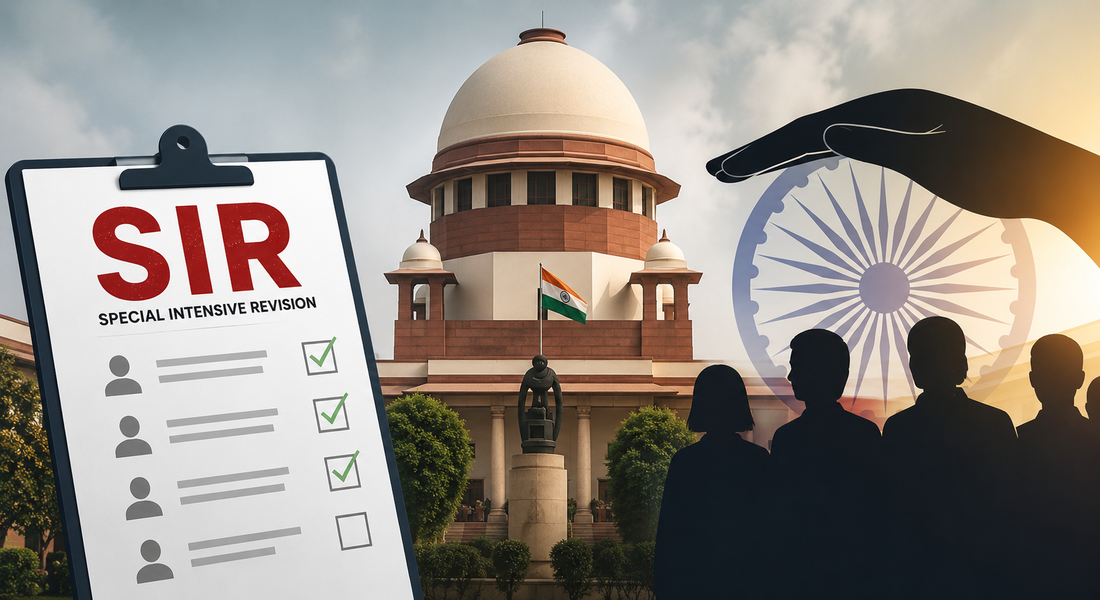

New Delhi: The Supreme Court on Wednesday upheld the Election Commission of India’s (ECI) power to carry out a Special Intensive Revision (SIR) of electoral rolls, while making it clear that exclusion from a voter list does not amount to loss of citizenship.
Delivering its verdict on petitions challenging the Election Commission’s voter roll revision exercise in Bihar Assembly constituencies, the top court said the poll body’s role is limited to determining eligibility for inclusion in electoral rolls and does not extend to deciding questions of citizenship.
“The Election Commission’s powers in the SIR exercise are limited to determining eligibility for inclusion in electoral rolls and do not extend to ascertaining citizenship status,” the court observed.
Clarifying the legal implications of exclusion from electoral rolls, the Supreme Court stated: “If a citizen does not appear on electoral roll that does not mean the citizen was unable to prove his citizenship, but shows the inability of the Election Commission to verify citizenship.”
The court emphasised that removal or non-inclusion of a person’s name from electoral rolls cannot automatically be interpreted as loss of citizenship. It added that individuals excluded from voter lists must be dealt with strictly in accordance with the law.
According to a report by the Bar and Bench, the apex court also issued the direction that the Election Commission shall refer within four weeks the case of persons whose names have been deleted from the 2003 (Bihar) rolls to the compentent authority under the Citizenship Act, 1995 for determination of their citizenshiip claims.
“The competent authority shall take necessary steps in accordance with law and conclude the process before the next Vidhan Sabha or local body elections, whichever is earlier, after giving notice and affording an opportunity of hearing to the concerned individuals. In the event the competent authority holds that such deleted individuals are citizens, their names shall be restored to the electoral rolls,” it said.
The verdict came on petitions alleging that the Election Commission had exceeded its powers by effectively determining citizenship through the voter verification process. Petitioners had challenged the poll body’s order directing a Special Intensive Revision of electoral rolls in Bihar, arguing that the exercise could lead to arbitrary exclusion of voters.
However, the Supreme Court held that the SIR process serves a “legitimate, constitutionally grounded purpose” aimed at ensuring the accuracy of electoral rolls. “We hold that the impugned exercise was founded upon legitimate, constitutionally grounded purpose, namely restoration of accuracy,” the bench said.
The court further observed that free and fair elections depend not only on polling procedures but also on maintaining accurate voter lists. It ruled that the SIR exercise is consistent with provisions of the Representation of the People Act and derives legitimacy from Article 324 of the Constitution, which empowers the Election Commission to supervise elections.
Importantly, the court said the entire SIR process remains open to judicial scrutiny, making it clear that any wrongful exclusion or arbitrary action can be challenged before appropriate legal forums.
On the issue of documentary proof for voter verification, the court noted that the Election Commission’s prescribed list of 11 documents is indicative rather than exhaustive. It also clarified that Aadhaar can be accepted as an additional document for identity verification purposes.
The judgment came months after the Supreme Court reserved its verdict in January following extensive hearings involving the petitioners and the Election Commission.