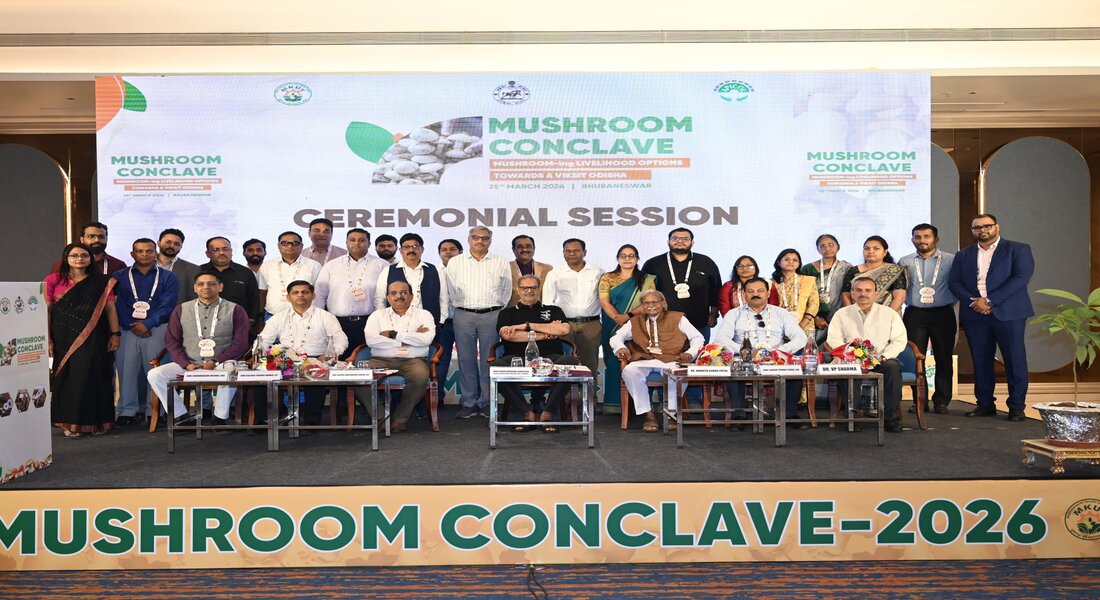

Bhubaneswar: The Mushroom Conclave 2026 has been organised in the city on Wednesday, focusing on expanding mushroom cultivation as a sustainable livelihood avenue in the state.
Organised by the Agricultural Promotion and Investment Corporation of Odisha Limited (APICOL) under the Department of Agriculture & Farmers’ Empowerment, the conclave centred on the theme “Mushrooming livelihood options towards a Viksit Odisha.”
The event featured technical sessions on advanced production techniques, post-harvest management, value addition and market linkages in the mushroom sector.
Addressing the gathering, Deputy Chief Minister Kanak Vardhan Singh Deo said Odisha accounts for around 11 percent of India’s total mushroom production. He described mushrooms as a “super food” due to their high nutritional value, low fat and cholesterol content, and environmentally sustainable cultivation practices. He added that the state government is promoting mushroom farming through subsidies under the Mukhyamantri Krushi Udyog Yojana (MKUY), along with efforts to strengthen market linkages and logistics support.
During the event, a new APICOL website was launched, and Go-Ahead letters were distributed to mushroom producers for setting up production and spawn units.
More than 170 participants from across the state, including members of the Mushroom Federation, attended the conclave. Nine expert speakers shared insights on various technical aspects of mushroom cultivation and its value chain.
Commissioner-cum-Secretary of the Department of Agriculture & Farmers’ Empowerment, Sachin Ramchandra Jadhav, said mushroom cultivation offers quick returns and requires relatively less water compared to other crops.
Other speakers included Director of Soil Conservation & Watershed Development Subrat Kumar Panda, Director of Horticulture Kalunge Gorakh Waman, OUAT Vice-Chancellor Dr Prabhat Kumar Raul, Dr V P Sharma, APICOL Managing Director Shubhranshu Mishra, and Prof Adwaita Kumar Patra, Chairman of the Odisha Mushroom Growers Federation. They highlighted the role of mushroom farming in boosting farmer incomes and strengthening rural livelihoods.
According to an official release, Odisha produced 63,000 metric tonnes of mushrooms this year. A total of 1,207 farmers have received approval to set up mushroom-based enterprises, including spawn production, cultivation and processing units for paddy straw, oyster and button mushrooms. Of these, 207 entrepreneurs have already received subsidies to establish their units.
The event underlined the state’s efforts to build a market-driven mushroom ecosystem and expand income opportunities for farmers.