
Bhubaneswar: The Odisha government on Wednesday signed a three-year Memorandum of Understanding (MoU) with the Abdul Latif Jameel Poverty Action Lab (J-PAL) South Asia to strengthen evidence-based policymaking across the state in line with Odisha Vision 2036 and 2047.
Under the partnership, J-PAL South Asia will work with various state government departments to identify priority policy challenges, generate rigorous research evidence and translate findings into actionable policy recommendations.
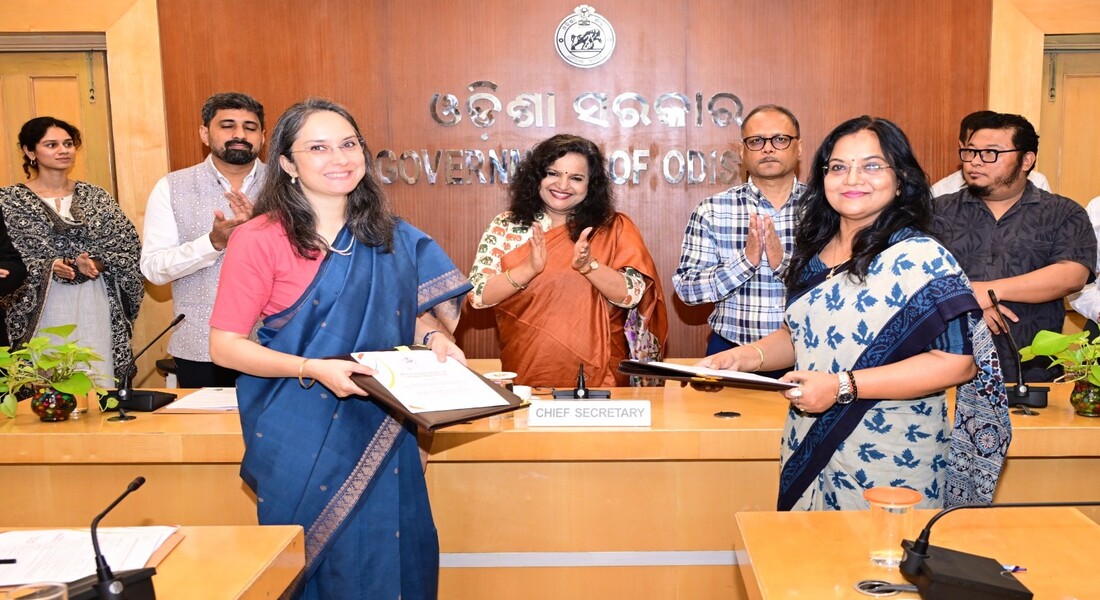
The MoU was signed by Rashmi Kabi, FA-cum-Additional Secretary of the Planning and Convergence Department, government of Odisha, and Shobhini Mukerji, Executive Director of J-PAL South Asia.
The signing ceremony was attended by Chief Secretary Anu Garg, Development Commissioner-cum-Additional Chief Secretary Deoranjan Kumar Singh, J-PAL South Asia Acting Associate Director (Policy) Murali Mallikarjunan and secretaries of various state government departments.
Odisha Vision 2036 and 2047 outlines the state’s roadmap to becoming Samruddha Odisha by 2036 and Viksit Odisha by 2047. The partnership builds on J-PAL South Asia’s engagement with Odisha since 2006, covering areas such as early childhood education, foundational literacy and numeracy, governance, sanitation, agriculture and gender.
As part of the collaboration, J-PAL South Asia will coordinate with government departments to understand their policy priorities and support the development of research-based solutions.
One of the ongoing initiatives highlighted under the partnership is Barnali, a gender-equity curriculum currently being taught in around 23,000 government schools. J-PAL South Asia serves as the knowledge and research partner to the School and Mass Education Department and Breakthrough Trust for the initiative.
The partnership will be guided by a Steering Committee chaired by the Chief Secretary, with senior government officials and representatives of J-PAL South Asia as members. The committee will meet every six months to review project proposals. Nodal officers from both sides will coordinate the activities, while the scope and deliverables of individual projects will be developed in consultation with the concerned departments.
Garg said the state’s ambition of achieving Viksit Odisha as part of Viksit Bharat required strong engagement with research institutions, policy research and the piloting of innovative approaches.
She highlighted the importance of adopting data- and AI-based interventions in line with global best practices.
She outlined J-PAL South Asia’s role in bringing relevant global evidence to the state’s policy priorities, helping departments adapt promising approaches to Odisha’s requirements, and supporting the design and testing of evidence- and data-based solutions before their wider implementation.
J-PAL South Asia Executive Director Shobhini Mukerji said Odisha had a longstanding record of generating and using evidence for policymaking. She noted that the organisation would continue working with the state government to address policy priorities by bringing in global research evidence, adapting it to local needs, co-developing programmes, and testing and scaling effective interventions.
She also acknowledged the state’s existing monitoring and evaluation capacity as a strong foundation for the partnership.