
Bhubaneswar: Odisha Deputy Chief Minister Pravati Parida on Tuesday released Rs 99.26 crore in interest subvention to 1,79,809 Self-Help Groups (SHGs) across the state, as part of the government’s efforts to strengthen women-led enterprises and improve the financial capacity of SHGs and their community-based organisations.
The financial assistance was released at a programme held at Mission Shakti Bhawan in Bhubaneswar. The deputy CM said the government is taking a series of measures to strengthen the financial and institutional capacity of SHGs and their federations, while creating new livelihood opportunities for women and helping more women become Lakhpati Didis.
“Women are not merely beneficiaries of development; they are emerging as drivers of Odisha’s economic and social transformation. I am confident that Nari Shakti will lead the development journey of Odisha in the coming years,” Parida said.
The Odisha government has made a budget provision of Rs 575 crore for interest subvention to SHGs during the financial year 2026-27. Earlier, on June 24, 2026, interest subvention of Rs 147.77 crore was released to 2,88,198 SHGs. With the latest release, a total of Rs 247.03 crore has been provided towards interest subvention to SHGs in the current financial year so far.
For 2026-27, the government has set a target of Rs 20,000 crore in bank credit linkage for SHGs. The government said the combined support of bank credit, interest subvention and community funds is intended to provide SHG members with adequate financial resources to strengthen their livelihoods and enterprises.
During Tuesday’s programme, another Rs 151.28 crore was released under various community-based financial support mechanisms. This included Rs 29.31 crore as Revolving Fund for 15,526 SHGs, Rs 113.80 crore as Community Investment Fund for 371 Gram Panchayat-level Federations and Rs 8.18 crore as Vulnerability Reduction Fund for 605 Area Level Federations.
Under the Revolving Fund component, 15,526 SHGs across 29 districts received a total of Rs 29.31 crore. The districts covered were Angul, Baleshwar, Bargarh, Bhadrak, Balangir, Boudh, Kataka, Deogarh, Dhenkanal, Gajapati, Ganjam, Jagatsinghpur, Jajpur, Jharsuguda, Kalahandi, Kandhamal, Kendrapara, Kendujhar, Khordha, Koraput, Malkangiri, Mayurbhanj, Nabarangpur, Nayagarh, Nuapada, Rayagada, Sambalpur, Subarnapur and Sundargarh.
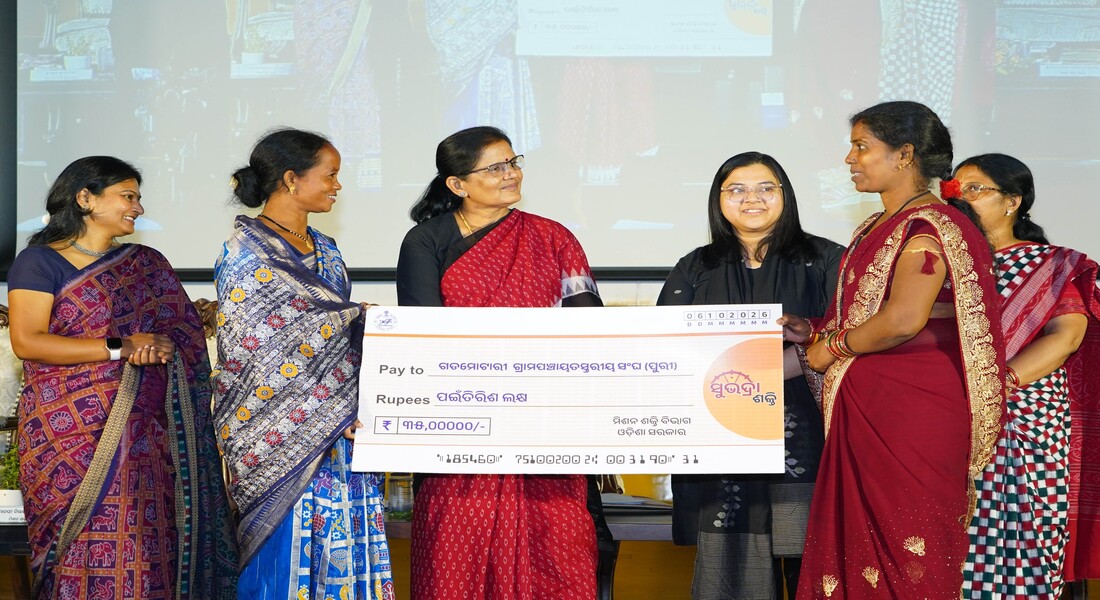
Similarly, Rs 113.80 crore was released to 371 Gram Panchayat-level Federations across 26 districts under the Community Investment Fund. Representatives of Algum and Gadmotari Gram Panchayat-level Federations from Puri received cheques of Rs 45 lakh and Rs 35 lakh respectively.
A further Rs 8.18 crore was released to 605 Area Level Federations across 19 districts under the Vulnerability Reduction Fund. The districts covered were Angul, Baleshwar, Bargarh, Balangir, Boudh, Dhenkanal, Gajapati, Ganjam, Jharsuguda, Kalahandi, Kendujhar, Malkangiri, Mayurbhanj, Nayagarh, Nuapada, Rayagada, Sambalpur, Subarnapur and Sundargarh.
Representatives of Gundadurisahi and Karadabani Area Level Federations from Ganjam received cheques of Rs 1.50 lakh each under the Vulnerability Reduction Fund.
The programme also marked the signing of two Memoranda of Understanding aimed at strengthening women’s livelihoods and entrepreneurship. Mission Shakti signed an MoU with Collective for Integrated Livelihood Initiatives to further promote and expand the Lakhpati Didi initiative.
Another MoU was signed with the Odisha Renewable Energy Development Agency to promote green entrepreneurship among women SHGs and encourage the adoption of renewable energy.
The collaboration is expected to help rural women entrepreneurs develop environmentally sustainable enterprises, secure sustainable livelihoods and contribute to the socio-economic development of their communities.
The programme was attended by Commissioner-cum-Secretary, Department of Mission Shakti, Manasi Nimbhal; Director, Mission Shakti, Dr Monika Priyadarshini; Convenor, SLBC Odisha; senior officials of the department; representatives of banks and partner organisations, OREDA and CINI; district-level officials; and members of Self-Help Groups from across Odisha through virtual mode.