At IndiaVerve, we go beyond the noise to bring you meaningful stories of change, resilience and progress—from India to the world stage. Our mission is to bring readers credible, wide-ranging coverage across politics, business, sports, culture, society and more.

Air India, IndiGo aircraft brush wings at Mumbai airport; no injuries reported

Mumbai: Two passenger aircraft operated by Air India and IndiGo were involved in an on-ground wingtip collision at Mumbai’s Chhatrapati Shivaji Maharaj International Airport on Tuesday, aviation officials confirmed. No injuries were reported in the incident.

The collision occurred when the right wing tips of the two aircraft brushed past each other while taxiing on the airside. Both airlines and the Directorate General of Civil Aviation (DGCA) confirmed that the planes sustained damage.

According to the DGCA, officials reached the site soon after the incident and directed both aircraft to return to their respective bays for inspection. Preliminary checks were carried out, and further technical examinations are underway.

Air India said its flight AI2732, operating from Mumbai to Coimbatore, was waiting on the taxiway for clearance to take off when the incident took place. “The aircraft scheduled to operate the service came into contact with another airline’s aircraft while waiting on the taxiway prior to take-off. The wingtips of the two aircraft made contact, resulting in damage to our aircraft’s wingtip,” the airline said in a statement.

The national carrier added that the aircraft has been grounded as a precautionary measure. All passengers were safely disembarked, and alternative travel arrangements are being made to ensure they reach their destination.

IndiGo, in a separate statement, confirmed that its flight 6E 791 from Hyderabad to Mumbai was involved in the incident after landing. “The wingtip of one of our aircraft came in contact with an aircraft of another airline while taxiing, after landing. All passengers are safe and were disembarked after parking,” the airline said, adding that the aircraft is undergoing maintenance inspections.

A formal inquiry is expected to be conducted by aviation authorities to determine the circumstances that led to the collision.

Rourkela Steel Plant posts best April–Jan performance in FY26

Bhubaneswar: Rourkela Steel Plant (RSP), a unit of Maharatna PSU Steel Authority of India Limited, has recorded its best-ever April–January performance in FY 2025–26 across major production and dispatch parameters.

During the first 10 months of the current financial year, RSP produced 34,57,761 tonnes of saleable steel, surpassing its previous April–January best of 34,35,767 tonnes achieved in the corresponding period last year.

Hot Strip Mill-2 (HSM-2) played a key role by rolling 22,06,432 tonnes of hot-rolled coils. This exceeded its earlier best of 21,16,097 tonnes recorded during the corresponding period of FY 2024–25. The New Sheet Shearing Line of HSM-2 also posted its best April–January output, producing 2,59,870 tonnes of HR plates, registering a growth of 23 per cent over the same period last year.

The New Plate Mill set a fresh benchmark by producing 8,25,999 tonnes of plates during April–January FY 2025–26, according to a company release. This surpassed its previous best of 7,73,779 tonnes recorded in the corresponding period of the previous financial year.

In upstream operations, Blast Furnace-5 ‘Durga’ achieved its highest-ever April–January performance with hot metal production of 26,97,961 tonnes. Blast Furnace-1 ‘Parvati’ complemented this output by recording an all-time best production of 8,95,446 tonnes of hot metal during the same period. Sinter Plant-III also registered its best April–January performance with a record sinter production of 30,97,986 tonnes.

In logistics, RSP achieved a record single-day road dispatch of 5,576 tonnes on January 30, 2026. The Traffic and Raw Materials Department also recorded its best-ever rail dispatch for January, moving 3,04,649 tonnes through 114 rakes in January 2026. This exceeded the previous best of 2,98,219 tonnes achieved in January 2024.

DRDO successfully tests SFDR technology from Odisha coast

Bhubaneswar: The Defence Research and Development Organisation (DRDO) on Tuesday successfully demonstrated the Solid Fuel Ducted Ramjet (SFDR) technology from the Integrated Test Range (ITR) at Chandipur, off the Odisha coast, marking a major milestone in India’s missile development programme.

The test, conducted at around 10:45am, places India among a select group of nations with proven SFDR capability. The technology is critical for the development of long-range air-to-air missiles and is expected to significantly enhance the Indian Air Force’s combat reach and tactical superiority.

During the flight trial, all key subsystems – including the nozzle-less booster, SFDR motor, and fuel flow controller – functioned as designed. After initial acceleration by a ground booster, the system achieved the required Mach number, following which the ramjet propulsion took over seamlessly.

Performance data collected through multiple tracking systems deployed along the Bay of Bengal confirmed the success of the demonstration, according to an official statement. Senior scientists from DRDO laboratories such as the Defence Research & Development Laboratory, Research Centre Imarat, High Energy Materials Research Laboratory, and ITR monitored the launch.

Defence Minister Rajnath Singh congratulated DRDO and its industry partners for the successful test, describing it as a significant step towards strengthening India’s defence preparedness.

Dr Samir V Kamat, DRDO Chairman and Secretary, Department of Defence R&D, also praised the teams involved, acknowledging their contribution to advancing indigenous missile technologies.

Centre boosts sports infrastructure

New Delhi: The Union government on Tuesday launched sports projects worth Rs120 crore across the country. Union Minister for Youth Affairs and Sports Dr Mansukh Mandaviya virtually laid foundation stones for six major infrastructure projects and inaugurated two athlete support facilities.

The projects aim to create world-class and athlete-friendly infrastructure. They cover North-Eastern, Eastern, and central regions, ensuring balanced and inclusive development.

Six projects under the Khelo India Scheme cost a total of Rs82 crore. They include upgrading a hockey turf in Bengaluru, building a multi-purpose hall in Patiala, laying athletic tracks in Bhopal, Guwahati, and Jalpaiguri, and constructing a judo hall in Bhopal, according to an official statement.

Mandaviya also inaugurated two completed facilities at NS NIS, Patiala, worth Rs38 crore. They include a central kitchen and dining hall to improve athlete nutrition and an Integrated Sports Science Centre for training, rehabilitation, and performance analysis.

Dr Mandaviya highlighted Sports Authority of India’s (SAI) role in managing and maintaining assets. He said the facilities must be well maintained, fully used, and, where possible, commercially leveraged.

The minister added that all projects will be closely monitored. SAI will conduct monthly reviews, while he will oversee quarterly reviews to ensure timely completion and optimal use.

He noted that the Khelo India Mission, announced by the Union finance minister, provides a framework to strengthen sports infrastructure. Dr Mandaviya said the government aims to place India among the top sporting nations by 2036.

The minister also highlighted a Rs500 crore allocation for sports goods manufacturing. It aims to boost domestic production and support a self-reliant, competitive sports ecosystem.

He emphasized that sport is now a profession. Talent identification and nurturing must be strengthened to help athletes progress from grassroots to elite levels.

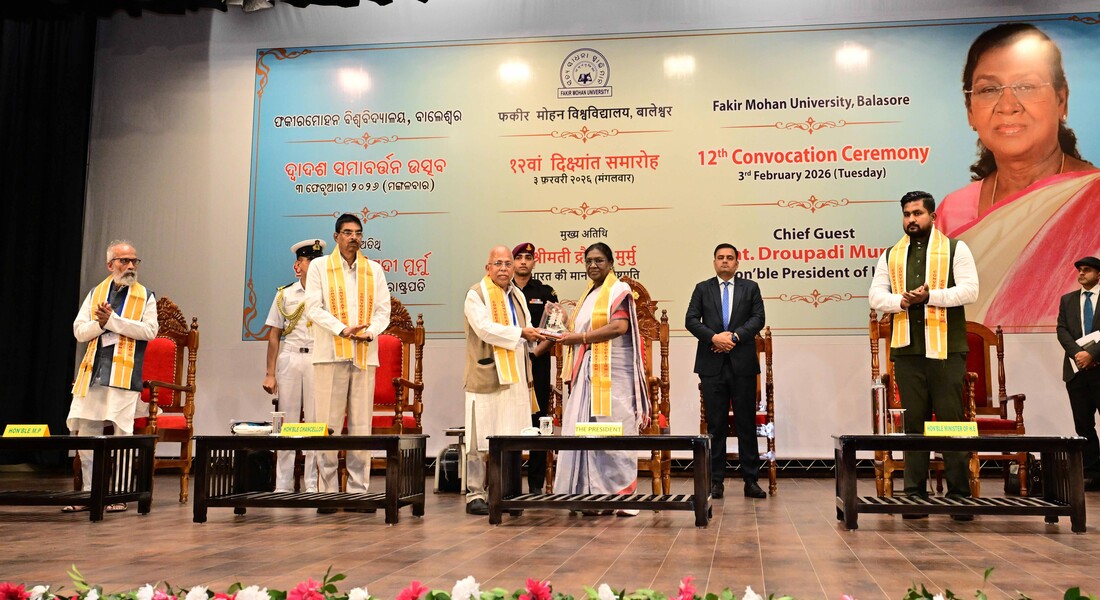
President Murmu urges universities to drive inclusive growth at Odisha convocation

Balasore: President Droupadi Murmu today said universities have a special responsibility to act as catalysts of inclusive growth, innovation and social transformation, while addressing the convocation ceremony of Fakir Mohan University in Balasore, Odisha.

The President also inaugurated the university’s new auditorium during the event. She paid tribute to Vyasakabi Fakir Mohan Senapati and recalled being deeply influenced by his short story Revati during her student days. She said the story of a young girl’s determination to pursue education in the 19th century continues to inspire her.

Drawing from her own life, President Murmu said she studied in a remote tribal village and later moved to Bhubaneswar to complete her higher education. She described Fakir Mohan Senapati as a lifelong source of inspiration and highlighted his deep respect for the mother tongue.

The President said education in one’s mother tongue helps students understand their surroundings, customs and cultural environment better. She noted that the National Education Policy 2020 places strong emphasis on learning in the mother tongue to help students remain connected to their cultural roots.

Referring to India’s rich knowledge traditions, President Murmu said ancient scriptures and manuscripts contain wisdom across fields such as science, medicine, astronomy and architecture. She encouraged students to engage in research that draws from this heritage to better understand the past and shape the future.

Congratulating the graduating students, the President said dedication remains the key to success in every endeavour. She remarked that while success in life is important, making life meaningful is even more valuable. She urged students to contribute to society and support those who have been left behind in the development process, according to an official release.

President Murmu appreciated Fakir Mohan University’s focus on research and community outreach alongside academics. She noted that the Balasore-Bhadrak region is known for paddy cultivation, betel leaves and fisheries, and commended the university for research and training programmes linked to these sectors.

She also praised initiatives such as Back to School, Earn While Learn, Each One Teach One, environmental awareness drives and beach cleaning programmes. The President said the proposal to establish a research centre on blue crabs or horseshoe crabs reflected the university’s forward-looking approach.

The President said universities across the country play a critical role in advancing national progress. She stressed that by promoting critical thinking, ethical leadership and research that addresses both local and global challenges, institutions of higher learning can help build a sustainable and equitable future. She expressed confidence that Fakir Mohan University would continue to play a transformative role through its academic vision and community engagement.

Parliament disrupted as Rahul Gandhi barred from reading Ladakh book excerpts

New Delhi: Chaos disrupted proceedings in the Lok Sabha on Tuesday after Congress leader Rahul Gandhi was stopped from reading excerpts from former Army chief General M.M. Naravane’s unpublished book, which reportedly refers to the 2020 India-China military standoff in eastern Ladakh. The repeated protests led to the adjournment of the House and the suspension of eight Congress MPs for the remainder of the session.

Rahul Gandhi attempted for the second consecutive day to raise the issue in the House but was denied permission by Speaker Om Birla. Opposition members protested the decision, with some MPs refusing to speak when called upon, citing solidarity with the Leader of the Opposition. The disruptions escalated, forcing the Lok Sabha to adjourn for the day.

Following the uproar, eight Congress MPs, including Hibi Eden, Amarinder Singh Raja Warring and Manickam Tagore, were suspended. Speaking to reporters later, Warring said Rahul Gandhi had authenticated the material and formally submitted it to the House. He questioned the decision to suspend members for protesting what he described as the denial of the opposition’s right to speak.

The Bharatiya Janata Party strongly criticised the Congress leader’s actions. BJP MP Anurag Thakur accused Rahul Gandhi of insulting Parliament and the armed forces. He said House rules require prior permission to read unpublished material and accused the Congress of disrupting proceedings after the presentation of the Union Budget.

Government sources later said the Speaker’s decision was based on established parliamentary rules, which do not allow members to quote from unpublished documents without prior approval. Senior ministers, including Home Minister Amit Shah and Defence Minister Rajnath Singh, had also objected to the move on Monday, triggering earlier adjournments.

When the House reconvened on Tuesday, Rahul Gandhi said he had authenticated the contents of the book and questioned why he was still being stopped. He alleged that the ruling party was trying to silence him on the India-China border issue. Two opposition MPs from the Samajwadi Party and the Trinamool Congress declined to speak in a show of support.

Outside Parliament, Gandhi also criticised the recently announced India-US trade agreement. He questioned how the deal was finalised after months of stalled negotiations and claimed it would harm Indian farmers. He demanded full disclosure of the terms of the agreement and called for a parliamentary debate.

https://twitter.com/RahulGandhi/status/2018622253840429323?ref_src=twsrc%5Etfw%7Ctwcamp%5Etweetembed%7Ctwterm%5E2018622253840429323%7Ctwgr%5E75cc2a2bd215b935ab93603185a613207e82bc24%7Ctwcon%5Es1_c10&ref_url=https%3A%2F%2Fpublish.twitter.com%2F%3Furl%3Dhttps%3A%2F%2Ftwitter.com%2FRahulGandhi%2Fstatus%2F2018622253840429323

The government rejected the allegations, saying sensitive sectors such as agriculture and dairy remain protected. Official sources said the trade agreement does not compromise farmers’ interests and that details will be shared through appropriate channels.

The Congress has demanded that the full text of the India-US trade deal be tabled in Parliament, as disruptions continued to affect legislative business for a second straight day.

Government launches ‘Mukhyamantri Kanya Bibaha Yojana’

Bhubaneswar: The government on Tuesday launched the ‘Mukhyamantri Kanya Bibaha Yojana’, a welfare scheme to support the marriage of daughters from economically weaker families. The initiative gives special focus to Scheduled Caste and Scheduled Tribe households.

Chief Minister Mohan Charan Majhi inaugurated the scheme at the sacred shrine of Maa Taratarini Temple in Ganjam district. He said the government remains committed to ensuring dignity and social security for women across the State.

Addressing the gathering, the CM said he attended the event not only as the head of the government but also as a father and brother. He extended his blessings to newly married couples and wished them a happy married life.

Under the scheme, eligible beneficiaries will receive Rs60,000 as financial assistance. The government aims to reduce the financial stress families face during the marriage of their daughters.

Majhi said women’s empowerment remains a core priority of his government. He noted that the scheme complements earlier initiatives such as the Subhadra Yojana. He added that the programme seeks to promote a respectful social outlook towards the girl child.

Officials said the scheme also targets social reform. It seeks to discourage practices such as dowry and promote widow remarriage. The government has also made marriage registration mandatory to strengthen women’s legal and social security.

The CM linked the initiative to Vision Odisha-2036, which focuses on building a developed and inclusive state. In a post on X, he said the government aims to ensure that every daughter becomes educated, safe, and self-reliant.

During his visit, Majhi offered prayers at the Maa Taratarini shrine. He also interacted with beneficiaries and residents.

The State government said the scheme aligns with the Union Budget 2026-27, which places strong emphasis on women-centric development. Initiatives such as Self-Help Group entrepreneur markets aim to boost women’s economic participation at the grassroots level.

Officials said the ‘Mukhyamantri Kanya Bibaha Yojana’ marks another step in Odisha’s efforts to combine welfare support with long-term women empowerment.

TEPA to boost India-Norway ties

New Delhi: The Trade and Economic Partnership Agreement (TEPA) between India and the European Free Trade Association (EFTA), in force since October 1, 2025, is expected to give fresh momentum to India–Norway trade, technology, and investment ties. Senior officials from both countries highlighted this during bilateral discussions held in Oslo on Monday.

The 12th round of Foreign Office Consultations between India and Norway placed the spotlight on leveraging TEPA to unlock new opportunities across sectors. The Indian delegation was led by Secretary (West) in the Ministry of External Affairs, Sibi George, while the Norwegian side was headed by Torgeir Larsen, Secretary General of the Royal Norwegian Ministry of Foreign Affairs.

Beyond trade, the two sides reviewed the overall trajectory of bilateral relations and agreed that TEPA would act as a catalyst for deeper collaboration in advanced technologies, innovation-driven industries, and sustainable investment. Officials noted that the agreement provides a strong institutional framework to expand economic engagement and strengthen long-term partnerships.

Discussions also covered cooperation in areas such as the blue economy, maritime affairs and shipping, renewable energy, circular economy practices, education, science and technology, artificial intelligence, space, and Arctic-related issues. India reiterated its commitment to strengthening ties with Norway as well as with the broader Nordic region, according to a Ministry of External Affairs release.

Multilateral cooperation featured prominently in the talks, with both sides exchanging views on developments at the UN and on regional and global issues of mutual interest. They underlined the importance of continued dialogue and coordination in addressing shared global challenges.

During his visit, George also met with Norway’s State Secretary for Trade and Industry, Ragnhild Sjoner Syrstad, to explore ways to deepen economic engagement. He later interacted with members of the Indian community in Oslo, acknowledging their role in reinforcing people-to-people links.

India–US trade deal reduces tariffs on Indian exports to 18%

New Delhi: India and the United States have finally concluded a trade agreement under which Indian goods exported to the US will face a reduced tariff of 18 per cent, marking a significant development in bilateral trade ties after nearly a year of prolonged negotiations.

Prime Minister Narendra Modi announced the tariff reduction on Monday following a phone conversation with US President Donald Trump. Modi said the decision would benefit Indian exporters and strengthen economic cooperation between the two countries. He noted that the agreement would help unlock new opportunities for trade between the world’s two largest democracies.


“Wonderful to speak with my dear friend President Trump today. Delighted that Made in India products will now have a reduced tariff of 18%. Big thanks to President Trump on behalf of the 1.4 billion people of India for this wonderful announcement,” Modi wrote in a post on X.

“When two large economies and the world’s largest democracies work together, it benefits our people and unlocks immense opportunities for mutually beneficial cooperation,” he added.

The confirmation of the deal came in stages, beginning with a social media post by US Ambassador Sergio Gor, followed by statements from President Trump and Prime Minister Modi. Union minister Ashwini Vaishnaw later confirmed that India and the US had reached a trade agreement, describing it as mutually beneficial.

President Trump said the agreement would take effect immediately and includes commitments by India to reduce tariffs and non-tariff barriers on US goods. He also stated that India would increase purchases of American products, including energy, technology, agricultural goods and coal, valued at more than $500 billion.

The reduced tariff of 18 per cent places India below several other countries facing higher duties in the US market. The agreement concludes nearly 12 months of negotiations that began during Prime Minister Modi’s visit to the United States last year, after bilateral trade ties came under strain due to tariff hikes and policy differences.

According to trade experts, the lower tariff is expected to benefit Indian export sectors such as textiles, apparel, seafood, chemicals, engineering goods, and gems and jewellery, which are highly sensitive to price changes. Engineering exports, including auto components and electrical equipment, operate on thin margins where tariff reductions can have an immediate impact on competitiveness.

Observers have also pointed out that the deal may help stabilise trade relations between India and the US after a period of uncertainty. Analysts note that a predictable tariff framework could allow bilateral trade to grow more steadily in the coming years once the agreement is fully implemented.

The agreement has also drawn political reactions at home. The Congress party has demanded that the government place the full text of the India–US trade deal, along with the recently concluded India–EU trade agreement, before Parliament for discussion. Senior Congress leader Jairam Ramesh said Parliament should be taken into confidence, particularly on issues related to market access and agricultural imports.

Ramesh alleged that the details shared by President Trump raised concerns and called for a debate while Parliament is in session. The government has not yet responded to the demand for a parliamentary discussion on the trade deal.

The India–US trade agreement follows multiple rounds of formal and informal negotiations over the past year, including visits by US trade officials to India. While the detailed provisions of the deal are yet to be made public, both sides have described the agreement as a step towards strengthening economic cooperation and restoring momentum to bilateral relations.

CISF Coastal Cyclothon 2026 reaches Odisha

Bhubaneswar: Paradip Port welcomed the CISF Vande Mataram Coastal Cyclothon 2026 on Sunday. This 26-day cycling expedition marks the 150th anniversary of “Vande Mataram” and will conclude on February 22.

The initiative highlights coastal security, environmental protection, and national unity.

The event promotes the message: “Surakshit Tat, Samriddh Bharat” – a secure coastline supports a prosperous India. It reflects unity, resilience, and shared responsibility for protecting the nation’s coasts and environment.

The East Coast team began from Bakkhali Beach, West Bengal, with 65 cyclists, half of whom are women. They are riding through West Bengal, Odisha, Andhra Pradesh, and Tamil Nadu before reaching Kochi, Kerala. Local communities, officials, and security agencies have supported the cyclists enthusiastically along the route, according to an official statement.

During their stop in Paradip, the cyclists met fishermen, youth, and industry representatives to promote coastal vigilance, national security, fitness, and healthy living. On Monday, they departed for Konark from Paradip Sea Beach. P. L. Haranadh, Chairman of Paradip Port Authority, flagged off the cyclists.

The program included cultural performances. Paramjyoti Kala Kshetra presented an Odissi dance, CISF wards performed Sambhalpuri dance, and school children sang Vande Mataram. Residents of the Port Township and Sandhakud village gathered to watch and celebrate the cyclists’ mission.

Dignitaries stressed the importance of coastal security, environmental care, and community participation. Sanat Kumar Patel, Commandant of CISF Unit, PPA, and an accomplished marathon runner, was honored by P. L. Haranadh for his dedication and achievements.

The cyclothon began on January 28 in New Delhi, inaugurated by Union Minister of State for Home Affairs, Nityanand Rai. Two teams are cycling simultaneously along the eastern and western coasts, covering 11 states, passing through major ports, industrial hubs, and strategic maritime points. Civilian participation is encouraged both on the road and online.