At IndiaVerve, we go beyond the noise to bring you meaningful stories of change, resilience and progress—from India to the world stage. Our mission is to bring readers credible, wide-ranging coverage across politics, business, sports, culture, society and more.

BJP sweeps Bengal, Asam as TVK dominates Tamil Nadu in dramatic political shift

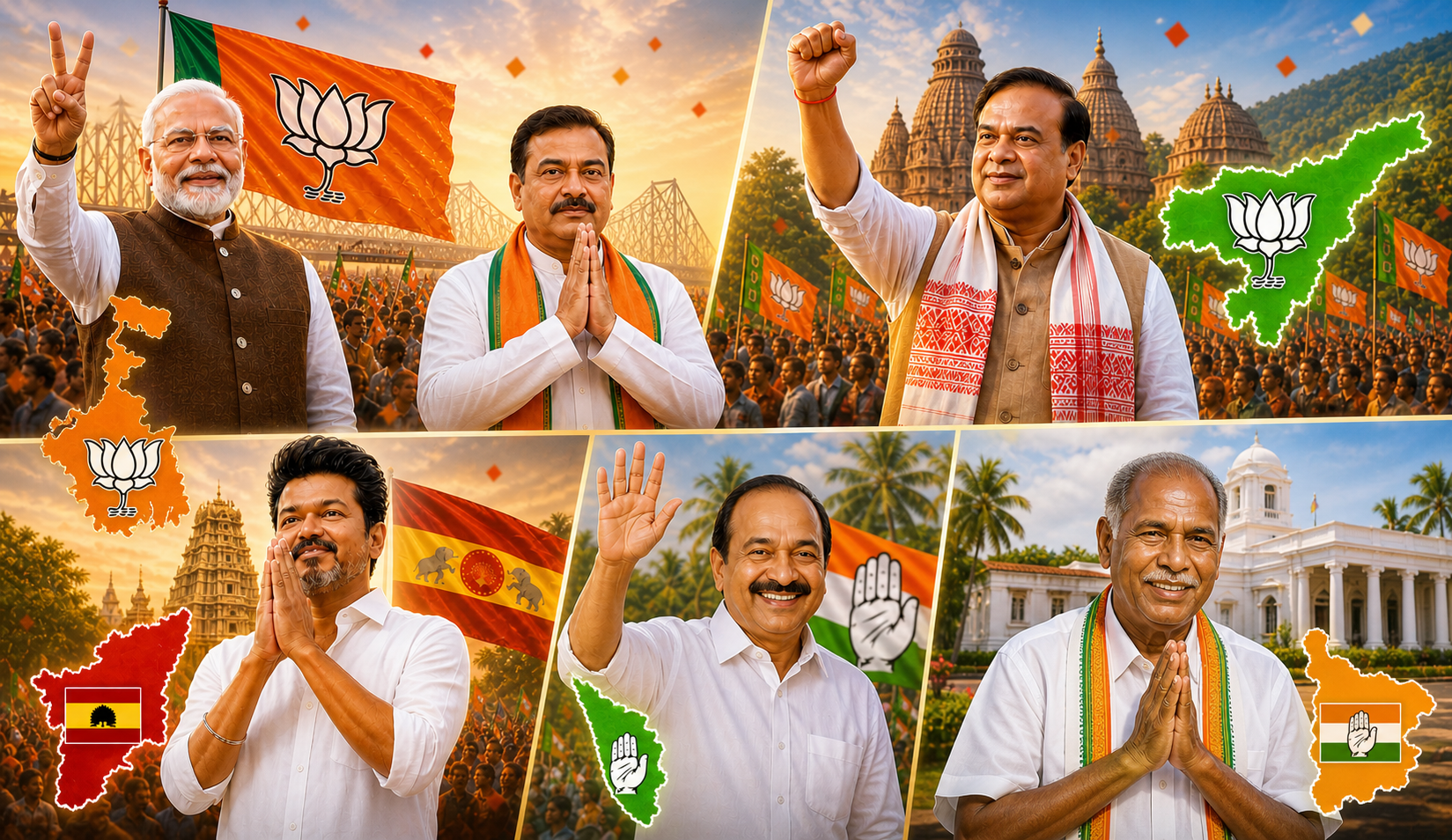
New Delhi: With counting nearing completion, trends as of 5 PM indicate decisive outcomes across key states, with the Bharatiya Janata Party poised for a commanding victory in West Bengal and actor-politician Vijay’s Tamilaga Vettri Kazhagam (TVK) emerging as the biggest disruptor in Tamil Nadu.

In West Bengal, results and trends available on Election Commission of India portal show the BJP winning in 12 and leading in 188 constituencies out of the toal 294 seats, comfortably crossing the majority mark and positioning itself to form the next government. The ruling All India Trinamool Congress was trailing with just one win and 87 leads, while the Indian National Congress was leading in just two seats. Others are ahead in three seats.

Leader of Opposition Suvendu Adhikari expressed confidence in the outcome, stating that the BJP would form the government. He also signalled a strong personal contest, asserting that he would win decisively. But as of now, Mamata Banerjee is leading in the Bhavanipur constituency with 46726 votes.

Echoing the party’s confidence, senior BJP leader Dharmendra Pradhan said the mandate reflects a rejection of fear-based politics and represents the aspirations of voters across Bengal, from northern districts to coastal regions.

In Assam, the BJP-led alliance is maintaining its dominance, leading in 62 seats and winning 20 constituencies. Asom Gana Parishad (AGP) has won 1 and is leading in 8 more seats, making the NDA totalig over 100 seats out of the 126 seats. The Congress-led alliance is trailing with 19 leads, while others account for two seats. In a notable contest, Congress leader Gaurav Gogoi lost from Jorhat, underlining the broader electoral setback for the party in the state.

The most striking development of the election, however, has come from Tamil Nadu. TVK has won 8 seats and was leading in 101 others in the 234-seat assembly, emerging as the single largest force in the state. The AIADMK alliance is ahead in 53 seats, while the ruling DMK alliance is trailing with 72 seats. The scale of this surge marks a dramatic shift in a state long dominated by the DMK-AIADMK binary.

Vijay’s performance is being seen as a rare political breakthrough, where a newly formed party has rapidly translated public appeal into electoral traction. The results suggest a consolidation of new voter blocs, particularly among younger voters and those seeking an alternative to established political formations.

In Kerala, the Congress-led United Democratic Front (UDF) was leading in 99 of the 140 seats, signalling a return to power. The ruling Left Democratic Front (LDF) is trailing with 35 seats, while the BJP-led alliance is ahead in three constituencies. State Congress leaders indicated that the trends reflect a clear pro-UDF sentiment.

Meanwhile, in Puducherry, the BJP-led alliance is ahead in 17 of the 30 seats, followed by the Congress-led alliance with eight seats and others leading in five constituencies.

While the Prime Minister is scheduled to address the BJP workers in the evening from the Party headquarters here, the part said in a post on X that its expanding presence from the heartland to Bengal reflects a growing belief among people in a nation committed to progress.

The party added that the political shift from North to the Northeast is now clearly visible, with Bengal marking the latest chapter in this broader trend, while reiterating its vision of building a “Viksit Bharat” by 2047 through collective effort

Reacting to the broader trends, senior BJP leader Keshav Prasad Maurya said voters across states have rejected opposition leaders and aligned with development-driven politics. He attributed the party’s performance to the leadership of Narendra Modi and emphasised that issues of national interest, governance and security were resonating with voters.

As counting progresses towards finality, the trends point to a dual political narrative—consolidation of BJP’s dominance in eastern and northeastern India, and a major structural shift in Tamil Nadu led by TVK’s unprecedented rise.

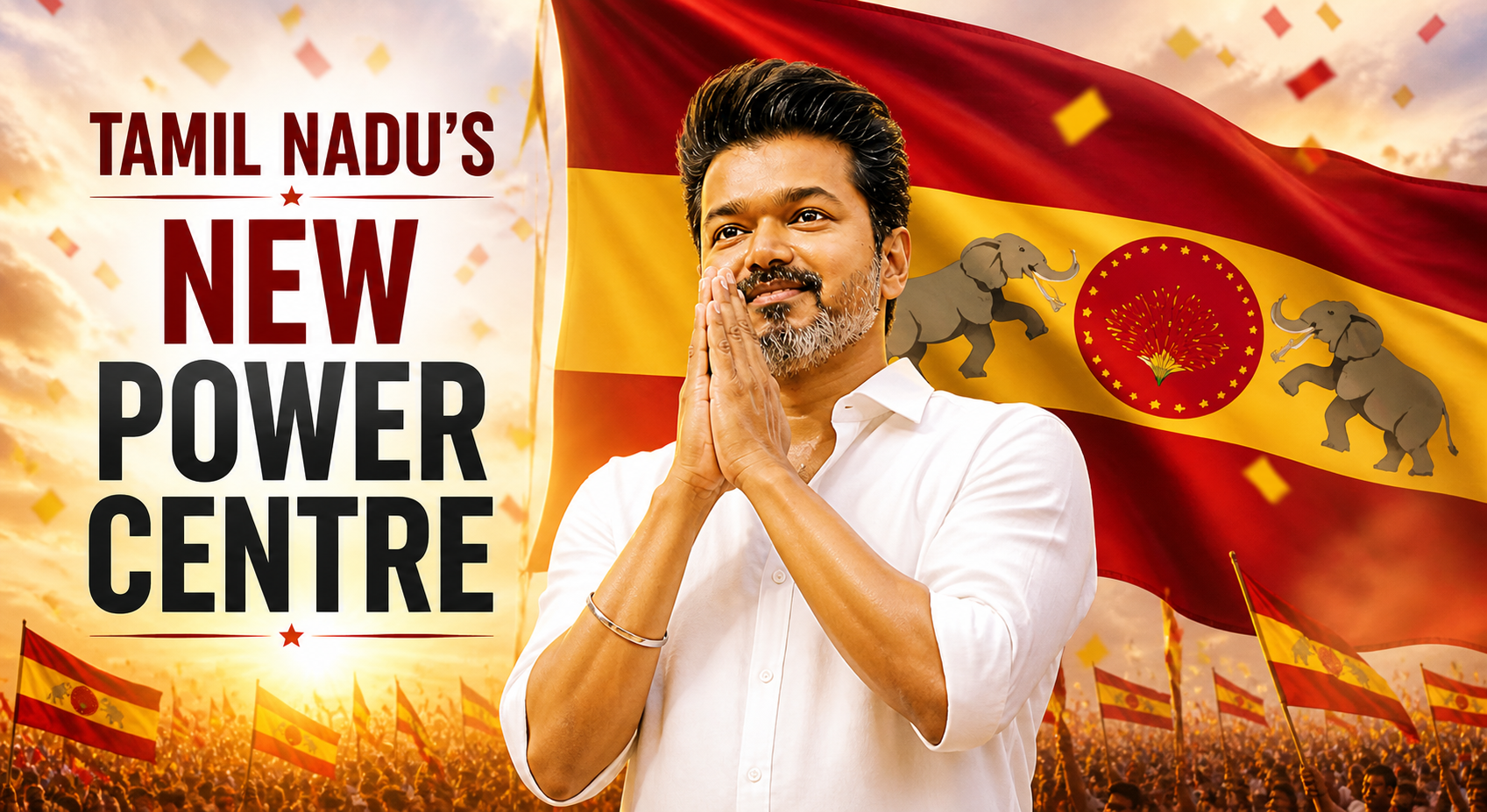
Vijay rewrites Tamil Nadu’s political playbook, emerges as new power centre

In its debut electoral test, TVK’s rapid rise reflects voter appetite for change, disrupting decades of bipolar politics and positioning Vijay as a key contender in government formation.

Actor-turned-politician Vijay has emerged as the biggest disruptor in Tamil Nadu’s political landscape, with early counting trends placing his party, Tamilaga Vettri Kazhagam (TVK), at the centre of a historic electoral moment.

As trends stabilised around midday, TVK was leading in over 100 seats, putting it within striking distance of the majority mark in the 234-member Tamil Nadu Assembly. For a party contesting its first full-fledged election, the scale of its performance marks a significant departure from the state’s long-standing bipolar political structure dominated by the DMK and AIADMK.

If these trends translate into final results, Vijay could become the first major film star in decades to directly convert personal popularity into electoral power through a newly formed party. Tamil Nadu has seen influential actor-politicians before—most notably M.G. Ramachandran, who became Chief Minister in 1977 after breaking away from the DMK—but subsequent stars have not managed to replicate that trajectory independently.

TVK’s rise has been neither sudden nor accidental. Vijay began consolidating his grassroots network more than a decade ago through his fan-based organisation, which gradually evolved into a structured social and civic platform. Over time, this network expanded its presence at the local level through welfare activities, building familiarity among voters beyond cinema audiences.

His eventual political entry was marked by a clear strategic choice—to contest without pre-poll alliances and position TVK as an alternative to the entrenched Dravidian parties. The campaign focused heavily on issues such as employment, education, corruption and governance, themes that resonated particularly with younger and urban voters.

Unlike traditional mass leaders in the state, Vijay avoided aggressive rhetoric, instead projecting a more measured, accessible leadership style. His outreach relied on controlled public engagements and strong digital communication, signalling a shift in campaign methods.

The current election has also tested the strength of this organisational model. With TVK candidates performing strongly across regions, the party has demonstrated its ability to translate support into votes—a challenge that has historically limited celebrity-led political ventures.

Even if the party falls short of an outright majority, its current position places it at the centre of government formation discussions. More importantly, it has already altered the competitive landscape by introducing a credible third force into Tamil Nadu politics.

The broader significance of this moment lies in what it represents—a shift from personality-driven politics rooted solely in cinema to a more structured, issue-based mobilisation backed by organisational groundwork. Whether or not Vijay ultimately assumes office, the 2026 election appears set to redefine the contours of political competition in the state.

Vijay’s TVK emerges as breakout force in Tamil Nadu as BJP leads in Bengal, Assam

New Delhi: Early trends from vote counting across key states have thrown up a major political surprise, with actor-politician Vijay’s Tamilaga Vettri Kazhagam (TVK) emerging as a dominant force in Tamil Nadu, reshaping what was expected to be a bipolar contest.

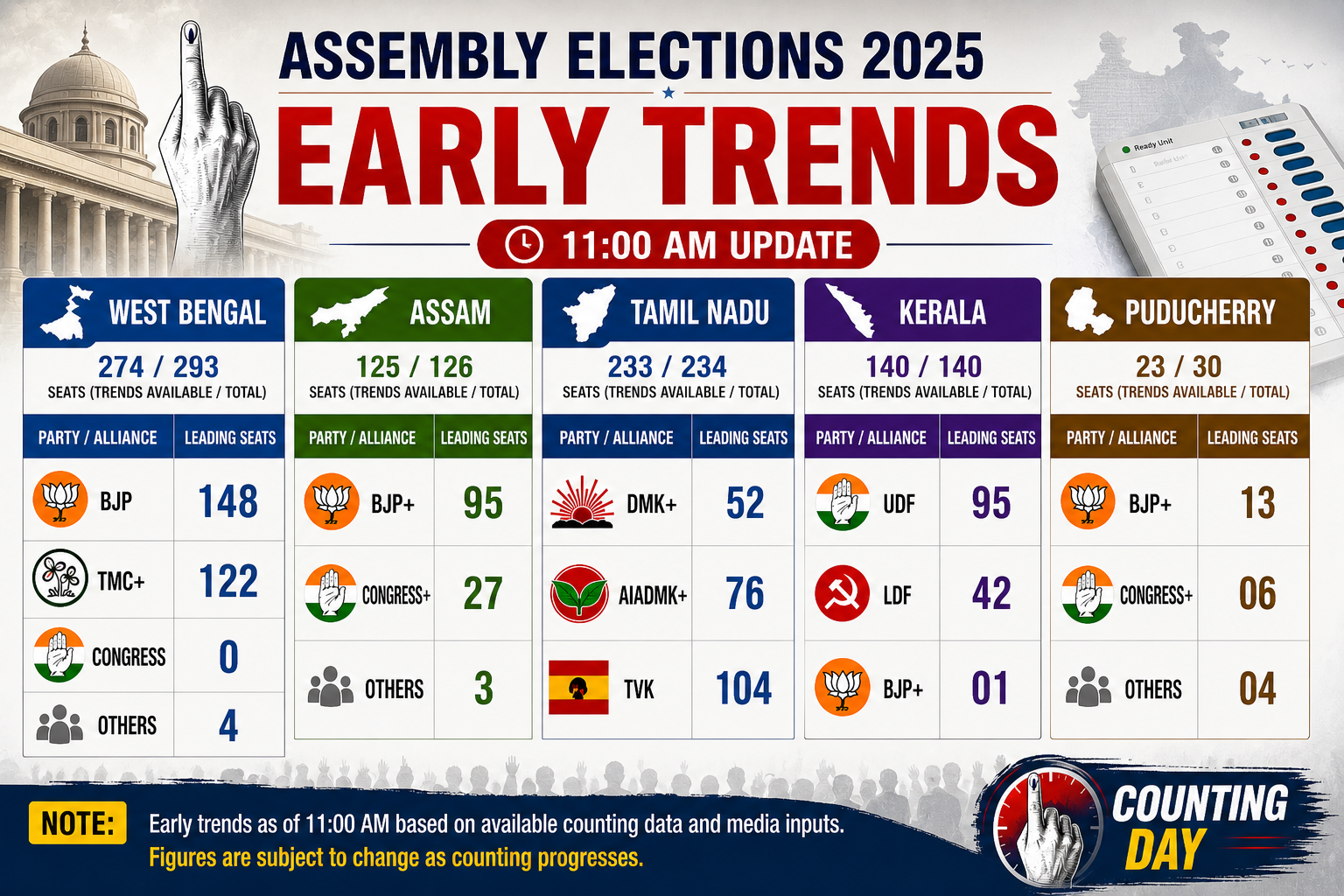
As of around 11:00 am, trends from Tamil Nadu show TVK leading in 104 of the 233 seats where counting is underway, significantly ahead of both the AIADMK alliance, which is leading in 76 seats, and the ruling DMK alliance, trailing with 52 seats. The scale of TVK’s performance marks the most striking development of the day, especially as pre-poll projections had largely favoured a DMK advantage in a three-cornered contest.

Vijay’s debut electoral outing has drawn attention for challenging established Dravidian parties directly. Unlike past actor-politicians such as M.G. Ramachandran or J. Jayalalithaa—who rose through existing party structures—a strong showing by TVK would signal a rare instance of a newly formed party converting individual popularity into immediate electoral success.

In eastern India, the Bharatiya Janata Party is closing in on forming the government in West Bengal. The party is leading in 148 of the 274 seats where trends are available, crossing the halfway mark in the 293-member Assembly. The ruling All India Trinamool Congress is trailing with 122 seats, while the Indian National Congress has not opened its account so far as per the trends being shown on Indian electronics media.

Speaking to journalists in Kolkata, senior BJP leader Suvendu Adhikari expressed confidence that his party would form the next government in the state, citing early trends that indicate a shift in voter patterns. He also pointed to a competitive contest in key constituencies, suggesting that traditional voting blocs may not be as consolidated as in previous elections.

In Assam, the BJP-led alliance continues to maintain a strong lead, ahead in 95 of the 125 seats where trends are available. The Congress-led alliance is trailing with 27 seats, while others are leading in three constituencies.

Meanwhile, in Kerala, trends for all 140 seats indicate a clear lead for the Congress-led United Democratic Front (UDF), which is ahead in 95 seats. The ruling Left Democratic Front (LDF) is leading in 42 seats, while the BJP-led alliance has opened its account with one seat. The results suggest a return to the state’s traditional pattern of alternating power between the two major alliances.

In Puducherry, the BJP-led alliance is ahead in 13 of the 23 seats where counting trends are available. The Congress-led alliance is leading in six seats, while others are ahead in four constituencies.

With counting still underway, the evolving trends point to both continuity and disruption—continuity in states like Assam and Kerala, and a potentially transformative shift in Tamil Nadu driven by the unexpected rise of TVK.

Early trends show BJP surge in Bengal, Assam and Puducherry, TVK in Tamil Nadu

New Delhi: Early trends from vote counting across four states and one Union Territory indicate a strong showing by the Bharatiya Janata Party in key regions, while regional parties appear to be holding ground in the south.

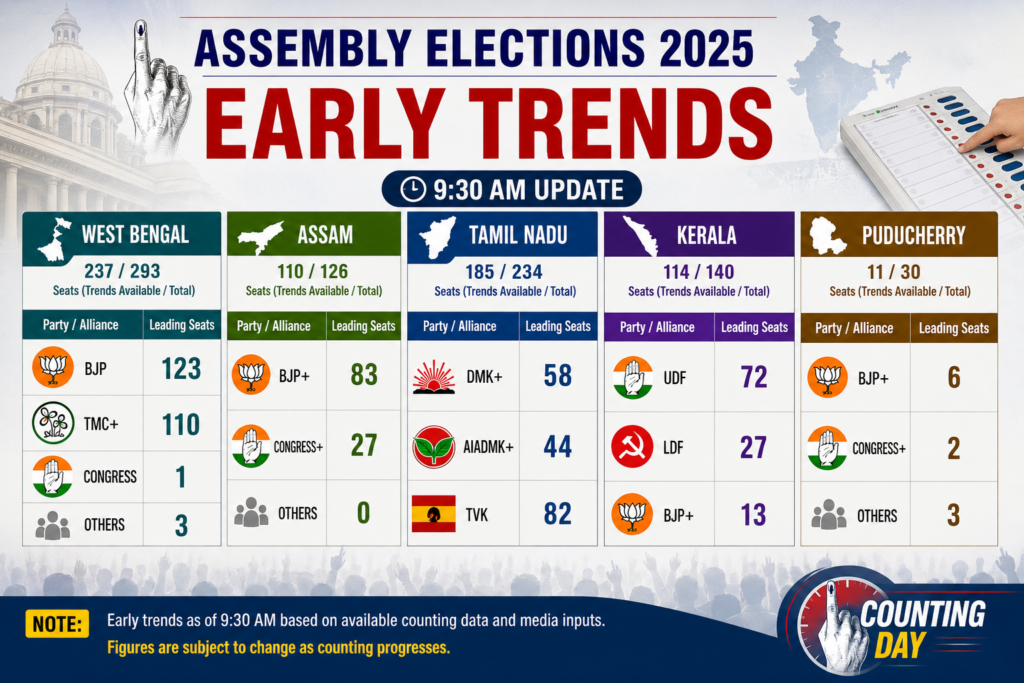
As of around 9:30 am, trends show the BJP leading comfortably in Assam, where it is ahead in 83 of the 110 seats for which trends are available. The Indian National Congress is trailing with leads in 27 seats.

In West Bengal, the BJP has taken an early lead in 123 of the 237 seats where counting trends have emerged, edging past the ruling All India Trinamool Congress, which is leading in 110 seats. The Congress is ahead in one seat so far.

Trends from Puducherry also indicate an early advantage for the BJP, which is leading in six of the 11 seats counted till now. The Congress is ahead in two seats, while other parties are leading in three constituencies.

In southern states, regional dynamics are more prominent. In Kerala, trends available for 114 seats show the opposition United Democratic Front (UDF), led by the Congress, ahead in 72 seats. The ruling Left Democratic Front (LDF) is leading in 27 seats, while the BJP alliance is ahead in 13 constituencies.

In Tamil Nadu, the ruling Dravida Munnetra Kazhagam (DMK) is leading in 58 of the 185 seats where trends are available, followed by the AIADMK alliance in 44 seats. A notable development is the strong early performance of actor-turned-politician Vijay’s party, Tamilaga Vettri Kazhagam (TVK), which is leading in 82 seats, emerging as a significant player in the state’s electoral landscape.

The counting of votes began earlier in the day amid tight security arrangements across all states. The results are expected to play a crucial role in shaping the broader political narrative ahead of upcoming national contests.

Odisha Gymnastics Championships ends on high note as sports minister pitches 2036 Olympics dream

Bhubaneswar: Odisha Sports & Youth Services Minister Suryabanshi Suraj has expressed strong confidence that India is on track to host the 2036 Olympics.

He underlined that events like the Junior and Senior Artistic Gymnastics National Championships are crucial stepping stones toward that ambition. He described the championship as a “launchpad” for nurturing future Olympic talent and proposed that Odisha’s advanced sports infrastructure be developed into a full-fledged Olympic Training Centre for the nation.

Emphasising discipline and patience, he urged athletes to prepare rigorously for global competition. He further asserted that, with continued support from the Central Government, Odisha is poised to build a distinct global identity in sports.

The remarks came as the women’s events of the Championships concluded at the Gymnastics High Performance Centre, Kalinga Stadium, in Bhubaneswar on Sunday. The competition witnessed high-quality performances, with gymnasts from across the country showcasing exceptional skill, balance, and composure on the final day.

Adding historical and cultural context, Puri Lok Sabha MP Sambit Patra highlighted Odisha’s legacy in physical training, linking the Paika Rebellion – considered one of the earliest armed uprisings against British rule – to the disciplined training traditions that resemble modern gymnastics. He also spoke about the importance of Puri’s Jagaghara culture and encouraged wider engagement with these traditional spaces.

On Sunday, the Balancing Beam event saw Niranjana Poonia of Haryana clinch the gold medal, followed by Anushka Patil of Maharashtra with silver and Priyanshi Bansal of Odisha securing bronze. In the Floor Exercise, Karishma representing Railways (RSPB) took gold, while Ashmi Debnath of West Bengal and Ishita Rewale of Maharashtra finished with silver and bronze respectively. Ishita Rewale, however, topped the Vault event to win gold, with Piyasa Kundu of Railways earning silver and Soumili Karar of West Bengal taking bronze. In the Uneven Bars, Odisha’s Tannu delivered a standout performance to claim gold, while Diya Thakor of Gujarat and Amani Dilshad of Kerala secured silver and bronze, respectively.

The Junior Women’s category also saw impressive performances. Anusuya Hawladar of West Bengal won gold in the Balancing Beam, while Sriparna Debnath of Tripura topped the Floor Exercise. Vaishnavi Vyas of Telangana secured gold in the Vault, and Paromita Bera of West Bengal emerged victorious in the Uneven Bars. Notably, Tripura’s Shreyanshi Ray delivered a consistent performance across events, winning multiple silver medals.

The championships concluded on a high note, reinforcing Odisha’s emergence as a key hub for gymnastics and competitive sports in India.