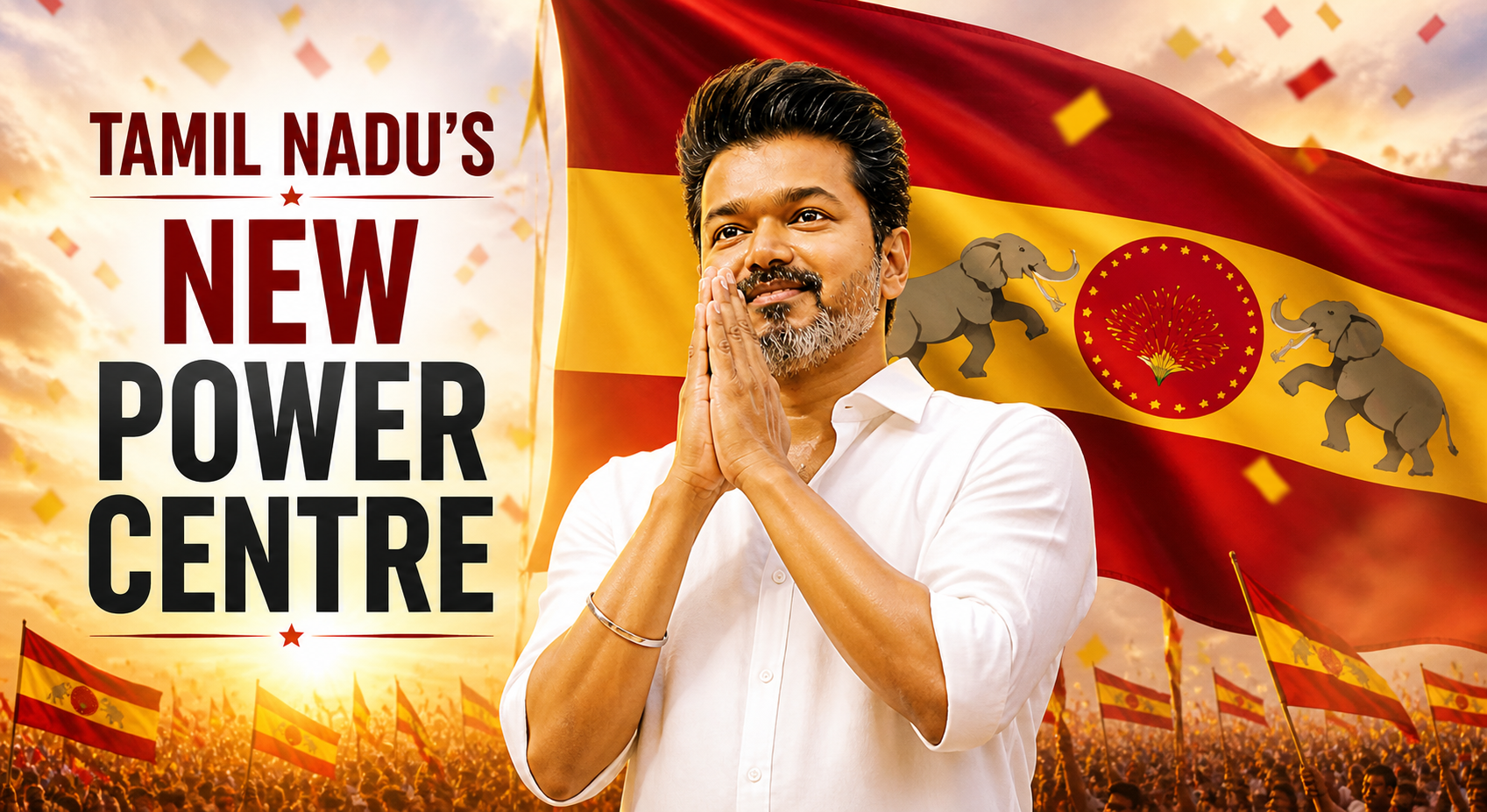

In its debut electoral test, TVK’s rapid rise reflects voter appetite for change, disrupting decades of bipolar politics and positioning Vijay as a key contender in government formation.
Actor-turned-politician Vijay has emerged as the biggest disruptor in Tamil Nadu’s political landscape, with early counting trends placing his party, Tamilaga Vettri Kazhagam (TVK), at the centre of a historic electoral moment.
As trends stabilised around midday, TVK was leading in over 100 seats, putting it within striking distance of the majority mark in the 234-member Tamil Nadu Assembly. For a party contesting its first full-fledged election, the scale of its performance marks a significant departure from the state’s long-standing bipolar political structure dominated by the DMK and AIADMK.
If these trends translate into final results, Vijay could become the first major film star in decades to directly convert personal popularity into electoral power through a newly formed party. Tamil Nadu has seen influential actor-politicians before—most notably M.G. Ramachandran, who became Chief Minister in 1977 after breaking away from the DMK—but subsequent stars have not managed to replicate that trajectory independently.
TVK’s rise has been neither sudden nor accidental. Vijay began consolidating his grassroots network more than a decade ago through his fan-based organisation, which gradually evolved into a structured social and civic platform. Over time, this network expanded its presence at the local level through welfare activities, building familiarity among voters beyond cinema audiences.
His eventual political entry was marked by a clear strategic choice—to contest without pre-poll alliances and position TVK as an alternative to the entrenched Dravidian parties. The campaign focused heavily on issues such as employment, education, corruption and governance, themes that resonated particularly with younger and urban voters.
Unlike traditional mass leaders in the state, Vijay avoided aggressive rhetoric, instead projecting a more measured, accessible leadership style. His outreach relied on controlled public engagements and strong digital communication, signalling a shift in campaign methods.
The current election has also tested the strength of this organisational model. With TVK candidates performing strongly across regions, the party has demonstrated its ability to translate support into votes—a challenge that has historically limited celebrity-led political ventures.
Even if the party falls short of an outright majority, its current position places it at the centre of government formation discussions. More importantly, it has already altered the competitive landscape by introducing a credible third force into Tamil Nadu politics.
The broader significance of this moment lies in what it represents—a shift from personality-driven politics rooted solely in cinema to a more structured, issue-based mobilisation backed by organisational groundwork. Whether or not Vijay ultimately assumes office, the 2026 election appears set to redefine the contours of political competition in the state.