
Updated at 22:00 hrs
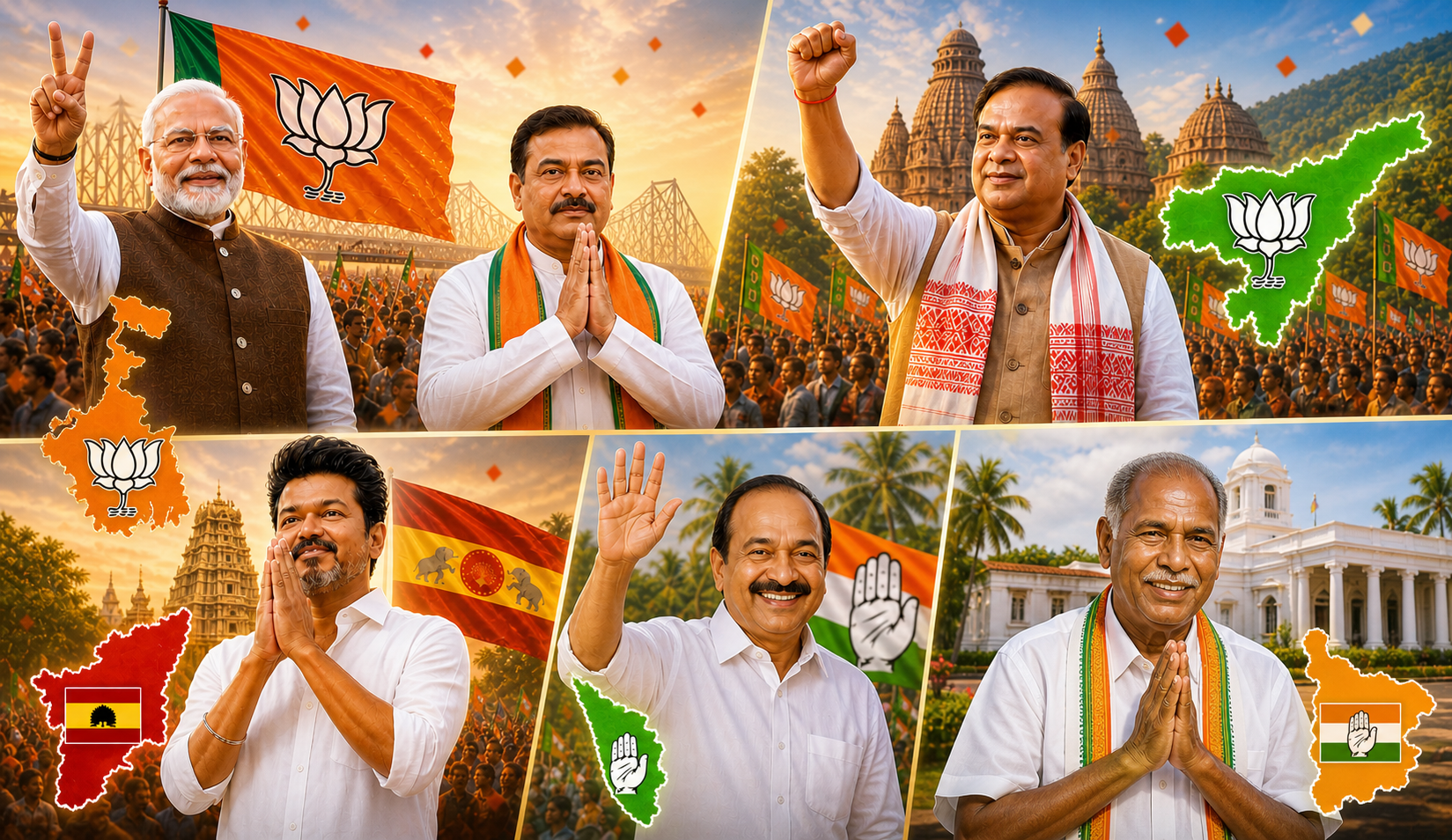
New Delhi: Final trends and results across key states have delivered a decisive and politically transformative verdict, with the Bharatiya Janata Party securing a sweeping victory in West Bengal by crossing the 200-seat mark, while actor-politician Vijay’s Tamilaga Vettri Kazhagam (TVK) emerged as the single largest force in Tamil Nadu, breaking the state’s long-standing Dravidian duopoly.
In Assam, the BJP-led alliance retained power comfortably, while in Kerala, the Congress-led United Democratic Front (UDF) returned to power with a clear majority, ending the Left Democratic Front’s tenure. In Puducherry, the NDA alliance led by the BJP and its partners moved ahead towards forming the government, completing a day of sharply divergent but decisive electoral outcomes across regions.
Addressing party workers at the BJP headquarters in Delhi, Prime Minister Narendra Modi underlined the scale of the victory and linked it to a broader political trend across the Ganga belt. “From Gangotri to Gangasagar, the lotus has bloomed everywhere… and now West Bengal,” he said, adding, “A journey for the future of Bengal is beginning today, one where development, steadfast trust, and new hopes will march forward hand-in-hand.”
In his victory speech broadcast live on BJP social media channels, Modi also highlighted governance priorities, stating, “In Bengal, women will now find an environment of safety, and the youth will find employment… In the very first cabinet meeting, the Ayushman Bharat scheme will be given the green signal.”
The Lotus blooms in West Bengal!
— Narendra Modi (@narendramodi) May 4, 2026
The 2026 West Bengal Assembly Elections will be remembered forever. People's power has prevailed and BJP's politics of good governance has triumphed. I bow to each and every person of West Bengal.
The people have given a spectacular mandate to…
The Prime Minister’s appearance in traditional Bengali attire during the speech was widely seen as a symbolic gesture acknowledging the state’s cultural identity.
Taking on to social media, Modi wrote on X, “The people have given a spectacular mandate to BJP and I assure them that our Party will do everything possible to fulfil the dreams and aspirations of the people of West Bengal. We will provide a Government that ensures opportunity and dignity to all sections of society.”
In a major setback for the Trinamool Congress, Chief Minister Mamata Banerjee lost the high-profile Bhabanipur seat to BJP’s Suvendu Adhikari by a margin exceeding 15,000 votes. The contest, which saw dramatic shifts through multiple counting rounds, ended with the BJP candidate overturning an early deficit. Banerjee, however, rejected the outcome, alleging irregularities and stating that her party would “bounce back.”
Meanwhile, in Kerala, the Congress-led United Democratic Front (UDF) moved towards a comfortable victory, ending the tenure of the Left Democratic Front (LDF). Trends showed the UDF securing a clear majority in the 140-member Assembly, signalling a return to the state’s pattern of alternating governments.
BJP sweeps Bengal, Asam as TVK dominates Tamil Nadu in dramatic political shift
May 04, 2026 (18:30 hrs)
New Delhi: With counting nearing completion, trends as of 5 PM indicate decisive outcomes across key states, with the Bharatiya Janata Party poised for a commanding victory in West Bengal and actor-politician Vijay’s Tamilaga Vettri Kazhagam (TVK) emerging as the biggest disruptor in Tamil Nadu.
In West Bengal, results and trends available on Election Commission of India portal show the BJP winning in 12 and leading in 188 constituencies out of the toal 294 seats, comfortably crossing the majority mark and positioning itself to form the next government. The ruling All India Trinamool Congress was trailing with just one win and 87 leads, while the Indian National Congress was leading in just two seats. Others are ahead in three seats.
Leader of Opposition Suvendu Adhikari expressed confidence in the outcome, stating that the BJP would form the government. He also signalled a strong personal contest, asserting that he would win decisively. But as of now, Mamata Banerjee is leading in the Bhavanipur constituency with 46726 votes.
Echoing the party’s confidence, senior BJP leader Dharmendra Pradhan said the mandate reflects a rejection of fear-based politics and represents the aspirations of voters across Bengal, from northern districts to coastal regions.
In Assam, the BJP-led alliance is maintaining its dominance, leading in 62 seats and winning 20 constituencies. Asom Gana Parishad (AGP) has won 1 and is leading in 8 more seats, making the NDA totalig over 100 seats out of the 126 seats. The Congress-led alliance is trailing with 19 leads, while others account for two seats. In a notable contest, Congress leader Gaurav Gogoi lost from Jorhat, underlining the broader electoral setback for the party in the state.
The most striking development of the election, however, has come from Tamil Nadu. TVK has won 8 seats and was leading in 101 others in the 234-seat assembly, emerging as the single largest force in the state. The AIADMK alliance is ahead in 53 seats, while the ruling DMK alliance is trailing with 72 seats. The scale of this surge marks a dramatic shift in a state long dominated by the DMK-AIADMK binary.
Vijay’s performance is being seen as a rare political breakthrough, where a newly formed party has rapidly translated public appeal into electoral traction. The results suggest a consolidation of new voter blocs, particularly among younger voters and those seeking an alternative to established political formations.
In Kerala, the Congress-led United Democratic Front (UDF) was leading in 99 of the 140 seats, signalling a return to power. The ruling Left Democratic Front (LDF) is trailing with 35 seats, while the BJP-led alliance is ahead in three constituencies. State Congress leaders indicated that the trends reflect a clear pro-UDF sentiment.
Meanwhile, in Puducherry, the BJP-led alliance is ahead in 17 of the 30 seats, followed by the Congress-led alliance with eight seats and others leading in five constituencies.
𝐅𝐫𝐨𝐦 𝐭𝐡𝐞 𝐡𝐞𝐚𝐫𝐭𝐥𝐚𝐧𝐝 𝐭𝐨 𝐁𝐞𝐧𝐠𝐚𝐥, 𝐭𝐡𝐞 𝐦𝐚𝐩 𝐢𝐬𝐧’𝐭 𝐣𝐮𝐬𝐭 𝐞𝐱𝐩𝐚𝐧𝐝𝐢𝐧𝐠, 𝐢𝐭’𝐬 𝐭𝐡𝐞 𝐛𝐞𝐥𝐢𝐞𝐟 𝐨𝐟 𝐚 𝐧𝐚𝐭𝐢𝐨𝐧 𝐝𝐞𝐭𝐞𝐫𝐦𝐢𝐧𝐞𝐝 𝐭𝐨 𝐩𝐫𝐨𝐠𝐫𝐞𝐬𝐬.
— BJP (@BJP4India) May 4, 2026
North to Northeast, the colour shift is no longer subtle. Bengal is simply the… pic.twitter.com/QODKYqCyU1
While the Prime Minister is scheduled to address the BJP workers in the evening from the Party headquarters here, the part said in a post on X that its expanding presence from the heartland to Bengal reflects a growing belief among people in a nation committed to progress.
The party added that the political shift from North to the Northeast is now clearly visible, with Bengal marking the latest chapter in this broader trend, while reiterating its vision of building a “Viksit Bharat” by 2047 through collective effort
Reacting to the broader trends, senior BJP leader Keshav Prasad Maurya said voters across states have rejected opposition leaders and aligned with development-driven politics. He attributed the party’s performance to the leadership of Narendra Modi and emphasised that issues of national interest, governance and security were resonating with voters.
As counting progresses towards finality, the trends point to a dual political narrative—consolidation of BJP’s dominance in eastern and northeastern India, and a major structural shift in Tamil Nadu led by TVK’s unprecedented rise.