At IndiaVerve, we go beyond the noise to bring you meaningful stories of change, resilience and progress—from India to the world stage. Our mission is to bring readers credible, wide-ranging coverage across politics, business, sports, culture, society and more.

Indian Navy commissions INS Nipun to boost submarine rescue capabilities

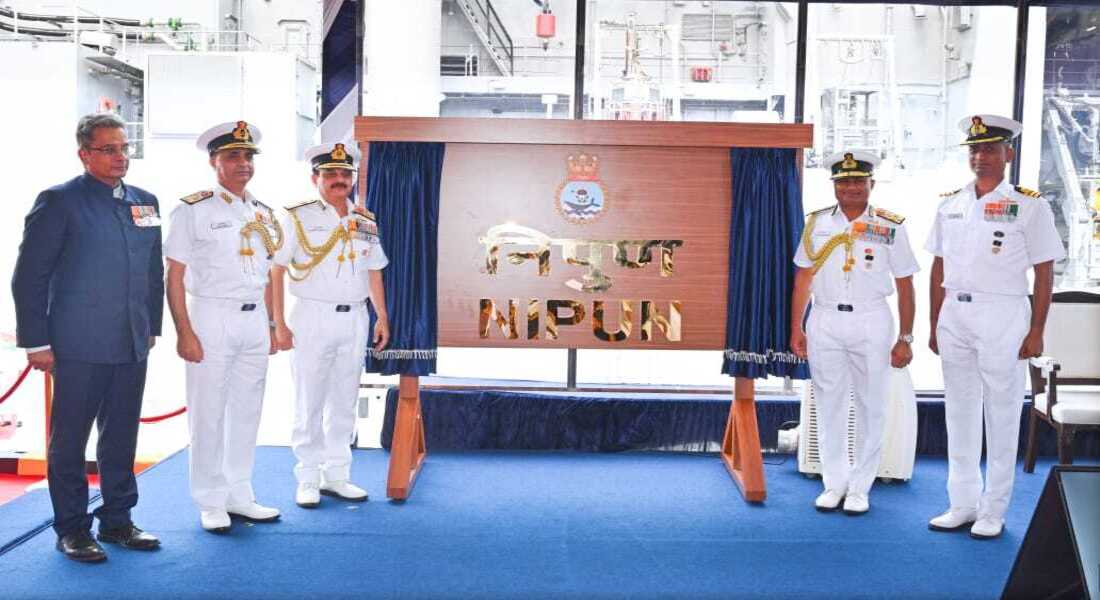
New Delhi: The Indian Navy commissioned INS Nipun, the second Diving Support Vessel (DSV) of the Nistar Class, at Naval Dockyard, Mumbai, on Monday.

The induction strengthens the Navy’s capabilities in deep-sea diving, underwater intervention, salvage and submarine rescue operations.

The commissioning ceremony was presided over by Chief of the Naval Staff (CNS) Admiral Krishna Swaminathan. Vice Admiral Sanjay Vatsayan, Flag Officer Commanding-in-Chief, Western Naval Command, also attended the ceremony.

Senior naval officers, representatives of Hindustan Shipyard Limited (HSL), veterans, distinguished guests and families of the commissioning crew were present at the event.

INS Nipun has been indigenously designed and constructed by HSL in Visakhapatnam. Its induction highlights India’s growing ability to design and build technologically complex specialist naval platforms, according to an official statement.

The vessel also represents another step towards Aatmanirbharta in defence shipbuilding. Its construction involved Indian shipyards, domestic industry and associated agencies supporting the Navy’s indigenous capabilities.

INS Nipun has been purpose-built for deep-sea diving and underwater operations. The vessel can support saturation, air and heliox diving and is equipped with remotely operated underwater systems for inspection and intervention.

Its specialised diving complex is supported by dynamic positioning, life-support systems and medical facilities. These capabilities allow the vessel to undertake sustained and complex underwater operations at sea.

A key role of INS Nipun will be supporting submarine rescue operations. Along with its sister ship INS Nistar, the vessel significantly strengthens the Indian Navy’s specialist capabilities in diving, underwater intervention, salvage and submarine rescue.

The vessel’s crest carries the motto ‘Far Beneath, Few Beyond’, reflecting the skill, endurance and resolve required for operations in the depths of the maritime environment.

Speaking at the commissioning ceremony, Swaminathan highlighted the close coordination between the Indian Navy, HSL and the domestic industrial network behind the vessel’s induction.

He pointed to the successful demonstration of all diving systems during sea trials in a single sortie as evidence of India’s technical confidence and engineering capability.

The CNS also stressed that combat readiness remains the Indian Navy’s highest priority amid an increasingly contested maritime environment and growing threats to global maritime highways.

Based on India’s West Coast under the Western Naval Command, INS Nipun will add to the specialised underwater capabilities needed to support multi-domain operations.

The Navy chief also highlighted the vessel’s specialised capabilities, which are available with only a limited number of navies worldwide.

These capabilities will allow India to respond swiftly to distressed submarines belonging to the Indian Navy as well as partner nations. They also strengthen India’s position as a preferred submarine rescue partner in the region.

Beyond submarine rescue, INS Nipun will provide specialised support for underwater salvage operations and Humanitarian Assistance and Disaster Relief missions.

Addressing the commissioning crew, the CNS emphasised their responsibility to develop the ship’s operational spirit and make effective use of its sophisticated capabilities.

He urged the crew to uphold the vessel’s motto of ‘Nischay, Nirbhay, Nipun’, representing resolve, fearlessness and professional mastery, while remaining guided by the naval values of duty, honour and courage.

With the hoisting of the Commissioning Pennant, INS Nipun formally entered operational service with the Indian Navy.

The vessel is now ready to support underwater operations and contribute to safeguarding India’s maritime interests.


India’s GDP grows 7.8% in Q1 FY27 as manufacturing and investment strengthen

New Delhi: India’s real GDP grew 7.8% in the first quarter of financial year 2026-27, with manufacturing, services and investment activity supporting economic growth despite global uncertainties.

Real GDP at constant 2022-23 prices was estimated at Rs 81.36 lakh crore in the April-June quarter, compared with Rs 75.46 lakh crore in the corresponding quarter of FY2025-26.

Nominal GDP at current prices stood at Rs 88.27 lakh crore, registering 10.3% growth from ₹80 lakh crore in the year-ago quarter.

Real GVA grew 8.2% during Q1 FY27 to Rs 73.82 lakh crore from Rs 68.21 lakh crore a year earlier. Nominal GVA increased 11.5% to Rs 80.53 lakh crore, according to an official statement.

The latest figures show continued strength across key parts of the economy, with manufacturing and investment emerging as important contributors to growth.

Manufacturing growth accelerated to 9.2% in Q1 FY27 from 8.3% in the same quarter of the previous financial year.

The financial, real estate, IT and professional services segment recorded 12.1% growth, compared with 8.8% a year earlier.

Agriculture and allied activities grew 3.6% during the quarter. The pace was lower than the 4.4% growth recorded in the corresponding quarter of FY2025-26.

On the expenditure side, gross fixed capital formation, which reflects investment activity, grew 11.9% in Q1 FY27. This was significantly higher than the 5.8% growth recorded in the same quarter last year.

The economy’s performance came amid heightened global uncertainty and disruptions linked to the West Asia conflict. Several indicators continued to show resilience, although some high-frequency measures recorded moderation during the quarter.

The Index of Industrial Production, services Purchasing Managers’ Index, domestic aviation traffic and bank credit improved sequentially from the previous quarter.

At the same time, manufacturing PMI, GST e-way bills, urban and rural automobile sales, fuel consumption and demand under rural job-guarantee programmes weakened during the quarter.

The latest GDP estimates were released under the new National Accounts Statistics series, which uses 2022-23 as the base year. MoSPI introduced the new annual and quarterly GDP series on February 27, 2026.

The ministry had subsequently released the Provisional Estimates of GDP for FY2025-26 on June 5, 2026.

The revised series has also updated quarterly GDP estimates from Q1 FY2022-23 to Q4 FY2025-26. The updated estimates incorporate the new series of the Output Producer Price Index and Index of Industrial Production, along with revised administrative data.

A major methodological change in the new national accounts series is the adoption of the Double Deflation approach for estimating manufacturing GVA.

Under this method, manufacturing output and intermediate consumption are separately deflated using the relevant Producer Price Indices. Real GVA is then calculated from the difference between real output and real intermediate consumption.

MoSPI said the approach provides a more robust assessment of real value added by capturing price changes in both manufacturing output and inputs.

The ministry also noted that the implicit price deflator for manufacturing GVA can decline or turn negative even when both output and input prices increase. This can happen when input prices rise faster than output prices due to supply-side shocks and changing margins.

A detailed explanation of the methodology and data sources used for the estimates will be provided in the Sources and Methods publication scheduled for release in September 2026.

The Q1 FY27 data shows that India’s economy maintained strong growth momentum, with manufacturing, services, and investment activity providing significant support during the quarter.

Usha Padhee reviews Kalibeti, Mudamba industrial estates in Khordha

Bhubaneswar: Additional Chief Secretary of the Housing and Urban Development Department and Odisha Industrial Infrastructure Development Corporation (IDCO) Chairperson, Usha Padhee, reviewed infrastructure development at the Kalibeti and Mudamba Industrial Estates in Khordha district.

Padhee conducted an extensive field inspection of both industrial estates to assess their preparedness for operationalisation. The review covered master planning, industrial plot allocation, land development and ongoing infrastructure works.

She was accompanied by IDCO Chief General Manager (Land) Saroj Sahu, the concerned Land Officer, and senior officials from the respective divisions.

During the inspection, Padhee directed officials to ensure meticulous planning, time-bound execution and regular field-level monitoring. She also called for the early identification and resolution of bottlenecks related to land, utilities and supporting infrastructure.

The IDCO chairperson said industrial infrastructure should be developed into functional and investor-ready ecosystems within defined timelines. She stressed the need for integrated planning covering land, utilities, mobility and environmental sustainability.

Padhee also emphasised sustainable water management in developing the industrial estates. She directed officials to incorporate rainwater harvesting and water recycling systems into the core infrastructure plans.

The inspection also focused on workforce mobility, particularly the commuting needs of women workers. Padhee directed the concerned authorities to extend Ama Bus public transport connectivity to the Kalibeti and Mudamba Industrial Estates.

She said safe, reliable and accessible public transport would help workers commute without difficulty, particularly women employed in apparel, textile and other manufacturing units.

Improved public transport connectivity would also strengthen access to employment opportunities for people living in surrounding areas, according to the officials.

Padhee further called for close coordination among IDCO divisions and stakeholder agencies to address field-level issues promptly. She stressed that infrastructure works should progress in a coordinated manner and remain aligned with approved plans and timelines.

Regular inspections and continuous monitoring were also emphasised to ensure timely implementation of the planned infrastructure.

The field inspection underlines IDCO’s focus on developing industrial estates with infrastructure, sustainability, and workforce requirements integrated into the planning process.

The objective is to create well-planned and investor-ready industrial destinations in Odisha while supporting industrial growth and expanding employment opportunities.

Iran retaliates with missile strikes on US bases in Jordan

New Delhi: Iran has launched ballistic missile strikes against US-operated airbases in Jordan after Washington attacked Iranian rocket launchers on Larak Island in the Strait of Hormuz.

The latest exchange marks a sharp escalation in the Iran war after weeks of reduced fighting. It came shortly after the conflict crossed the six-month mark and as diplomatic efforts to end the hostilities remained stalled.

The US said its forces struck two Iranian launchers on Larak Island earlier on Sunday. A US official said American forces had observed Islamic Revolutionary Guard Corps personnel preparing to launch rockets carrying sea mines into the Strait of Hormuz.

Iran’s Revolutionary Guards (IRGC) said the US strike killed and wounded several soldiers and civilians. The IRGC warned that Tehran would respond to the attack.

Iranian state television later reported that the IRGC had launched ballistic missiles at US-operated positions at the King Hussein and al-Azraq airbases in Jordan.

According to the report, the strikes targeted technical infrastructure, maintenance facilities, and positions used by fighter aircraft. Iranian state media claimed that the attacks caused heavy damage.

An Iranian spokesperson said the US would face economic and military consequences for the attack.

According to the guardian.com, the initial US strike on Larak Island was carried out using drones.

However, the US said on Sunday night that incoming missiles directed at US forces in Jordan had been intercepted. It said there had been no significant impact from the Iranian attack at that point.

The latest confrontation is closely linked to the strategic importance of the Strait of Hormuz. Washington said its operation against the Iranian launchers was intended to prevent Tehran from placing additional sea mines in the waterway.

The US had announced days earlier that it had completed operations to clear explosives from the strait. US President Donald Trump had also warned Iran that any ship or boat attempting to lay new mines in international waters would be destroyed.

The Strait of Hormuz has remained a major pressure point throughout the conflict. Before the war, the waterway carried roughly one-fifth of the world’s consumed oil supplies.

The latest strikes also threaten to disrupt efforts to contain the conflict. The last known US attacks on Iran had taken place in late July, while the broader war had entered a period of stalemate in recent weeks.

Washington has meanwhile threatened tougher sanctions against countries that continue to support Tehran. The US administration has also described its pressure campaign against Iran as economic warfare.

The current war began on February 28, when the US and Israel launched attacks against Iran. Tehran responded with strikes against Israel and Gulf states hosting US military facilities.

A ceasefire was reached in April, while a memorandum of understanding aimed at establishing a final peace agreement was signed in June. However, the diplomatic process has failed to produce a lasting settlement.

Pakistan and Qatar have been among the countries involved in mediation efforts, but months of negotiations have yet to deliver a comprehensive agreement.

The latest US-Iran exchange therefore comes at a sensitive moment, with the Strait of Hormuz remaining both a military flashpoint and a major concern for global energy supplies.