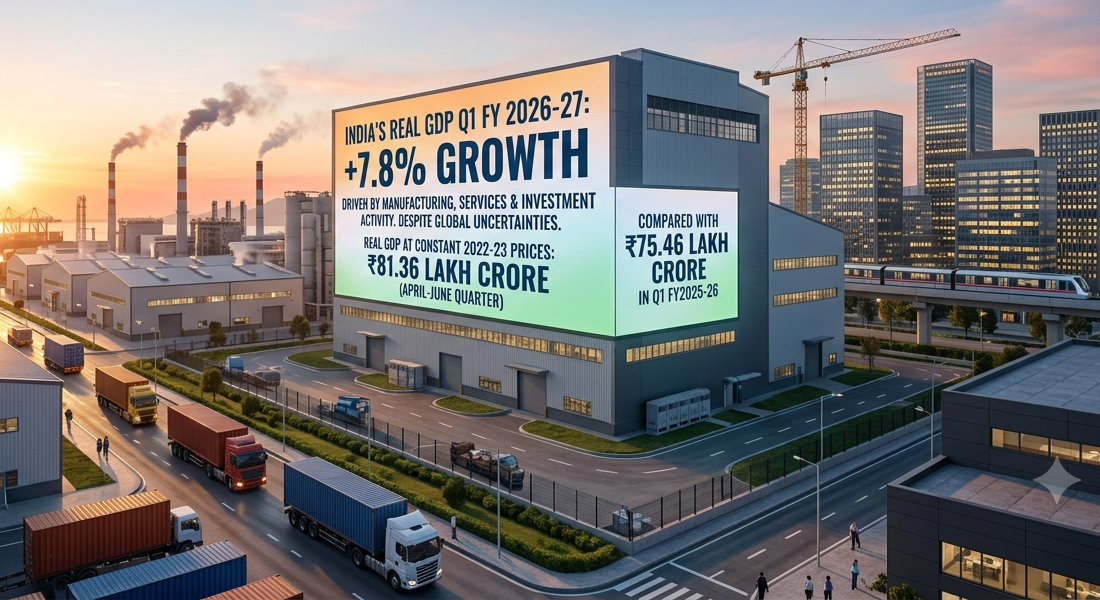

New Delhi: India’s real GDP grew 7.8% in the first quarter of financial year 2026-27, with manufacturing, services and investment activity supporting economic growth despite global uncertainties.
Real GDP at constant 2022-23 prices was estimated at Rs 81.36 lakh crore in the April-June quarter, compared with Rs 75.46 lakh crore in the corresponding quarter of FY2025-26.
Nominal GDP at current prices stood at Rs 88.27 lakh crore, registering 10.3% growth from ₹80 lakh crore in the year-ago quarter.
Real GVA grew 8.2% during Q1 FY27 to Rs 73.82 lakh crore from Rs 68.21 lakh crore a year earlier. Nominal GVA increased 11.5% to Rs 80.53 lakh crore, according to an official statement.
The latest figures show continued strength across key parts of the economy, with manufacturing and investment emerging as important contributors to growth.
Manufacturing growth accelerated to 9.2% in Q1 FY27 from 8.3% in the same quarter of the previous financial year.
The financial, real estate, IT and professional services segment recorded 12.1% growth, compared with 8.8% a year earlier.
Agriculture and allied activities grew 3.6% during the quarter. The pace was lower than the 4.4% growth recorded in the corresponding quarter of FY2025-26.
On the expenditure side, gross fixed capital formation, which reflects investment activity, grew 11.9% in Q1 FY27. This was significantly higher than the 5.8% growth recorded in the same quarter last year.
The economy’s performance came amid heightened global uncertainty and disruptions linked to the West Asia conflict. Several indicators continued to show resilience, although some high-frequency measures recorded moderation during the quarter.
The Index of Industrial Production, services Purchasing Managers’ Index, domestic aviation traffic and bank credit improved sequentially from the previous quarter.
At the same time, manufacturing PMI, GST e-way bills, urban and rural automobile sales, fuel consumption and demand under rural job-guarantee programmes weakened during the quarter.
The latest GDP estimates were released under the new National Accounts Statistics series, which uses 2022-23 as the base year. MoSPI introduced the new annual and quarterly GDP series on February 27, 2026.
The ministry had subsequently released the Provisional Estimates of GDP for FY2025-26 on June 5, 2026.
The revised series has also updated quarterly GDP estimates from Q1 FY2022-23 to Q4 FY2025-26. The updated estimates incorporate the new series of the Output Producer Price Index and Index of Industrial Production, along with revised administrative data.
A major methodological change in the new national accounts series is the adoption of the Double Deflation approach for estimating manufacturing GVA.
Under this method, manufacturing output and intermediate consumption are separately deflated using the relevant Producer Price Indices. Real GVA is then calculated from the difference between real output and real intermediate consumption.
MoSPI said the approach provides a more robust assessment of real value added by capturing price changes in both manufacturing output and inputs.
The ministry also noted that the implicit price deflator for manufacturing GVA can decline or turn negative even when both output and input prices increase. This can happen when input prices rise faster than output prices due to supply-side shocks and changing margins.
A detailed explanation of the methodology and data sources used for the estimates will be provided in the Sources and Methods publication scheduled for release in September 2026.
The Q1 FY27 data shows that India’s economy maintained strong growth momentum, with manufacturing, services, and investment activity providing significant support during the quarter.