
A new study suggests asteroid impacts may have carried Earth’s microbes to Venus for billions of years, raising intriguing questions about the origin of extraterrestrial life.
What if the first signs of life discovered on another planet were actually… ours?
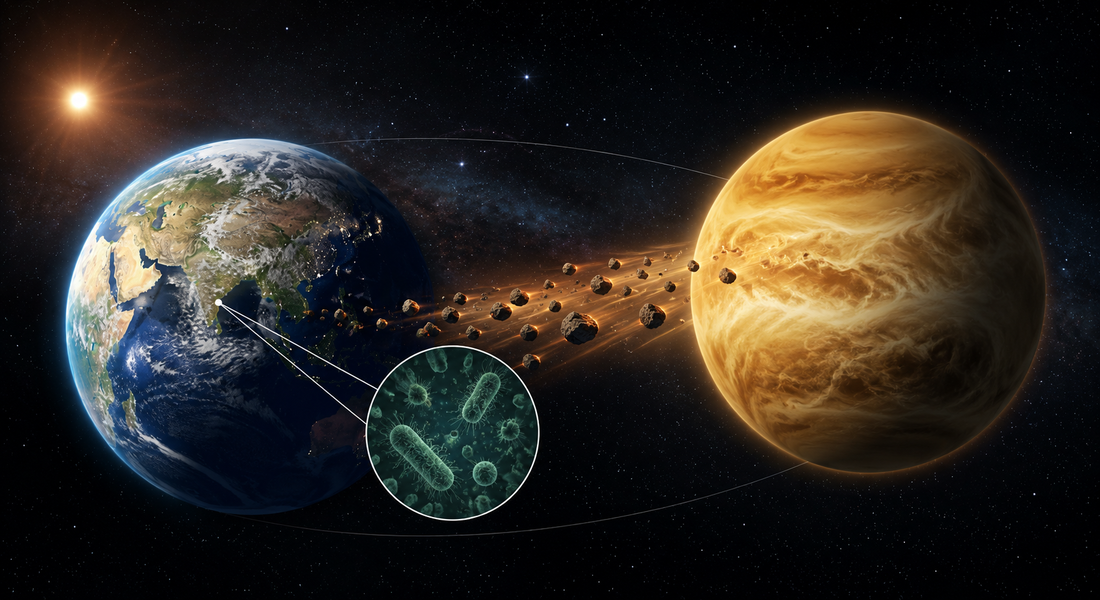
A new scientific study suggests that Earth may have been sending microscopic life to Venus for billions of years. According to researchers, powerful asteroid impacts could have blasted rocks carrying hardy microbes into space, with some eventually reaching Venus and surviving within its mysterious cloud layers. If future missions detect life there, scientists say one possibility is that it may have originated on Earth rather than on Venus itself.
According to a study presented at the 2026 Lunar and Planetary Science Conference (LPSC), researchers from The Johns Hopkins University Applied Physics Laboratory (JHUAPL) and Sandia National Laboratories explored whether microscopic organisms could survive the journey from Earth to Venus. Their findings were reported by Universe Today in an article written by Matthew Williams.
The research is based on the theory of panspermia, which proposes that life—or its basic building blocks—can spread between planets aboard asteroids, comets and other rocky debris. Scientists have previously explored this possibility between Earth and Mars. The latest study extends the idea to Venus, whose cloud layers have attracted growing scientific interest as a potential habitat for microbial life.
To estimate the possibility of life reaching Venus, researchers used the Venus Life Equation (VLE), a scientific framework developed in 2021. Similar in concept to the famous Drake Equation, the VLE combines several factors to estimate the likelihood of existing life by evaluating its origin, resilience and the continuity of habitable conditions.
The team first examined whether microscopic organisms could survive the violent process of being blasted off Earth’s surface during an asteroid impact, followed by prolonged exposure to the vacuum of space, radiation and extreme temperatures. Previous studies and meteorite analyses have suggested that organic material can withstand such harsh conditions, ScienceDaily reported.
Researchers then modelled how Earth-origin rocks, known as bolides, would behave after entering Venus’ dense atmosphere. Using a widely accepted atmospheric fragmentation model, they calculated whether fragments carrying microbes could remain suspended in the planet’s cloud layers rather than being destroyed during atmospheric entry.
According to the study, hundreds of billions of microscopic fragments may have reached Venus over geological timescales. The researchers’ preferred estimate suggests that around 100 viable microbial “cells” could be dispersed into Venus’ atmosphere every year. Over the past one billion years, as many as 20 billion such cells may have been transferred from Earth.
The researchers caution that considerable uncertainty remains in their calculations and acknowledge that several variables in the Venus Life Equation are still poorly understood. They also emphasise that the study does not prove life exists on Venus.
However, the findings provide a compelling explanation that scientists may need to consider if future missions discover microbial life in Venus’ atmosphere. Rather than evolving independently on Venus, that life could potentially be descendants of microscopic organisms that first evolved on Earth and later made an extraordinary interplanetary journey.
The study also highlights how planetary collisions may have played a far greater role in spreading life across the Solar System than previously imagined, opening new avenues for research into humanity’s oldest question: Are we truly alone?