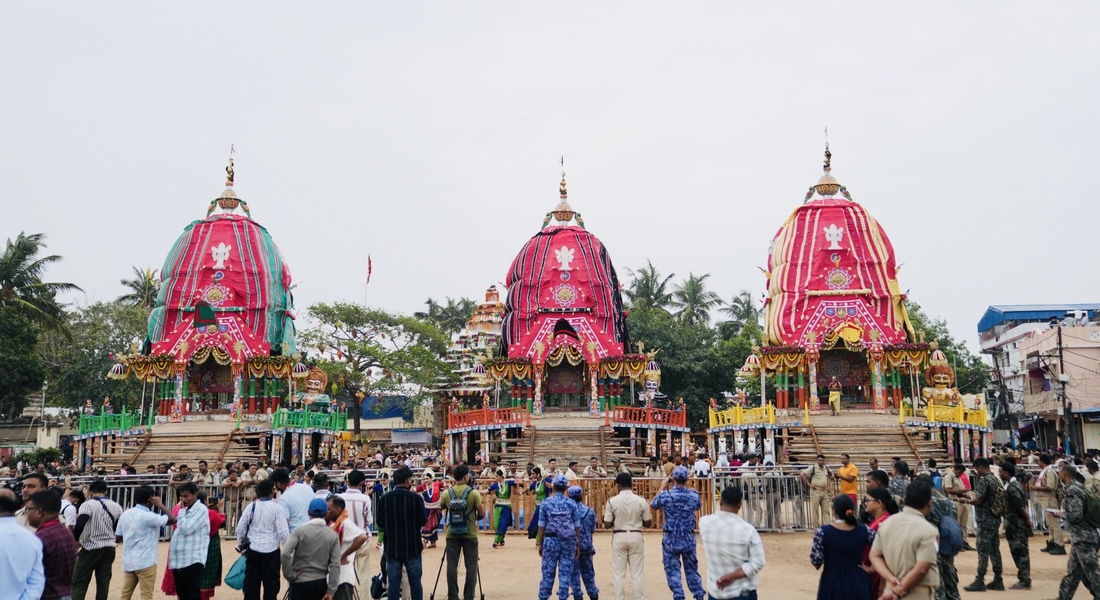

Puri: Lakhs of devotees converged on the holy town of Puri on Friday as the Bahuda Yatra, the return journey of Lord Jagannath, Lord Balabhadra and Devi Subhadra from the Gundicha Temple to the Shree Jagannath Temple, commenced amid elaborate security and administrative arrangements.
The Bahuda Yatra, one of the most significant events of the annual Rath Yatra festival, marks the return of the sibling deities to the 12th-century Srimandir after their week-long stay at the Gundicha Temple. Devotees from across Odisha and different parts of the country began arriving in Puri from the early hours of the day, with the Grand Road (Bada Danda) witnessing a massive influx of pilgrims.
The day’s rituals began at the Gundicha Temple with the traditional Pahandi ceremony, during which the deities were ceremonially brought out and placed on their respective chariots. The Gajapati Maharaja of Puri was scheduled to perform the customary Chhera Pahanra ritual before devotees pull the three chariots towards the Srimandir.
The chariot procession is scheduled to take place between 10 am and 6 pm, with the three majestic chariots travelling along the Grand Road to the Lion’s Gate (Singhadwara) of the temple.
Anticipating one of the largest gatherings of the festival, the Puri district administration, Shree Jagannath Temple Administration (SJTA) and Odisha Police have put in place extensive security, traffic regulation and crowd management measures to ensure the smooth conduct of the event.
Security personnel have been deployed at strategic locations across the town, with special emphasis on regulating pilgrim movement and preventing overcrowding along the chariot route. Multi-layered security, medical assistance centres, emergency response teams, drinking water facilities and public assistance booths have also been established to facilitate devotees.
As part of the traffic management plan, authorities have created 31 dedicated parking zones in and around Puri. These facilities can accommodate around 7,330 light motor vehicles and more than 18,000 two-wheelers. Additional traffic diversions and special arrangements have also been made for vehicles entering the town from the Bhubaneswar side to minimise congestion.
Officials have also expressed concern over weather conditions, with the India Meteorological Department (IMD) forecasting light to moderate rainfall across several parts of Odisha till July 28 under the influence of an active southwest monsoon and a trough line. Authorities have urged devotees to remain cautious and cooperate with officials in case of rain during the procession.
The administration has appealed to pilgrims to follow traffic advisories and security instructions to ensure the safe and orderly conduct of the festival.
One of the most poignant moments of the Bahuda Yatra is the traditional halt of Lord Jagannath’s Nandighosha chariot near the Samadhi Pitha of the 17th-century saint-poet Salabega on the Grand Road.
Salabega, regarded as one of the greatest devotees of Lord Jagannath, was the son of Mughal Subedar Lalbeg and a Hindu mother. According to popular belief, Salabega was unable to reach Puri in time during one Rath Yatra and fervently prayed for a glimpse of the Lord. Moved by his devotion, Lord Jagannath’s chariot is believed to have halted on its own until the poet arrived to offer his prayers.
Centuries later, the tradition continues during every Bahuda Yatra, symbolising the inclusive philosophy of Jagannath culture that transcends barriers of caste, creed and religion. As the Nandighosha chariot pauses briefly before the Salabega shrine, devotees chant hymns and offer prayers, recalling the saint-poet’s timeless devotion to Lord Jagannath.
Members of the Salabega Cultural Council have reportedly made special arrangements at the shrine for the occasion. As per tradition, offerings of flattened rice, fruits and other traditional bhog are made to the deity before being distributed among devotees as prasad. The organisation has also organised voluntary services for pilgrims during the festival.
Following the Bahuda Yatra, the annual Rath Yatra celebrations will continue with the rituals of Suna Besha, Adhara Pana and finally Niladri Bije, when the sibling deities ceremonially re-enter the sanctum sanctorum of the Shree Jagannath Temple, marking the conclusion of the world-famous festival.