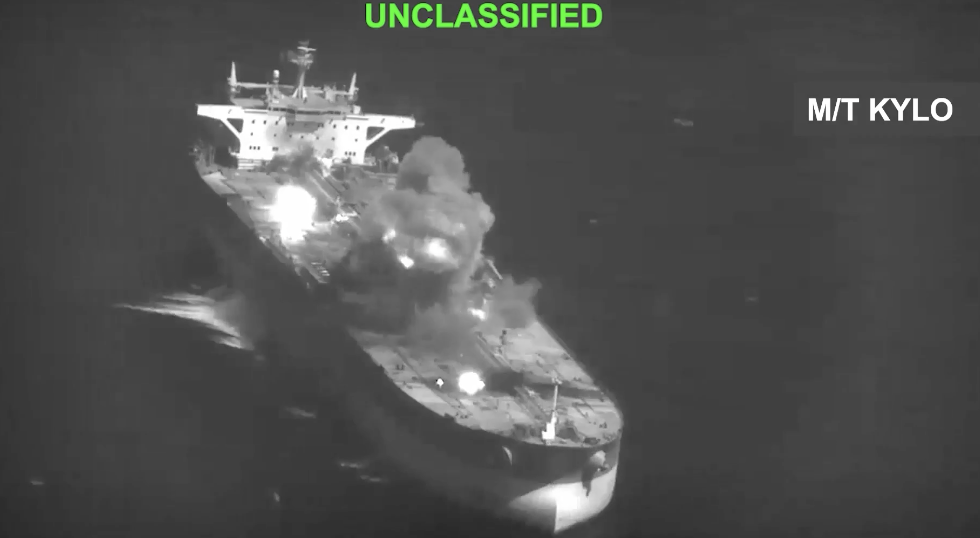

The US and Iran have exchanged attacks in and around the Strait of Hormuz, with Washington targeting three Iranian oil tankers and Tehran claiming strikes on US-linked vessels.
The military confrontation between the United States and Iran has intensified after Washington said it struck three Iranian oil tankers, following Iranian ballistic missile attacks on two US Navy warships.
The US military said the strikes targeted Iranian crude oil carriers in the Gulf of Oman and near Iran’s Kharg Island. US Central Command (CENTCOM) said the action came after the Islamic Revolutionary Guard Corps (IRGC) launched ballistic missiles towards a US aircraft carrier and a guided-missile destroyer operating in regional waters.
According to CENTCOM, the two US warships evaded multiple attacks and no American personnel were injured. The US military said two Iranian crude oil carriers were disabled and a third was destroyed, alleging that the vessels were part of a multibillion-dollar network that helps finance the IRGC and its regional allies.
CENTCOM commander Admiral Brad Cooper said the strikes were intended to demonstrate that attacks on US forces would carry an economic and military cost. He also warned that Washington would act to defend American personnel and could target Iran’s oil fleet if further attacks occur.
Iran, however, rejected the US account and said its forces had targeted several vessels associated with the United States. The IRGC said it had fired ballistic missiles at a US aircraft carrier and a Navy destroyer that it accused of harassing Iranian vessels and participating in a naval blockade.
The IRGC claimed that both US ships were forced to leave the conflict zone after sustaining damage. The force warned that continued US military action would trigger a major response from Iran’s armed forces.
The IRGC also issued a warning to vessels operating in the Gulf and around the Strait of Hormuz, urging them not to engage in what it described as suspicious movements or attempts to use unauthorised waterways.
An Iranian parliamentary security official, Hassan Ghashghavi, described the confrontation as part of what he called an “existential war with America”. He argued that the US naval blockade should not have been imposed in the first place.
The latest exchange marks another escalation in a conflict that has already lasted six months. The confrontation began on February 28 following a series of US and Israeli attacks on Iran. After nearly a month without direct military clashes, the two sides resumed attacks at the beginning of September.
The conflict has also taken a toll on US forces. US President Donald Trump said on September 4 that the war, which has resulted in the deaths of 18 US service members, was “small potatoes”, even as military confrontations continued.
Efforts to secure a ceasefire have repeatedly broken down, with both Washington and Tehran continuing to use military and economic pressure against each other.
Separately, the Iranian Red Crescent Society has asked the International Criminal Court (ICC) to investigate a US missile strike that reportedly hit a wedding gathering in the southern Iranian town of Kuhestak.
According to the humanitarian organisation, the attack took place at about 9:30pm local time on Tuesday and killed at least four people while injuring 67 others. The victims included two women and two children aged four and 16, Al Jazeera reported
The Red Crescent said most of those injured were also women and children and warned that the death toll could rise because some victims remained in critical condition.
In its submission to the ICC, the organisation called for an independent and impartial investigation, citing the civilian nature of the location that was struck.
The humanitarian group said the incident could potentially constitute a war crime, pointing to international legal protections for civilians and civilian objects and restrictions on attacks expected to cause disproportionate harm to civilians.
The latest allegations add another dimension to the widening conflict, with civilian casualties and the protection of shipping routes emerging alongside the direct military confrontation between the US and Iran.
Fighting Spreads Beyond Iran
The wider regional conflict has also seen renewed Israeli military activity in neighbouring areas. Israeli forces bombed Zawtar al-Sharqiyah in southern Lebanon and carried out artillery attacks on the outskirts of al-Rafid in southern Syria, according to the reports.
In Gaza City, rescue teams recovered the remains of 55 Palestinians killed in an Israeli strike on the Malka family home on November 19, 2023. The recovery, nearly three years after the attack, highlights the continuing efforts to locate and recover victims amid the prolonged conflict.
With fighting involving multiple regional theatres and tensions around the Strait of Hormuz remaining high, the latest US-Iran exchange threatens to further complicate efforts to contain the conflict and restore negotiations.