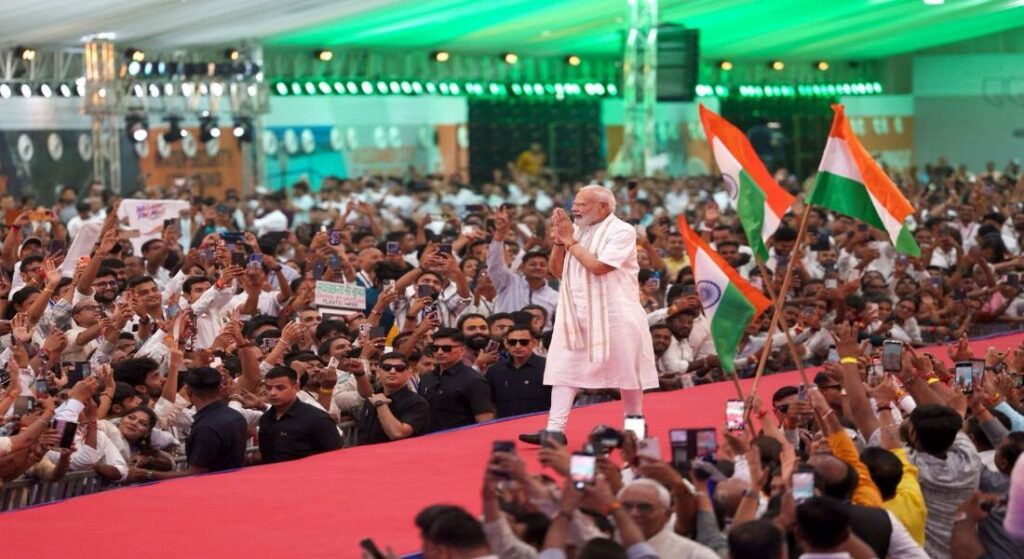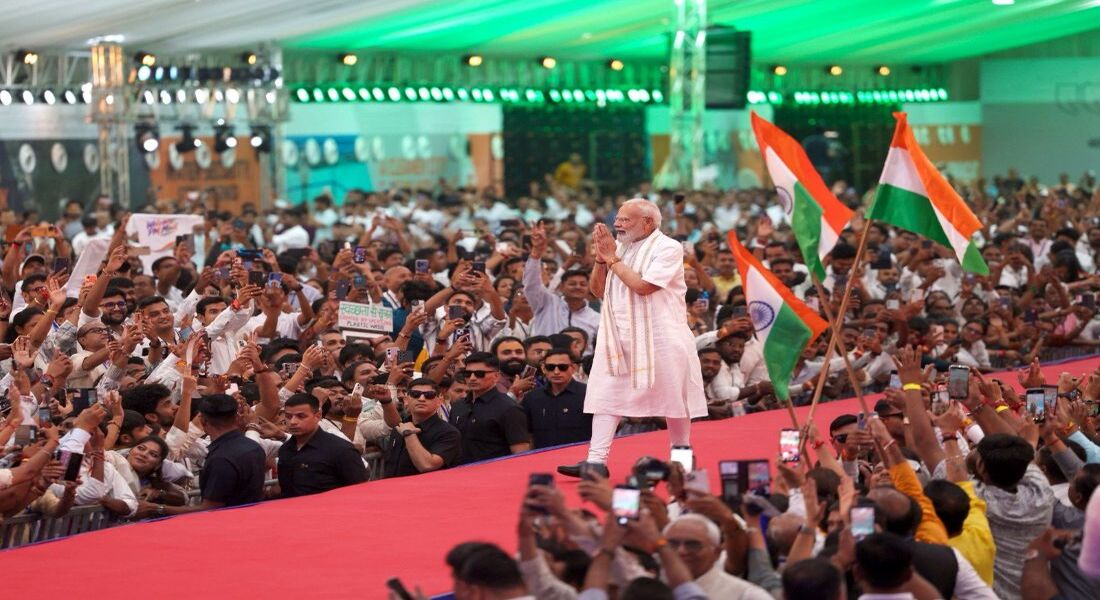

New Delhi: Prime Minister Narendra Modi on Tuesday laid foundation stones for, inaugurated and dedicated to the nation development projects worth more than Rs 35,000 crore in Vadodara, Gujarat.
Addressing a gathering at the Maharaja Sayajirao University ground, Modi said the projects would give further momentum to the country’s journey towards a Viksit Bharat.
He welcomed people who joined the programme both physically and through online platforms, according to an official statement.
The PM highlighted the completion of the 2,800-kilometre Dedicated Freight Corridor (DFC), describing it as a major achievement for 21st-century India. He said Vadodara had a special connection with the Gati Shakti initiative as the final links of the massive freight corridor were connected from the city.
The completion of the DFC network is expected to strengthen freight movement across the country and improve connectivity between major industrial centres, ports and markets.
Modi said the Eastern and Western Dedicated Freight Corridors were transforming the country’s commercial landscape and were becoming a backbone of national commerce.
He explained that separating passenger and freight traffic had enabled more than 430 cargo trains to operate daily. According to him, freight movement that earlier took around 30 hours by truck could now be completed in 10 to 12 hours through the improved rail network.
The PM also said the reduction in travel time over 100 kilometres was helping save fuel, reduce freight costs and lower the environmental impact of transportation.
He also underlined the benefits of the freight network for farmers. He said perishable agricultural products such as flowers, vegetables and fruits could now reach markets and mandis faster, helping farmers access larger markets and ensuring timely delivery of their produce.
Highlighting the capacity of the new freight infrastructure, Modi referred to the operation of a double-stack container freight train from JNPT Port to Vadodara. He said a single such train could carry cargo equivalent to more than 250 trucks, allowing large quantities of goods to move rapidly across the country.
The PM also highlighted the expansion of rail connectivity into remote and tribal areas of Gujarat, Madhya Pradesh and Maharashtra. He said newly launched rail services would benefit people travelling to areas including Chhota Udepur and Alirajpur.
He said railway modernisation, along with investments in roads, metros, airports and gas pipelines, was generating wider economic activity and employment. Referring to the railway budget of more than Rs 2.75 lakh crore, Modi said infrastructure spending was creating new jobs and encouraging industries and businesses around major projects.
On manufacturing, Modi highlighted Vadodara’s long industrial history and its emergence as a major MSME centre. He also pointed to the city’s role in the manufacture of India’s first domestically produced military transport aircraft, the C-295.
The PM said India had significantly expanded its manufacturing capacity in the railway sector since 2014. He stated that the country had produced 50,000 modern railway coaches and added nearly 2.5 lakh wagons to the railway network during this period.
Modi also highlighted India’s progress in solar manufacturing and renewable energy. He said domestic production of solar photovoltaic modules had reduced dependence on costly imports and supported the expansion of solar capacity.
He cited the Kadana Dam floating solar project and the PM Surya Ghar Muft Bijli Yojana as examples of the country’s expanding clean-energy ecosystem. He said the scheme had empowered 55 lakh families across India, including 11 lakh families in Gujarat, to become electricity producers while creating employment opportunities.
The PM said India was entering a new era of manufacturing that extended from chips to ships and stressed the importance of self-reliance in critical supply chains.