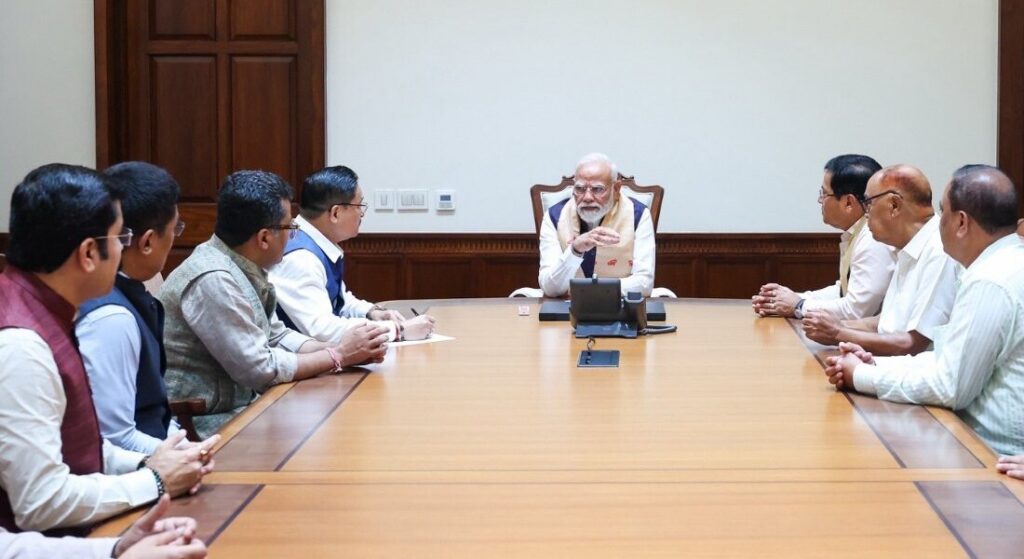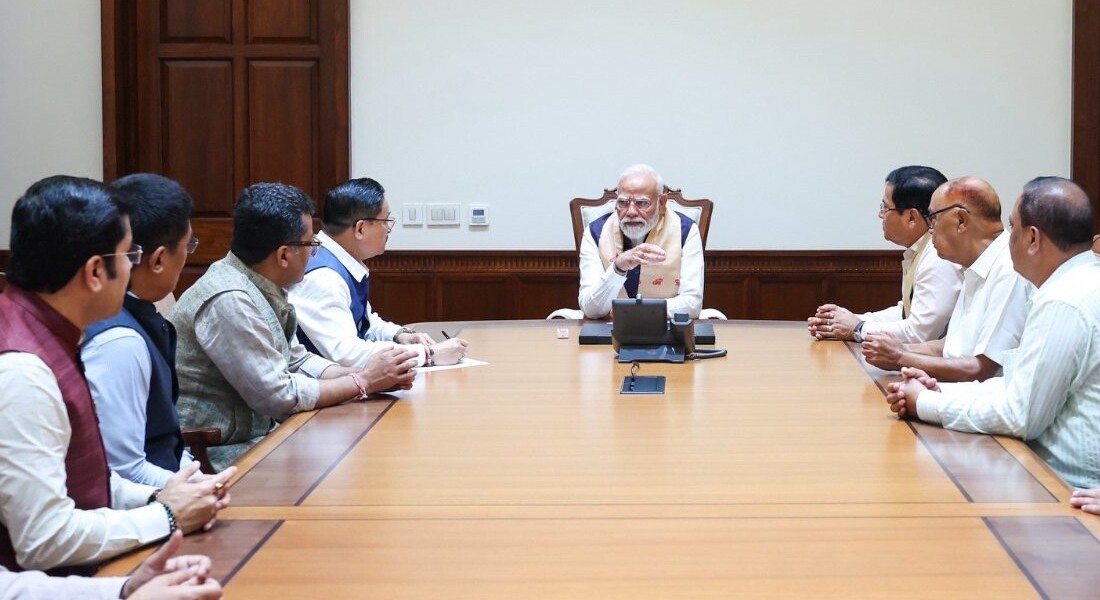

New Delhi: The Union Cabinet, chaired by Prime Minister Narendra Modi, on Wednesday approved a 3% increase in Dearness Allowance (DA) for central government employees and Dearness Relief (DR) for pensioners, along with three major initiatives covering rural governance, sports goods manufacturing and container production.
The decisions include the Pradhan Mantri Viksit Gram Swaraj Yojana (PM VGSY), the Khelo India Sports Goods Manufacturing Scheme and the Container Manufacturing Promotion Scheme (CMPS), according to an official statement.
The Cabinet approved an additional instalment of DA and DR with effect from July 1, 2026. The increase of 3 percentage points will raise the existing rates from 60% to 63% of basic pay or pension.
The increase is intended to compensate central government employees and pensioners for rising prices. It will benefit approximately 48.54 lakh central government employees and 68.71 lakh pensioners.
The combined annual impact on the government exchequer is estimated at Rs. 10,016.10 crore. The increase follows the accepted formula based on the recommendations of the Seventh Central Pay Commission.
The Union Cabinet also approved the PM VGSY, a Centrally Sponsored Scheme aimed at strengthening grassroots governance and improving rural development planning.
The scheme will be implemented from 2026–27 to 2030–31, in line with the period of the Sixteenth Finance Commission. It has a total outlay of Rs. 7,395.55 crore, comprising a central share of Rs. 4,869.48 crore and a state share of Rs. 2,526.07 crore.
Around 32 lakh elected representatives, Panchayat functionaries and other stakeholders across more than 2.55 lakh Panchayats and traditional local bodies are expected to benefit directly.
The scheme aims to help Gram Panchayats prepare comprehensive development plans by bringing together local priorities, government schemes and available resources. It will support the preparation of 2.55 lakh Gram Panchayat Development Plans annually through the eGramSwaraj portal.
The initiative will also strengthen the capacity of elected representatives, improve coordination between government departments and promote greater public participation in local development.
Each coordinated awareness-generation exercise is expected to reach at least one crore citizens. The scheme will also support the preparation of at least 2.55 lakh online audit plans annually through AuditOnline, with an emphasis on transparent accounting, public disclosure and improved revenue mobilisation by Panchayats.
The scheme will cover all states and Union Territories, including traditional rural local government institutions in areas where Panchayats do not exist. No permanent posts will be created under the scheme, although need-based contractual personnel may be engaged at state, district and block levels.
The Cabinet has approved the Khelo India Sports Goods Manufacturing Scheme with an outlay of Rs. 1,856.67 crore for the period from 2026 to 2033-34.
Announced in the Union Budget 2026-27, the scheme aims to strengthen India’s sports goods manufacturing sector by encouraging investment, improving production capacity, supporting innovation and expanding exports.
The initiative is aligned with Khelo Bharat Niti 2025, Make in India and Atmanirbhar Bharat. It is expected to attract domestic and international investment, generate employment and improve the competitiveness of Indian sports goods in global markets.
A key component is the development of dedicated Sports Goods Manufacturing Zones. These zones will bring manufacturers, suppliers, testing facilities, design and prototyping centres, and ancillary enterprises together to create integrated manufacturing ecosystems.
The zones are expected to be developed in coordination with existing industrial infrastructure under the BHAVYA Scheme and NICDC Industrial Parks.
The scheme will also provide support to attract major domestic and global manufacturers, brands and retail chains to establish production facilities. Its investment support and turnover-linked incentives are intended to encourage new manufacturing units, expand existing capacity and strengthen domestic supply chains.
A combined outlay of Rs. 1,130 crore has been earmarked for the Anchor Investment Support and Turnover Linked Support components. The scheme will also focus on upgrading existing sports goods manufacturing clusters, including common facilities and shared infrastructure, with particular attention to micro, small and medium enterprises.
The Union Cabinet has also approved the Container Manufacturing Promotion Scheme with a budgetary outlay of Rs. 10,000 crore up to the financial year 2039-40.
Announced in the Union Budget 2026-27, the scheme aims to establish a globally competitive container manufacturing ecosystem in India, reduce import dependence and strengthen supply-chain resilience.
It will support the establishment of new manufacturing facilities as well as the expansion of existing container production units.
The scheme has three major components. Interest Subvention Assistance has an allocation of Rs. 859 crore and will provide a 3% annual interest subsidy on eligible term loans for new manufacturing facilities and the expansion of existing capacity.
Operational Expenditure Assistance, with an allocation of Rs. 8,891 crore, will provide financial support for containers manufactured to global shipping standards and sold by eligible manufacturers. The assistance is intended to bridge the cost gap and improve the competitiveness of domestically produced containers.
Another Rs. 150 crore has been allocated for testing and certification assistance, including support for common facilities for specialised tests such as dynamic longitudinal impact testing.
The scheme aims to increase India’s annual container manufacturing capacity by around tenfold to 7.5 lakh twenty-foot equivalent units. It also seeks to position the country as a potential global export hub for quality shipping containers.
According to the scheme’s projections, the initiative could generate around 3,000 direct jobs and more than 50,000 indirect jobs. It is also expected to support related industries involved in manufacturing corner castings, specialised steel, wooden frames and paints.