
Flooding, landslides and infrastructure damage disrupt life in eastern India as Odisha steps up rescue operations and Andhra Pradesh estimates preliminary losses at Rs 4,600 crore.
Bhubaneswar/New Delhi: Cyclone Arnab has left a trail of destruction across eastern India, triggering severe flooding in Odisha, damaging infrastructure and crops in Andhra Pradesh and disrupting road and rail connectivity, even as the weather system weakened after moving inland. More than 59,000 people have been evacuated from vulnerable areas in Odisha, while Andhra Pradesh has put its preliminary damage estimate at Rs 4,600 crore.
The India Meteorological Department (IMD) said the remnant of Very Severe Cyclonic Storm Arnab weakened into a depression over south Chhattisgarh and adjoining south Odisha on the morning of October 29. It subsequently weakened into a well-marked low-pressure area over central Chhattisgarh and adjoining Odisha by the evening. Despite the weakening system, exceptionally heavy rainfall continued to affect several districts, particularly in southern Odisha.
Odisha has been among the worst-affected states, with Ganjam and Gajapati districts bearing the brunt of torrential rainfall. The state government has deployed 60 Odisha Disaster Rapid Action Force (ODRAF) teams, nine National Disaster Response Force (NDRF) teams and 244 Fire and Emergency Services teams for rescue, evacuation and restoration work.
In Andhra Pradesh, Chief Minister N Chandrababu Naidu has conducted aerial and ground surveys of cyclone-hit areas and reviewed relief and restoration operations. The state government is mobilising additional personnel to restore electricity, roads and communication services.
OVER 59,000 EVACUATED IN ODISHA
Revenue and Disaster Management Minister Suresh Pujari said 59,028 people had been evacuated from vulnerable areas across Odisha, with 830 shelters arranged to accommodate them. Gajapati recorded the highest number of evacuees at 17,441, followed by Malkangiri with 15,477, Ganjam with 11,882 and Nabarangpur with 10,519.
The state government has deployed 69 specialised disaster-response teams, comprising 60 ODRAF and nine NDRF teams. An additional 244 Fire and Emergency Services teams are engaged in clearing roads blocked by fallen trees, restoring connectivity and rescuing people from vulnerable locations.
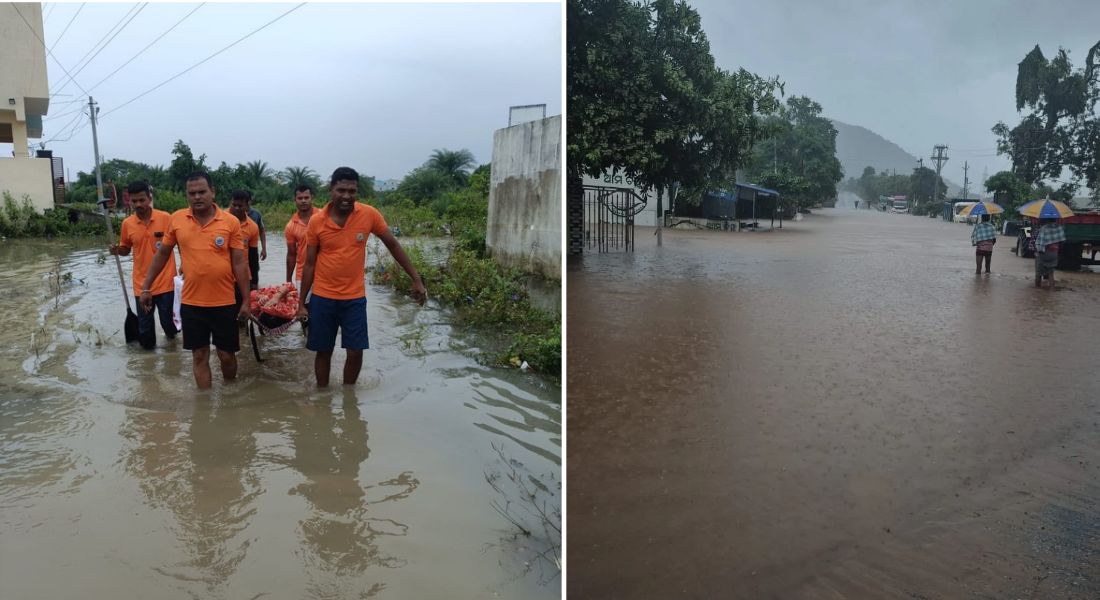
Ganjam has the largest concentration of specialised response teams, with 45 ODRAF and seven NDRF teams deployed. Gajapati has 12 ODRAF and one NDRF team. Rescue operations are being conducted using boats, while helicopters have been pressed into service in areas where strong water currents have prevented ground teams from reaching stranded residents.
The administration has also coordinated with the Indian Coast Guard to evacuate people from severely affected locations in Ganjam. Cooked food, drinking water and other essential supplies are being provided to people moved to safer places.
The scale of rainfall in southern Odisha has been exceptional. Patrapur in Ganjam district recorded 546 mm of rainfall, while G Udayagiri in Kandhamal received 462.4 mm. Several other locations across Ganjam, Gajapati and Kandhamal recorded rainfall exceeding 200 mm.
The heavy downpour caused rivers to swell, submerged low-lying areas and damaged roads and other infrastructure. Floodwaters disrupted movement across several parts of Ganjam and Gajapati, while landslides and fallen trees further complicated rescue and restoration work.
In Ganjam, 299 villages across 22 blocks were reported affected. The administration has identified 922 vulnerable villages and deployed four SRC powerboats to support rescue operations. Authorities are also monitoring river systems and vulnerable locations, including Kalinga Ghati.
In Gajapati, 711 villages across seven blocks were reported affected, with 119 vulnerable villages identified. Seven rescue boats have been deployed, while officials are monitoring Gotta Barrage, Badanala and drainage systems. The Vamsadhara river was reported at 52.5 metres, below its danger level of 54.10 metres, in the department’s October 29 update.
The impact extended beyond the two worst-affected districts. Heavy rainfall also affected Malkangiri, Koraput, Nabarangpur, Rayagada, Kalahandi, Nuapada and Kandhamal.
Road connectivity was disrupted at several locations. In Gajapati, roads were closed at four locations in Mohana, Udayagiri and Rayagada blocks. In Koraput, traffic on the Pattangi–Galigabdar road was temporarily disrupted by flowing floodwater but was subsequently restored.
Reports from Ganjam also indicated damage to road infrastructure, inundation of residential areas and disruption of routes connecting Sorada with neighbouring towns. A stretch of National Highway 326 connecting Berhampur with Mohana was reported washed away by floodwaters, adding to the connectivity challenges in the region.
RAIL SERVICES DISRUPTED, POWER RESTORATION UNDER WAY
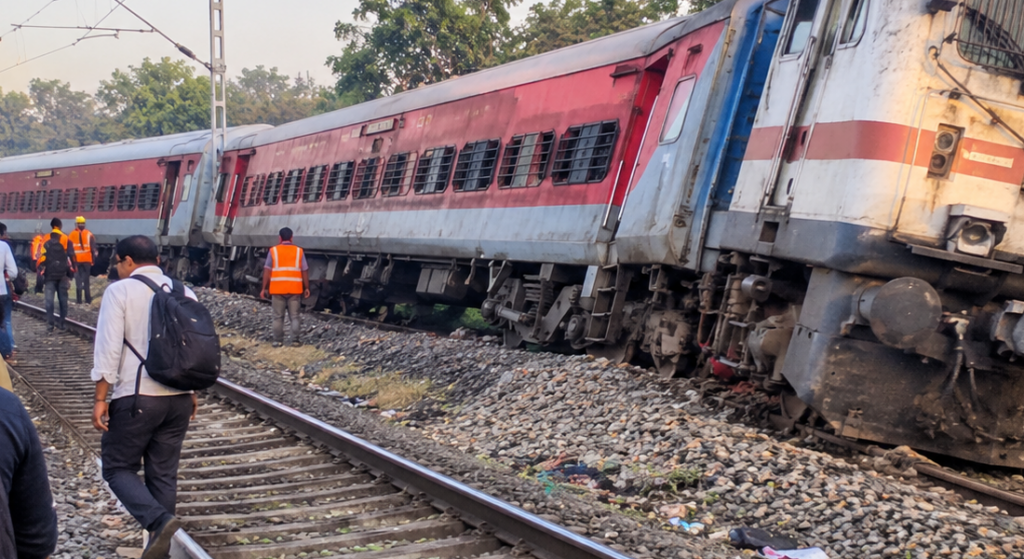
Flooding of the Bahuda river disrupted railway operations along the Howrah–Chennai route, particularly in the Ichchapuram–Jhadupudi section under the Visakhapatnam Division. Railway authorities reported abnormal water levels at bridges in the section, forcing precautionary changes to train operations.
Several trains were cancelled or suspended, while others were diverted or rescheduled. Some services were also stranded at locations in Odisha. The disruption affected passenger movement along an important railway corridor linking eastern and southern India.
The Odisha government is coordinating with railway authorities and the administrations of Ganjam and neighbouring Srikakulam district in Andhra Pradesh to assist stranded passengers and provide them with information.
Power restoration is another priority. According to the Revenue and Disaster Management Department, electricity supply had been restored at 298 of the 316 affected 33 kV substations. Approximately 84 per cent of affected electricity connections had also been restored, with repair work continuing.
ANDHRA PRADESH PUTS PRELIMINARY LOSSES AT RS 4,600 CRORE
Andhra Pradesh has estimated the preliminary damage caused by Cyclone Arnab at around Rs 4,600 crore, with the state government cautioning that the figure could rise after a detailed assessment.
Chief Minister N Chandrababu Naidu conducted an aerial survey of cyclone-affected areas, including parts of the Krishna and Godavari regions, and inspected relief arrangements. He also reviewed the progress of restoration work with the Chief Secretary, senior officials and district collectors.
Naidu directed officials to expedite the restoration of electricity, roads and other essential services. Power utilities have been asked to mobilise additional personnel from other regions and states, if required, and continue working until electricity supply is restored to every affected village and household.
He also expressed concern over delays in restoring mobile network services and urged telecom companies to accelerate repairs.
The damage to the power sector in Andhra Pradesh alone has been estimated at around Rs 500 crore by Energy Minister Gottipati Ravi Kumar. Around 1,700 personnel were engaged in repair operations, with another 500 employees being mobilised from the state’s three distribution companies. An additional 500 electricity employees from Telangana also joined the restoration effort.
The Andhra Pradesh State Disaster Management Authority’s provisional assessment has recorded damage to 3,631 houses and 3,009 huts. It has also reported that around 3.33 lakh hectares of crop area were inundated, while more than 21,800 hectares of horticultural land were affected. The assessment further lists damage to roads, culverts and other infrastructure across several districts.
The state government has also reported progress in restoring electricity supply. Under the Andhra Pradesh Eastern Power Distribution Company Limited, supply had been restored in 4,771 of the 5,400 affected villages, according to the update provided to the Chief Minister. Restoration work was continuing in the remaining areas.
CENTRE ASSURES ASSISTANCE TO AFFECTED STATES
The Centre has assured assistance to states affected by Cyclone Arnab. Union Home Minister Amit Shah spoke with the Chief Ministers of Andhra Pradesh, Puducherry, Odisha and Chhattisgarh on October 29 and assured them of all possible support to mitigate the hardships faced by people.
In the wake of Cyclone Arnab, spoke with the Chief Ministers of Andhra Pradesh, Puducherry, Odisha and Chhattisgarh and assured them of every assistance to mitigate the hardship of the people in the face of the disaster. NDRF and SDRF teams have sprung into action and are…
— Amit Shah (@AmitShah) October 29, 2026
Shah said NDRF and State Disaster Response Force teams were carrying out rescue and relief operations, and that Inter-Ministerial Central Teams would soon be sent to assess the impact of the cyclone and determine the additional assistance required.
Central teams are scheduled to visit cyclone-affected areas, including Andhra Pradesh, to assess the damage. Odisha has also said that a central team will visit Ganjam and Gajapati to review the flood situation and assess losses.
NEW WEATHER SYSTEM OVER ANDAMAN SEA
While Arnab’s remnant was weakening over central India, the IMD reported the formation of a separate low-pressure area over the South Andaman Sea and adjoining areas on October 29.
The weather agency said the system was likely to move west-northwestwards and intensify into a well-marked low-pressure area, with the possibility of further development over the southeast Bay of Bengal and adjoining Andaman Sea around October 31.
The emerging system has drawn attention as weather models indicate the possibility of further rainfall activity over parts of eastern and southern India. However, its future movement and intensity will depend on subsequent meteorological assessments.
For now, the immediate challenge for Odisha and Andhra Pradesh remains the restoration of normal life in areas battered by Arnab. Rescue teams continue to evacuate vulnerable residents, while governments and utility agencies work to restore transport links, electricity and other essential services.