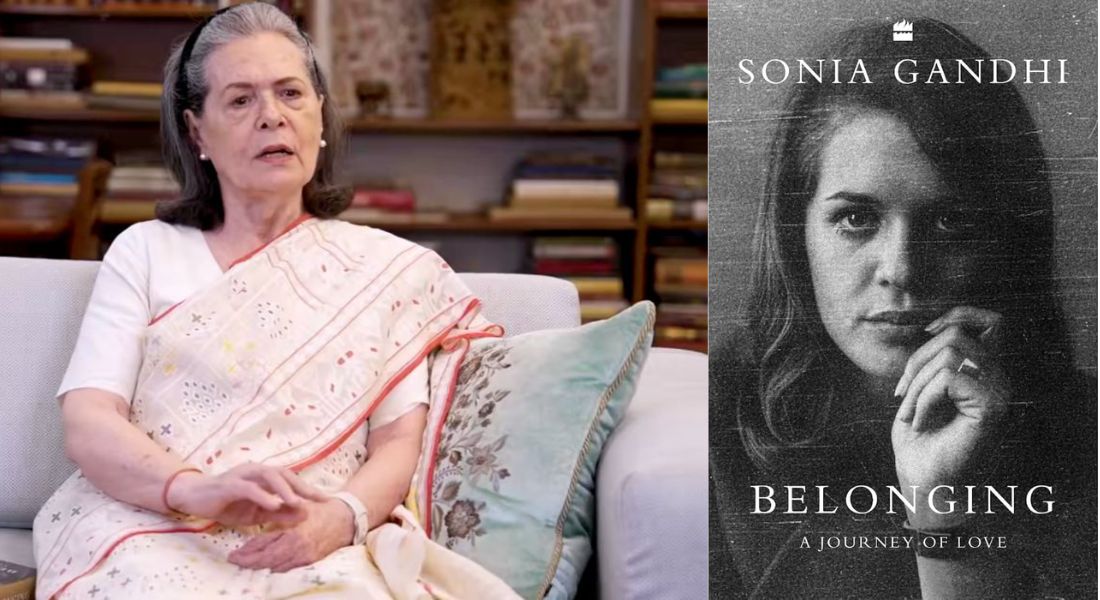

In Belonging: A Journey of Love, the former Congress president recounts family losses, her relationship with Indira Gandhi, and her increasingly strained interactions with Prime Minister Narendra Modi, drawing sharp reactions from the BJP and the Shiromani Akali Dal.
New Delhi: From the death of her first child and the assassinations of Indira and Rajiv Gandhi to her assessment of the changing relationship between political leaders and the media, Congress leader Sonia Gandhi’s memoir, Belonging: A Journey of Love, offers a deeply personal account of nearly six decades of life in India, interwoven with some of the country’s most consequential political developments.
The memoir traces Gandhi’s journey from a small town in Italy to the centre of Indian political life after her marriage to Rajiv Gandhi in 1968. While recounting private moments of grief and family life, she also revisits the Emergency, Operation Blue Star, the evolution of the Congress party and the growing ideological divide in contemporary Indian politics.
One of the most intimate revelations concerns the couple’s first child, a baby boy born prematurely on January 18, 1969, more than a year before Rahul Gandhi’s birth. Sonia recalls that the newborn appeared healthy and that she and Rajiv immediately developed an attachment to him. However, the child survived only a few hours. She writes that both parents were devastated by the loss and that Rajiv, despite his reserved upbringing, broke down and cried alongside her. Indira Gandhi, who was away on an official tour, reportedly cut short her visit and returned to comfort the couple.
The memoir also revisits the traumatic period surrounding Operation Blue Star in 1984. Sonia recounts that Indira Gandhi was deeply distressed after seeing images of the damage caused by the military operation at the Golden Temple complex in Amritsar. According to Sonia, tears rolled down her mother-in-law’s face as she looked at the images. She also recalls the discovery of grenades in a room of their residence following the operation, underscoring the atmosphere of insecurity surrounding the family.
The book addresses the Emergency imposed by Indira Gandhi in June 1975, during which civil liberties were curtailed, political opponents imprisoned and press freedom restricted. Sonia describes the decision as a mistake and writes that much of the damage could have been avoided had Indira exercised greater control over her younger son, Sanjay Gandhi. She believes her mother-in-law eventually recognised the consequences of the decision.
A significant part of the memoir is devoted to the changing nature of political relationships. Sonia says she has had practically no meaningful interaction with Prime Minister Narendra Modi despite his more than 12 years in office. Recalling encounters at official gatherings, she writes that the two exchange formal greetings but that Modi tends to look away and avoid eye contact. She contrasts this with an earlier political culture in which leaders across party lines maintained cordial relations. She also recalls calling former Prime Minister Atal Bihari Vajpayee after the 2001 Parliament attack to enquire about his safety.
Gandhi presents the political divide as fundamentally ideological, contrasting her vision of an inclusive, secular and socially just India with what she describes as Modi’s RSS-influenced understanding of the country. She also criticises the treatment of political opponents and argues that public discourse has become increasingly hostile.
The former Congress president raises concerns about the changing relationship between the media and the government, pointing to Modi’s absence from open, independent press conferences during his tenure. She argues that the opportunity for journalists to question prime ministers directly has diminished.
The memoir’s publication itself became contentious after Penguin Random House India withdrew from the project in August. Gandhi told The Guardian that the publisher was uncomfortable with criticism of the government and had dropped the book after she declined suggested edits. Penguin disputed this account, saying that the suggestion that its decision was linked to her refusal to make editorial changes did not accurately reflect the circumstances. The memoir is being published in India by HarperCollins, while Alfred A Knopf has released it in the United States.
The book has already drawn sharp political reactions. Shiromani Akali Dal spokesperson Arshdeep Singh Kler criticised Sonia’s account of Indira Gandhi’s distress over Operation Blue Star, arguing that expressions of anguish could not erase the suffering caused to the Sikh community. Speaking to media, he described the operation as an attack on the community and Sri Akal Takht Sahib, and invoked the 1984 anti-Sikh violence, demanding that Congress leaders acknowledge the suffering of victims and their families.
The BJP also questioned the memoir’s portrayal of the Congress legacy. Party spokesperson CR Kesavan called the book Whitewashing rather than Belonging, accusing Sonia Gandhi of attempting to soften the historical record of the Nehru-Gandhi family and the Congress. He particularly rejected what he described as an attempt to normalise the Emergency, citing the suspension of fundamental rights and press censorship. Kesavan also questioned her references to the Babri Masjid demolition and accused her of being selective in expressing concern over communal violence.
Through personal recollections and political assessments, Belonging presents Sonia Gandhi’s interpretation of India’s journey from the Congress-dominated decades of the post-Independence era to the present political landscape. Its revelations have reopened debates over the past, while its political observations have ensured that the memoir is being received as more than a personal account.