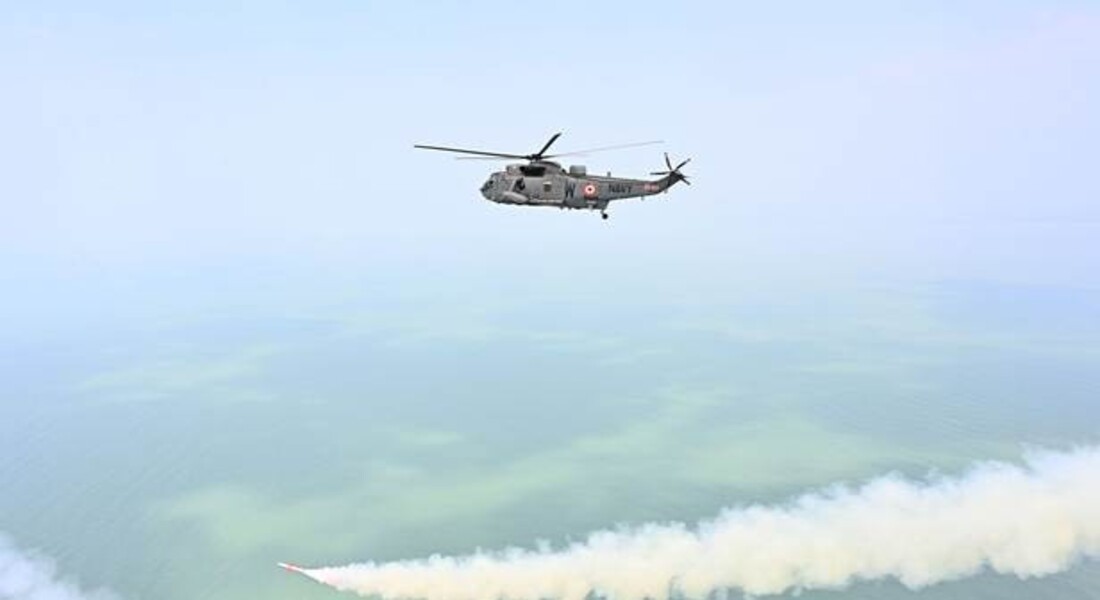

Bhubaneswar: Defence Research and Development Organisation (DRDO), in collaboration with the Indian Navy, on Wednesday successfully carried out the maiden salvo launch of the Naval Anti-Ship Missile–Short Range (NASM-SR) from a naval helicopter platform off the coast of the Bay of Bengal near Odisha.
During the trial, two missiles were fired in quick succession from the same helicopter, marking the first-ever salvo launch of an advanced air-launched anti-ship missile system in this category. According to officials, all mission objectives were achieved.
The launches were tracked and validated using radar, electro-optical systems, and telemetry deployed by the Integrated Test Range at Chandipur. The missile system also demonstrated its precision strike capability, including a successful waterline hit, according to an official statement.
The NASM-SR is equipped with a solid propulsion booster and a long-burn sustainer. It integrates advanced subsystems such as a seeker, fibre-optic gyroscope-based inertial navigation system, radio altimeter, high-bandwidth two-way data link, and jet-vane control. These technologies have been developed indigenously by DRDO laboratories in partnership with Indian industry.
The missile has been developed by Research Centre Imarat, along with other DRDO facilities, including Defence Research and Development Laboratory, High Energy Materials Research Laboratory, Terminal Ballistics Research Laboratory, and ITR Chandipur. Production is being undertaken by development-cum-production partners with support from Indian industries and start-ups.
Defence Minister Rajnath Singh congratulated DRDO, the armed forces, and industry partners for the successful test, stating that the system will significantly boost the operational capabilities of the country’s defence forces.
Secretary, Department of Defence R&D and DRDO Chairman Samir V Kamat also commended the teams involved in the successful launch.