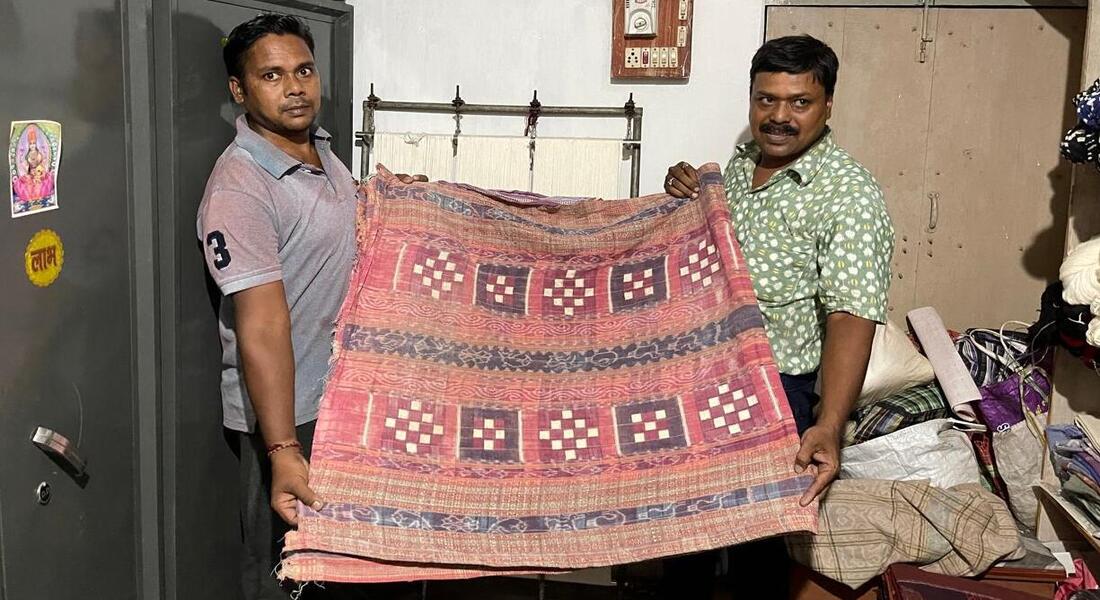

When we look at an Odishan Ikat saree, what do we see?
We see colour. We see patterns. We see motifs. We appreciate the extraordinary skill of the weaver. We may recognise a conch, an elephant, a lotus, a fish, a wheel, a temple, or perhaps a motif drawn from the world of Lord Jagannath.
But my research led me to ask a somewhat different question:
What does the textile mean to the people who create it, wear it and live with it?
That question takes us towards a phenomenological understanding of Odishan Ikat.
Phenomenology, in its simplest sense, asks us to understand the world as it is experienced by people. Instead of beginning with an external classification of an object, it asks us to enter the world of lived experience—to understand how people themselves perceive, remember, interpret and give meaning to that object.
And this is particularly important for understanding handloom. Because Odishan Ikat is not merely something that is produced. It is something that is lived.
My research examines the motifs of Odisha’s Ikat and the myths and meanings associated with them. The study deliberately brings together what I call the “field view” and the “text view.” The field view emerges from the narratives of weavers themselves, while the textual view comes from literary, historical and cultural sources.
This distinction becomes extremely significant from a phenomenological perspective.
A motif may have a documented meaning in a book. But what does that motif mean to a weaver sitting before the loom in Nuapatna, Barpali, Sonepur or Maniabandha? What memories does it evoke? From whom did the weaver learn it? Does the weaver associate it with a temple, a festival, a childhood memory, a story told by a parent, or simply with something seen repeatedly in the surrounding landscape?
These are questions about the lifeworld.
The lifeworld is the everyday world that we inhabit before we begin to analyse it academically. It is the world of family, work, faith, nature, memory, relationships, festivals and everyday routines.
Odishan Ikat emerges precisely from such a lifeworld. The motifs found in Ikat are deeply connected with culture, religion, the environment and everyday encounters. A tree is therefore not necessarily only a tree. A conch is not simply a geometric form. An elephant is not merely an animal reproduced decoratively. Each enters the textile carrying layers of experience.
That is why the motif becomes a particularly interesting sociological object.
My research finds that motifs can carry nature, mythology, spirituality, local customs, history, religious practices and everyday lifestyles. They can communicate the relationship between human beings and nature and preserve cultural memory.
Phenomenology allows us to go one step further. It asks us to understand how these meanings become real in people’s consciousness.
Consider the relationship between Odishan Ikat and Jagannath culture.
For an outside observer, the Gita Govinda Khandua may be a remarkable textile. But within Odisha’s cultural world, it occupies another level of existence. The cloth participates in ritual. It carries sacred words. It enters the temple. It becomes associated with devotion, memory and inherited cultural practice.
The textile therefore moves from being material to experiential.
Similarly, when a weaver repeatedly reproduces a traditional motif, we should not immediately assume that this is simply mechanical repetition of an inherited design.
The act may represent continuity.
The weaver may be reproducing something learned from a father, mother, grandfather or master weaver. The knowledge may not even have been formally articulated. It may exist in the movement of the fingers, in remembering how threads must be tied, in anticipating how colour will spread, and in knowing how an apparently fragmented arrangement of dyed yarn will eventually become a recognisable motif.
This is embodied knowledge.
The research emphasises that Odisha’s motifs are themselves products of social and cultural processes. Their interpretation can involve practical worldly experience, literary knowledge and an understanding of cultural symbols. Importantly, the research calls for connecting particular motif forms with collective patterns of experience rooted in social structures and group life.
This is where phenomenology becomes especially powerful. It enables us to see the loom not simply as a technology of production but as a site of consciousness, memory and meaning-making.
The hand knows something. The eye knows something. The community remembers something. And gradually, these different forms of knowing become cloth. There is also a beautiful paradox within Ikat itself.
The weaver has to imagine the finished design before the cloth exists. The threads are tied and resist-dyed before weaving; individual threads must ultimately come together to reveal the intended design. The research describes precisely this extraordinary process of skill and alignment.
In a sense, therefore, the motif exists first in consciousness.
It exists as an intention. Then it becomes thread. Then colour. Then pattern. And finally, it becomes textile.
But the phenomenological journey does not end with the weaver. When the saree is worn, another layer of experience begins.
A woman may choose an Ikat because it reminds her of Odisha. Another may associate a particular saree with her mother. Someone living outside Odisha may wear Sambalpuri Ikat as an expression of regional identity. Another may wear Khandua because of its association with Jagannath culture.
Thus, the meaning of the textile is continually recreated through wearing, remembering and experiencing. This is why I would argue that Odishan Ikat should not be understood simply as a repository of motifs.


It is a repository of lived experience.
The motifs carry stories, but people activate those stories. The loom carries knowledge, but the weaver embodies that knowledge. The saree carries identity, but the wearer experiences that identity. And therefore, preserving Ikat cannot mean merely preserving technique.
We must preserve the ecosystem of meanings surrounding the technique—the stories, oral narratives, ritual associations, vocabulary, memories of weavers, relationships with nature and cultural contexts from which motifs emerge.
My research ultimately suggests that these textiles constitute a woven record of identity, values and heritage. And perhaps this is the most important contribution of a phenomenological lens.
It changes the question from: “What does this motif represent?” to: “How is this motif experienced?” From: “Who designed this textile?” to: “What world made this textile possible?” And from: “How do we preserve Ikat?” to the much deeper question: “How do we preserve the lifeworld from which Ikat derives its meaning?”
Because an Odishan Ikat is ultimately more than woven cloth.
It is memory made visible.
It is knowledge made tangible.
It is culture experienced through the body.
And it is a lifeworld woven into threads.
A phenomenological approach begins with Edmund Husserl’s idea of going “back to the things themselves.” In other words, instead of beginning with predetermined categories, we try to understand an object as it appears in human experience. Applied to Odishan Ikat, this means that we do not begin by treating a motif merely as a decorative unit. We ask how the motif is perceived, remembered and experienced by the weaver and by the wearer.
This takes us to Alfred Schutz and the idea of the lifeworld. The lifeworld is the ordinary world of everyday experience—the world of family, work, ritual, memory, landscape and inherited knowledge. Odishan Ikat emerges from precisely such a lifeworld. The motifs recorded in my research repeatedly draw from religion, mythology, nature, everyday life and the cultural environment of the weaving communities.
So when a weaver creates a conch, elephant, fish, tree, temple form or Jagannath-inspired motif, the image does not emerge in isolation. It comes from a larger world of familiarity. The weaver has seen these symbols in temples, festivals, stories, rituals, landscapes and family traditions. Schutz would help us understand this as a stock of knowledge at hand—knowledge accumulated through everyday social life and passed from generation to generation.
We can also bring in Maurice Merleau-Ponty, who emphasised the importance of the body in human experience. This is particularly relevant to weaving. A master weaver does not possess knowledge only intellectually. Much of the knowledge resides in the body—in the movement of the hand, the coordination of eye and the thread, the rhythm of tying, dyeing and weaving. This is what we may call embodied knowledge.
The hand often knows before words can explain.
This is especially visible in Ikat because the design is created through resist-dyeing the yarn before the final weaving takes place. The weaver must imagine how dispersed dyed threads will eventually align and reveal the motif. The research itself highlights the extraordinary precision and planning involved in this process.
There is also a strong connection here with Clifford Geertz’s interpretive anthropology. Geertz argued that human beings live within webs of meaning that they themselves have created. Symbols help people understand and organise their cultural worlds. My research similarly uses a symbolic anthropological approach and notes that motifs communicate worldview, value orientation, ethos and cultural meaning.
Seen in this way, an Ikat motif becomes a kind of cultural text.
A conch can evoke sacredness.
An elephant can signify strength or prosperity.
A temple form can recall religious geography.
A Jagannath-associated motif may evoke devotion as well as Odia identity.
The motif therefore does not simply represent something. It participates in a system of meaning.
We can also bring in Pierre Bourdieu’s concept of habitus. Habitus refers to deeply internalised ways of seeing, thinking and acting that develop through social experience. The research observes that design innovation itself can be understood in relation to social structure and habitus.
For a hereditary weaving community, certain aesthetic choices may become almost instinctive. A weaver may know what looks balanced, appropriate or culturally meaningful without consciously articulating a rule. Such aesthetic sensibilities have been formed through long participation in the weaving tradition.
This also connects to Bourdieu’s idea of cultural capital. The research points out that weavers possess specialised artistic knowledge and skill that contribute to cultural identity. Their knowledge is therefore not merely technical knowledge; it is a form of cultural capital embedded within communities and transmitted across generations.
Another useful theoretical lens is Maurice Halbwachs’ idea of collective memory. Memory is not only individual; communities remember together. Their shared memories are carried through stories, rituals, places and material objects.
Odishan Ikat can therefore be understood as a form of materialised collective memory.
The Dola Bedi motif, for example, carries associations with ritual, festival, community gathering and devotional practice, while its continued use helps preserve communal memory.
Similarly, motifs connected with Jagannath culture do not merely depict religion; they help reproduce a shared cultural memory of Odisha.
And finally, phenomenology reminds us that meaning is never completely fixed.
The same Ikat saree may mean different things to different people. To the weaver, it may represent livelihood and inherited skill. To an older woman, it may evoke memories of family. To a young person, it may become an expression of contemporary Odia identity. To someone outside Odisha, it may represent regional heritage.
So we can understand Odishan Ikat through several interconnected theoretical ideas:
Husserl gives us experience. Schutz gives us the lifeworld. Merleau-Ponty gives us the embodied craft. Geertz gives us symbols and cultural meaning. Bourdieu gives us habitus and cultural capital, and Halbwachs gives us collective memory. Together, they help us understand why an Ikat saree cannot be reduced to fabric.
It is simultaneously object, experience, memory, skill, symbol and identity.
And this theoretical perspective brings us to perhaps the central argument of the research: motifs are products of social and cultural processes, and they connect particular forms of design with collective patterns of experience rooted in group life.
Therefore, when we look phenomenologically at Odishan Ikat, we are not simply looking at the textile. We are looking through the textile into the lived world of Odisha.
And it is there that the quest for meaning behind the motif begins…
***
Dr. Roopa Roshan Sahoo is a senior IAS officer of the 2006 batch and has been serving as Commissioner-cum-Secretary to the Governor, Odisha, since July 22, 2025. With extensive experience in public policy, tribal welfare, rural development and cultural preservation, her work focuses on inclusive governance, community empowerment and sustainable development. She holds a PhD in Sociology, with her research focusing on the myths and realities behind motifs in Odisha’s Ikat tradition. The views expressed are of the author’s.