
Frequent removals, corruption allegations and internal power struggles signal deep unease within China’s top military and political hierarchy
China’s political and military establishment appears to be witnessing significant internal churn, with reports suggesting that President Xi Jinping is increasingly unable to rely on his top military leadership. Over the past three years, more than 30 senior officials of the People’s Liberation Army (PLA), including several generals and admirals, have been removed from their positions.
Currently, only a handful of top-ranking generals remain in key roles, while several senior officials are reportedly missing. This has raised questions about the growing trust deficit within China’s military command structure. Discussions around these developments point to factors such as mistrust, internal rivalry and corruption.
Notably, several military leaders who were once considered close to Xi Jinping and played key roles in consolidating his leadership have also been removed. The Central Military Commission (CMC), the highest military body in China, is chaired by the President himself. However, out of six top officials who were part of the CMC in 2022, only one continues to remain in position.
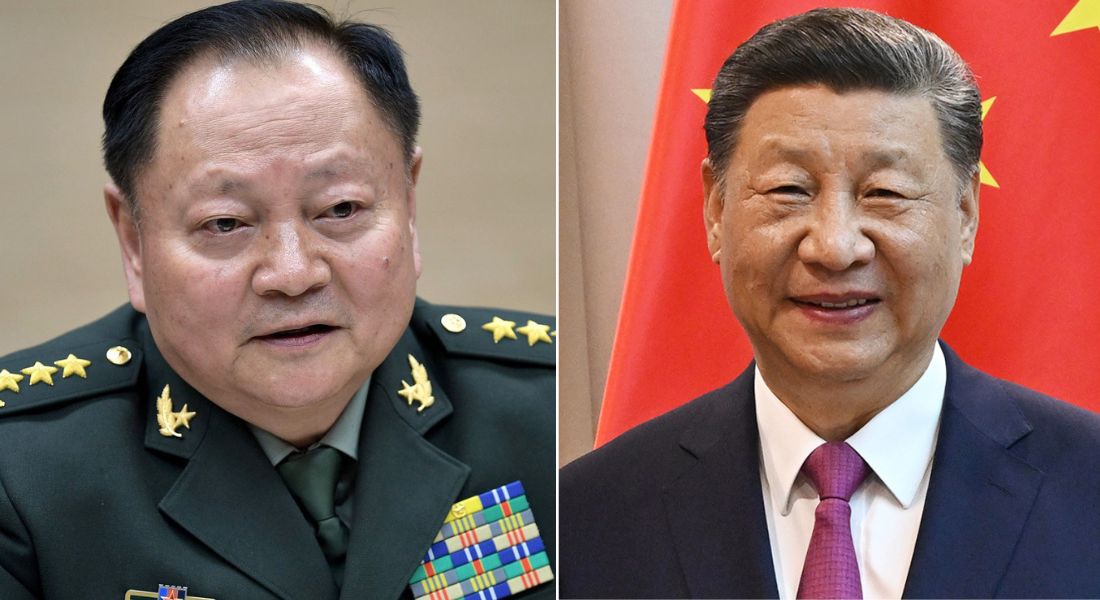
Among those removed is Zhang Youxia, who served as Vice Chairman of the CMC and was considered one of the most powerful figures in China’s military hierarchy after Xi. Another senior officer, General Liu Zhenli, has also reportedly lost his position. Both were responsible for key aspects of China’s military planning and preparedness.
Zhang Youxia’s removal has drawn particular attention, given his close association with Xi Jinping. He is believed to have played a crucial role in Xi securing a third presidential term in 2023. However, allegations have surfaced that Zhang was building influence within the military and creating divisions among Xi’s trusted circle. This has led to speculation that his growing power may have been perceived as a threat.
The developments come amid broader concerns about corruption within China’s military, especially in the rocket and missile forces. Reports have indicated serious irregularities, including instances where missiles were allegedly filled with water instead of fuel and substandard infrastructure was used for deployment.
Following these revelations, the entire top leadership of the PLA’s Rocket Force was removed. Since coming to power in 2012, Xi Jinping has overseen disciplinary action against more than 200,000 military personnel, including around 120 senior officers across the army, navy and air force.
The internal reshuffle has intensified in recent years, particularly after 2023. In 2022, out of 44 uniformed senior military officials in the Communist Party’s Central Committee, 29 were removed. Similarly, multiple top-level officials in the CMC have been replaced, leaving only a limited number of trusted figures in key roles.
Zhang Youxia’s background further underscores the significance of these developments. Coming from a family of revolutionary leaders, he belongs to the so-called “princeling” class in China’s political system. He joined the military at the age of 18 and served in the 1979 China-Vietnam war. Over the years, he rose to become a full general and later a member of the Communist Party’s Politburo.
In January 2026, an investigation was reportedly initiated against Zhang for alleged violations of party discipline. In China, such probes are often linked to corruption charges or questions over loyalty to the top leadership.
There have also been indications of political instability at the highest levels. In June 2025, Xi Jinping was reportedly absent from public view for two weeks, leading to speculation about internal power struggles. Officially, this absence was attributed to health reasons, though discussions pointed to possible tensions within the leadership.
China’s political system, led by the Communist Party, concentrates significant authority in the hands of its top leadership. Xi Jinping currently holds multiple key positions, including General Secretary of the Communist Party and Chairman of the Central Military Commission.
After constitutional changes in 2018 removed the two-term limit for the presidency, Xi secured a third term in 2023. Discussions now suggest that he may be preparing for a fourth term in 2027, alongside efforts to reshape the military leadership with a new group of trusted officials.
These developments point towards an ongoing consolidation of power, even as internal challenges within China’s military and political structures continue to surface.
***
The author is a Bhubaneswar-based senior columnist. Views expressed are personal and do not necessarily reflect those of IndiaVerve.