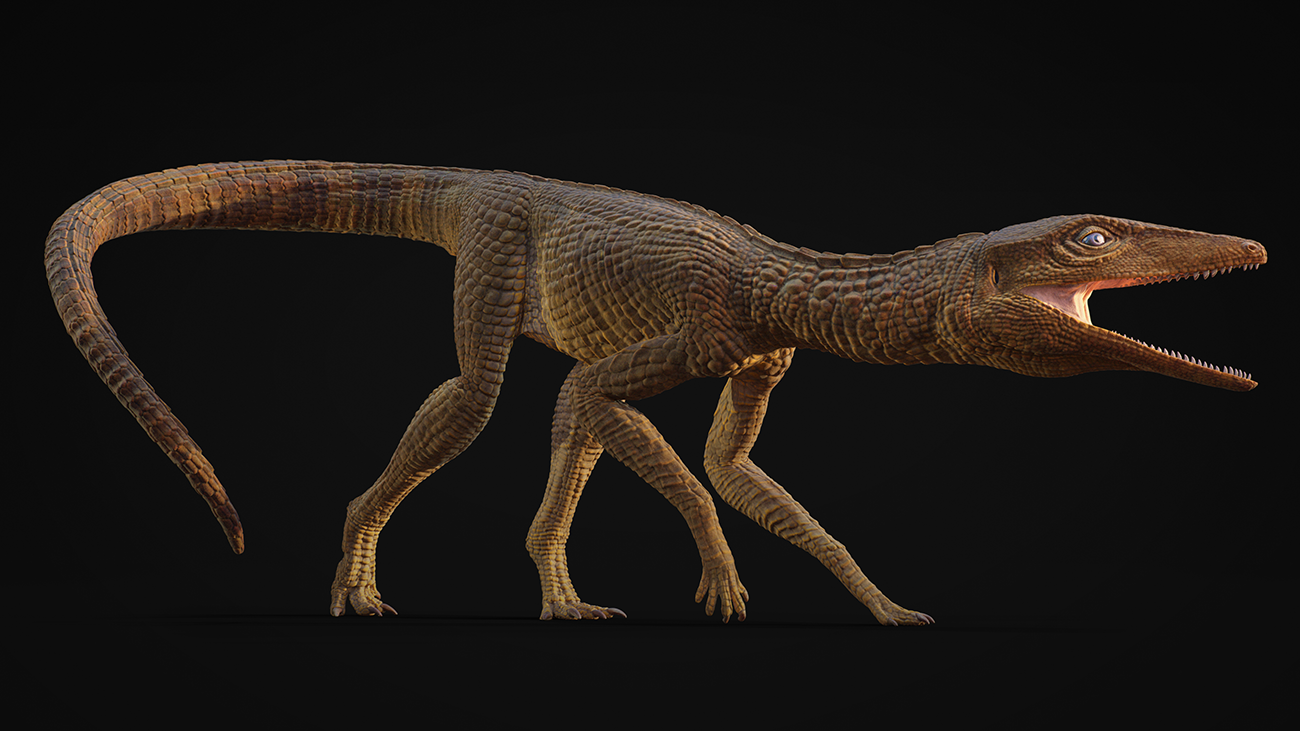

London: Millions of years before crocodiles became synonymous with slow, stealthy predators lurking in water, one of their ancient relatives was built for speed, sprinting across land with surprising agility like a greyhound.
Scientists have identified a new species of early crocodile relative that lived around 215 million years ago in present-day United Kingdom. Unlike modern crocodiles, this reptile was adapted for life entirely on land, with long limbs and a light frame that allowed it to move swiftly in search of prey.
The species, named Galahadosuchus jonesi, is believed to have inhabited dry, upland landscapes during the Late Triassic period. It likely fed on small animals, including early mammals, amphibians and reptiles, using speed rather than ambush to hunt.
Researchers from the Natural History Museum in London found that the animal’s body structure was closer to that of a running mammal than a modern reptile. Its upright posture and slender build suggest an active predator capable of navigating vegetation and open terrain with ease.
The discovery, however, carries a personal dimension as well.
The species has been partly named after David Rhys Jones, a schoolteacher who played a key role in inspiring the study’s lead author, Ewan Bodenham, to pursue science. Reflecting on the tribute, Bodenham recalled how his teacher’s enthusiasm and ability to challenge students left a lasting impression on him.
“Mr. Jones was just such a good teacher, not only in being able to explain things well, but you could tell that he was genuinely interested in the sciences. I think that really inspired me,” said Bodenham, PhD student at the Natural History Museum London and UCL.
Fossil remains of the species were recovered from ancient fissure deposits in southern Wales and southwest England. These natural formations preserved the remains of animals that were washed into underground cavities and buried over time.
Initially, scientists considered whether the fossil belonged to a known species, but detailed analysis revealed multiple anatomical differences, confirming it as a distinct and previously unknown species.
The finding, published in the journal The Anatomical Record, adds to growing evidence that early relatives of crocodiles were far more diverse than their modern counterparts, occupying different ecological roles — including fast-moving terrestrial hunters.
It also provides valuable insight into life on Earth just before the Triassic-Jurassic mass extinction, a period marked by significant environmental upheaval. Studying such species helps researchers understand how ancient ecosystems functioned and how organisms responded to dramatic changes.
Beyond its scientific importance, the discovery stands as a reminder that inspiration in classrooms can echo across millions of years — shaping journeys that lead to uncovering the distant past, the reasearchers said.