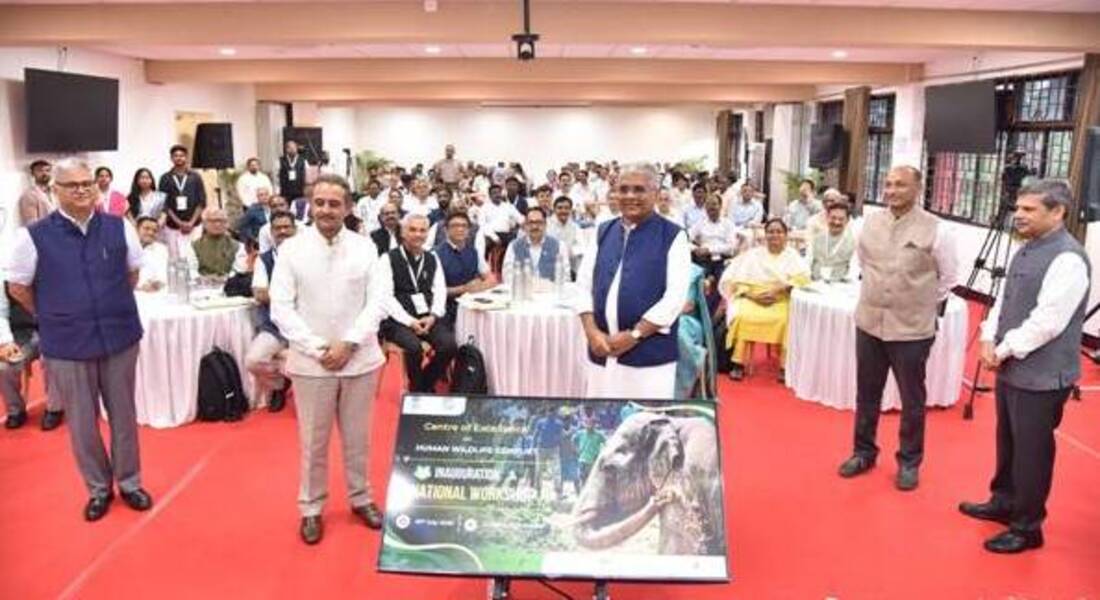

Coimbatore: Union Environment, Forest and Climate Change Minister Bhupender Yadav today inaugurated the Centre of Excellence (CoE) on Human-Wildlife Conflict here and launched the National Human-Wildlife Conflict Portal, underscoring the Centre’s focus on scientific, technology-enabled and community-driven approaches to tackle one of India’s growing conservation challenges.
Addressing a National Workshop on Human-Wildlife Conflict, Yadav said the increasing interaction between people and wildlife due to habitat fragmentation, changing land-use patterns and expanding human activities has made the issue a major conservation and development concern. He stressed that the country’s response should be solution-oriented and supported by modern technology.
According to an official release, the newly established Centre of Excellence, announced earlier by Prime Minister Narendra Modi during the seventh meeting of the National Board for Wildlife, will serve as a national hub for research, innovation, policy support, capacity building and dissemination of best practices for evidence-based management of human-wildlife conflict.
The Minister said the institute should develop strategies for managing conflicts involving tigers outside tiger reserves, as well as leopards and elephants. He also emphasised the need for mission-mode awareness campaigns in both urban and rural areas to educate people on safely responding to wildlife encounters. Species-specific and region-specific measures, he said, would help reduce conflict and public anxiety.
Yadav urged forest departments across the country to adopt preventive measures to minimise damage to crops and human settlements while working closely with local communities through coordinated consultations. He also called for wider adoption of innovative technologies in wildlife conservation, stating that “coexistence and harmony, instead of conflict, should be the mantra of ecological sustainability.”
Union Minister of State for Environment, Forest and Climate Change Kirti Vardhan Singh said India’s conservation successes have led to increased human-wildlife interactions, making the issue both an environmental and socio-economic challenge. He expressed confidence that the Centre of Excellence would strengthen the capacity of officials and communities while promoting the use of advanced technologies alongside traditional knowledge.
The Minister also launched the National Human-Wildlife Conflict Portal, a digital platform designed to support data management, knowledge sharing and decision-making for conflict mitigation across the country. In addition, the first edition of the publication, Current Status of Human-Wildlife Conflict in India: An Overview, was released, providing an assessment of prevailing trends and emerging challenges.
The workshop featured technical sessions on human-elephant conflict, human-big cat conflict and the role of technology and innovation in conflict mitigation. The deliberations are expected to contribute to stronger national strategies, improved stakeholder coordination and more effective measures for promoting peaceful coexistence between people and wildlife.