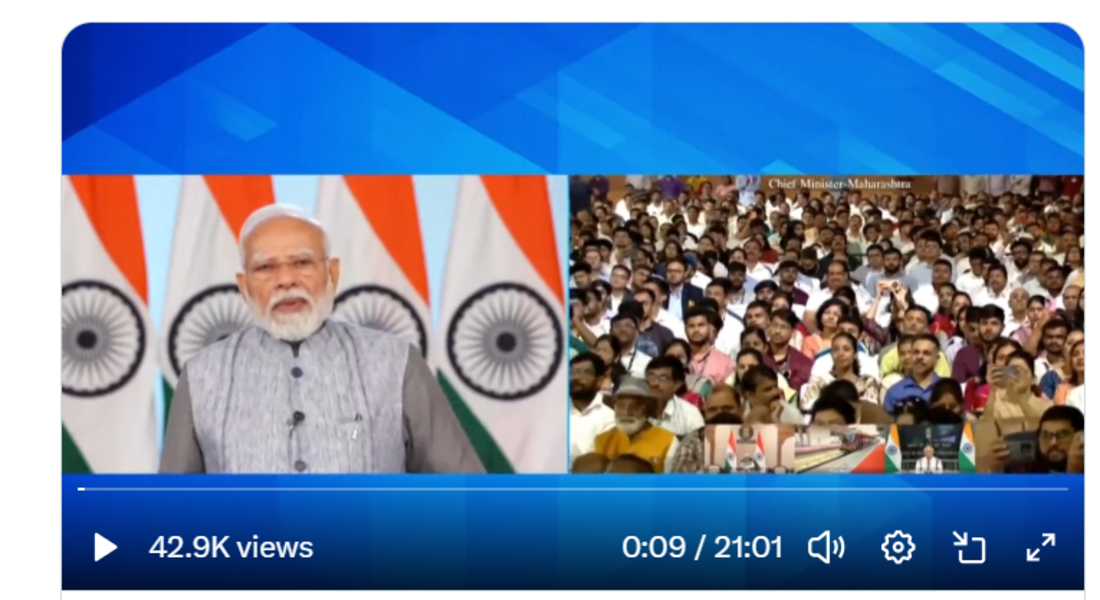

New Delhi: Prime Minister Narendra Modi on Tuesday inaugurated and laid the foundation stone for Pune Metro projects worth around Rs 21,800 crore, marking a major step towards strengthening urban connectivity and expanding public transport infrastructure in Maharashtra.
Addressing the gathering through video conferencing, Modi extended Diwali greetings to the people of Pune and Maharashtra, saying that the joy of festivals becomes greater when new public facilities are added to people’s lives.
Recalling that he had laid the foundation stone for the first phase of Pune Metro around 10 years ago, the Prime Minister said the inauguration of the Hinjawadi-Shivajinagar corridor would improve connectivity to one of Pune’s major information technology hubs.
The new metro line, for which work was initiated through the foundation stone ceremony, would further strengthen links between the older and newer parts of the city.
Describing Pune as a historic centre of ideas that has consistently contributed to shaping the nation and society, Modi said the city was now emerging as an important hub of youth aspirations and innovation.
Its growing presence in information technology, automobiles, pharmaceuticals, startups, innovation and manufacturing was contributing to the vision of a Viksit Bharat.
He said the expansion of metro connectivity would provide fresh momentum to Pune’s development and support its emergence as a modern urban centre.
The Prime Minister observed that the identity of modern cities was no longer determined solely by their industries, popular cuisine or local products. Their competitiveness and the ease of living they offered to residents had also become important measures of urban development.
He said metro networks played an important role in improving both these aspects by reducing commuting time and providing greater convenience to passengers. Saving time in cities, he added, improved productivity, strengthened economic activity and ultimately benefited both poor and middle-class families.
Highlighting India’s progress in urban transportation, Modi said the country’s metro network had expanded to nearly 1,200 kilometres across 26 cities over the past 12 years, serving more than one crore passengers every day. He noted that India was now counted among the world’s three largest metro networks.
Referring to the expansion of metro infrastructure in Maharashtra, the Prime Minister said the state had only around 10 to 11 kilometres of operational metro lines in 2014. The network had since grown to nearly 175 kilometres, while construction was underway on more than 680 kilometres of additional metro lines, involving investments exceeding Rs 2.5 lakh crore.
He highlighted the employment opportunities created by these infrastructure investments, saying that the expenditure was generating work for labourers, engineers and people employed in shops and factories.
Another significant feature of the newly inaugurated Hinjawadi-Shivajinagar corridor, according to Modi, was its development through the Public-Private Partnership model.
He said the project demonstrated how cooperation between the government and private sector could accelerate infrastructure development and contribute to the country’s progress.
The Prime Minister said India’s infrastructure priorities over the past 12 years had included the expansion of rural roads, highways, expressways and railway networks, along with railway electrification, tunnels and bridges. In the coming years, he said, the country would increasingly focus on developing its cities into some of the best urban centres in the world.
Emphasising the importance of urban centres in India’s economic development, Modi said cities were not merely residential spaces but major centres of economic activity. He stressed the need to transform hundreds of smaller cities across the country into active growth hubs.
In this connection, he referred to the Urban Challenge Fund, approved in February this year, which is backed by Rs 1 lakh crore in Central assistance to mobilise investments worth several lakh crore rupees in urban development.
He urged urban local bodies and private sector partners to participate in the initiative in mission mode and expressed confidence that Maharashtra would further expand its contribution to the programme.
During his address, Modi also highlighted India’s economic growth and progress in reducing poverty, describing the two as significant achievements that had attracted international attention.
He said India had maintained the world’s fastest economic growth rate despite challenging global conditions. Referring to the latest World Bank report, he also highlighted that around 50 crore people had moved out of extreme poverty over the past 10 to 12 years.
The Prime Minister said these achievements were closely connected, as economic growth expanded government resources and created opportunities for greater public investment. He added that efforts to eliminate corruption and leakages had helped ensure that government assistance reached intended beneficiaries directly.
According to him, investments in roads, railways, airports, metro networks, electricity, drinking water and gas pipelines were improving people’s living conditions while generating employment opportunities.
Modi also highlighted the contribution of welfare initiatives such as housing for poor families, household toilets, tap water connections under Har Ghar Jal and cooking gas connections. He said these facilities had improved living standards, strengthened people’s confidence and saved valuable time that families could utilise to earn additional income.
Recalling his completion of 25 years as the head of a government last month, the Prime Minister spoke about his long-standing approach to poverty reduction through the empowerment of disadvantaged sections.