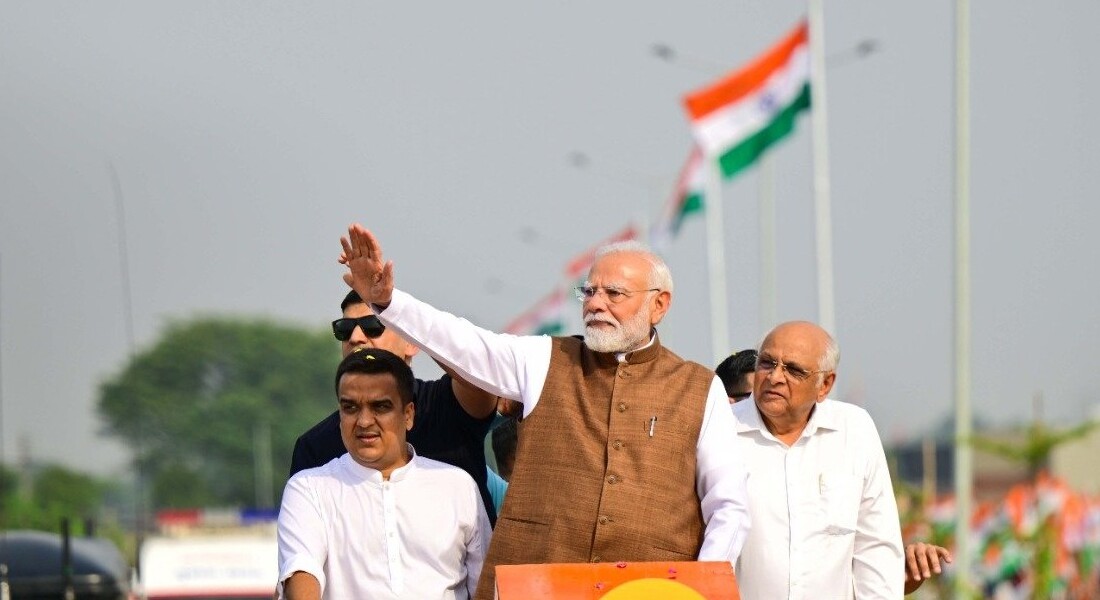

New Delhi: Prime Minister Narendra Modi on Friday inaugurated and dedicated development projects worth more than Rs 14,000 crore to the nation and laid foundation stones for several new initiatives in Banaskantha, Gujarat.
He also released the latest instalment of the PM Kisan Samman Nidhi, transferring more than Rs 18,000 crore to the bank accounts of around 10 crore farmers across the country.
Addressing a gathering on the occasion, Modi highlighted the government’s efforts to strengthen agriculture, improve farmers’ incomes and expand rural economic opportunities through initiatives covering farming, animal husbandry, fisheries and infrastructure.
He said the agricultural budget had increased more than fivefold compared with 2013-14, underlining the government’s focus on farmers’ welfare. Nearly Rs 4.5 lakh crore has been transferred directly to small farmers through PM-KISAN, he added.
In Gujarat, more than ₹1,000 crore has been deposited into the accounts of over 50 lakh farmers under the scheme. Of this, nearly Rs 50 crore has reached farming families in Banaskantha, according to an official statement.
The Prime Minister identified five major government interventions that, according to him, had delivered financial benefits and savings exceeding Rs 50 lakh crore for farmers. These included PM-KISAN transfers, fertiliser subsidies, Minimum Support Price (MSP) payments, crop insurance compensation and savings through solar-powered irrigation.
He said the government had spent around Rs 16 lakh crore to protect farmers from the impact of rising international fertiliser prices. Over the past 12 years, wheat and paddy farmers had received more than Rs 24 lakh crore through MSP.
Farmers had also received over Rs 2 lakh crore in compensation under the Pradhan Mantri Fasal Bima Yojana over the last 10 to 12 years, he said.
Under the PM-KUSUM scheme, nearly 12 lakh solar pumps have been distributed, helping farmers reduce their dependence on diesel. Their use has saved farmers the expense of purchasing more than 80 crore litres of diesel.
Highlighting the growing role of science and technology in agriculture, Modi said more than 26 crore Soil Health Cards had been issued to farmers. Around 3,000 new seed varieties had also been made available in recent years to help cultivators deal with changing weather conditions.
He emphasised the importance of animal husbandry in strengthening rural incomes, particularly for women engaged in dairy and livestock activities.
The newly built research centre in Banaskantha will support the conservation and scientific improvement of indigenous cattle breeds, including Gir, Sahiwal and Kankrej, and buffalo breeds such as Mehsana, Murrah and Jaffarabadi.
Describing it as the country’s first such facility for the Kankrej breed, Modi said modern reproductive technologies, including in-vitro fertilisation (IVF), would help farmers improve the quality of their livestock.
He also highlighted the nationwide free livestock vaccination programme, under which around 150 crore vaccine doses have been administered, benefiting the livestock of more than eight crore farmers.
According to the Prime Minister, average daily milk yield per cow or buffalo has increased from less than five litres in 2013-14 to nearly eight litres currently. He said India remained the world’s largest milk producer and had recorded the fastest growth in milk productivity.
The government is also promoting the conversion of cattle dung and agricultural residue into useful products. Foundation stones were laid for two bio-CNG plants in Banaskantha to support the production of biogas, bio-CNG and organic fertilisers.
Modi also pointed to the expansion of the fisheries and beekeeping sectors. India’s seafood exports had more than doubled, while honey production had doubled over the past 12 years. He noted that India had become the world’s second-largest exporter of natural honey, with women’s self-help groups contributing to the growth of the sector.
The Prime Minister also highlighted a cluster development programme aimed at supporting fruit and vegetable growers. Twelve clusters were approved for tomato, potato, chilli, grapes, banana, onion, orange, pomegranate and cocoa.
Farmers are receiving subsidies to establish new orchards and rejuvenate existing ones. Modi said two clusters in North Gujarat would particularly benefit potato growers in Banaskantha and Sabarkantha.
He also referred to the increased capacity of the potato processing plant manufacturing French fries, which would enable greater procurement of potatoes from farmers.