
New Delhi: The Quad countries have expressed their intention to provide more than USD 85 million in technical and financial assistance to promote access to trusted artificial intelligence across the Indo-Pacific, while stepping up cooperation on economic security, critical minerals, maritime surveillance and emerging technologies.
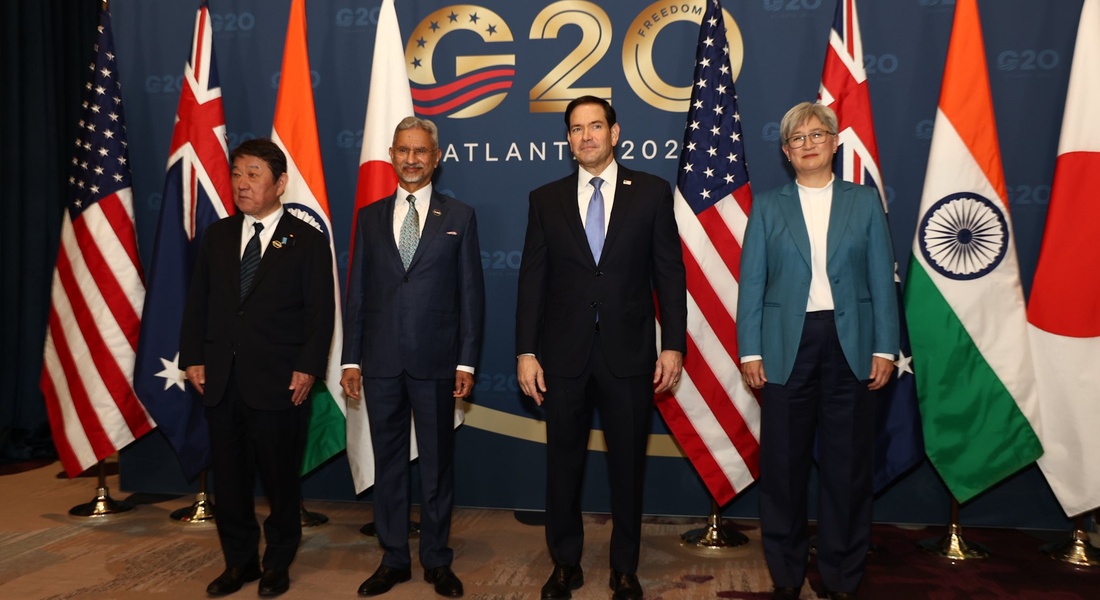
The commitment was announced in a joint statement following a meeting of the foreign ministers of India, Australia, Japan, and the US Secretary of State in Atlanta, Georgia, on Saturday.
The ministers reviewed progress on ongoing Quad initiatives and reaffirmed their commitment to a free and open Indo-Pacific, the External Affairs Ministry said in a press release.
The ministers underscored the importance of economic security in maintaining global stability and prosperity, stressing the need for reliable and open global supply chains and trusted, resilient infrastructure.
They also expressed grave concerns over economic coercion, including arbitrary export restrictions and non-market policies and practices that create overcapacity and disrupt supply chains in critical industries.
Highlighting the strategic importance of international maritime routes, the ministers stressed the need to protect navigational rights and freedoms in the Strait of Hormuz, the Red Sea and the Bab el-Mandeb Strait in accordance with international law as reflected in the UN Convention on the Law of the Sea (UNCLOS).
They emphasised the importance of uninterrupted commerce, energy security, and the safe passage of vessels and maritime crews without tolls.
Artificial intelligence and initiatives such as Pax Silica were identified as important drivers of future economic growth. The ministers expressed their intention to provide more than $85 million in technical and financial assistance to expand access to trusted AI across the Indo-Pacific, including through the Quad AI Accelerator.
The four countries also raised concerns over the growing threat posed by online and cyber scams operated by criminal groups involved in human trafficking and forced fraud. These operations steal tens of billions of dollars annually from citizens of the four countries. The ministers committed to working together to dismantle such networks and hold transnational criminal groups and their leaders accountable.
The joint statement also recognised India’s leading role in responding to the flash floods that struck Nepal on August 26, 2026. The ministers expressed condolences for those who lost their lives and acknowledged India’s leading role as the first responder in Nepal’s rescue efforts, alongside significant assistance provided by all Quad countries.
On critical minerals, the ministers welcomed progress under the Quad Critical Minerals Initiative Framework announced in May 2026. The initiative focuses on recovering valuable minerals from electronic waste and scrap materials to reduce dependence on any single supplier and strengthen supply chain resilience.
They welcomed private sector-led investments in waste collection networks, processing plants and refineries, alongside efforts to establish trusted critical minerals recycling value chains. The US has committed USD 10 million to support infrastructure and facilities in India and ASEAN countries for recovering critical minerals from waste. The countries will also explore ways to streamline export and import procedures to facilitate the movement of recyclable materials across borders.
Energy security remained another priority, with the Quad having convened its first-ever Fuel Security Forum in September. The discussions focused on strengthening fuel security across the Indo-Pacific, including through the development of strategic petroleum reserves and stockholdings.
The ministers also highlighted ongoing cooperation with Fiji to modernise key ports at Suva, Lautoka and Rokobili. The US Millennium Challenge Corporation is supporting the development of a Port Strategic Development Framework, while Australia is assessing the feasibility of a new transshipment port facility.
Quad countries have so far provided more than 2,000 infrastructure fellowships across the Pacific, Southeast Asia and South Asia to strengthen technical skills and infrastructure capabilities in the region.
In a move to expand commercial engagement, the ministers announced the first-ever Quad Business Leaders’ Forum, which will bring together industry leaders, government representatives and policy experts to strengthen ties between public and private sectors and promote commercial deals in key sectors.
Quad export credit agencies will also meet in Tokyo on November 18 to identify opportunities for practical cooperation, building on their 2024 Memorandum of Cooperation.
Digital connectivity and maritime security featured prominently in the discussions. The four countries are working to develop trusted, redundant and high-speed undersea cable routes and share best practices for securing critical digital infrastructure.
The second Quad-at-Sea Ship Observer mission, conducted from September 25 to October 7, sailed from Chennai to Perth aboard an Indian Coast Guard Offshore Patrol Vessel, with representatives from all four countries on board. The mission was described as an important step towards strengthening maritime interoperability and addressing unlawful maritime activities.
The countries also look forward to holding their first exercise under the Indo-Pacific Maritime Surveillance Collaboration initiative during Sea Dragon 2027. The initiative was announced in May in New Delhi to enhance information sharing and maritime domain awareness.
In addition, the first Quad Maritime Domain Awareness Track 1.5 Symposium under the Quad Maritime Training Initiative is scheduled for early 2027. It will provide a platform for regional partners to discuss maritime domain awareness approaches, technologies and information sharing.
On emerging technologies, the ministers committed to identifying priority countries for cooperation in trusted advanced communication technologies, including 5G, 6G, Open Radio Access Networks (Open RAN) and AI RAN. They also agreed to develop a pipeline of trusted 5G projects and explore future cooperation on AI RAN.
The four countries reinforced the need to build secure, resilient and trusted supply chains for advanced semiconductors and AI hardware. They will launch a new effort to identify potential supply chain bottlenecks before they cause disruptions. Work on mapping digital identity standards and strengthening cybersecurity cooperation will also continue.
The ministers further reaffirmed their commitment to improving regional disaster response capabilities through the Quad Humanitarian Assistance and Disaster Relief Partnership. Australia, Japan and the United States will send observers to India’s Annual Joint Humanitarian Assistance and Disaster Relief Exercise (AJHE-26) in November to build shared capacity to respond to natural disasters.