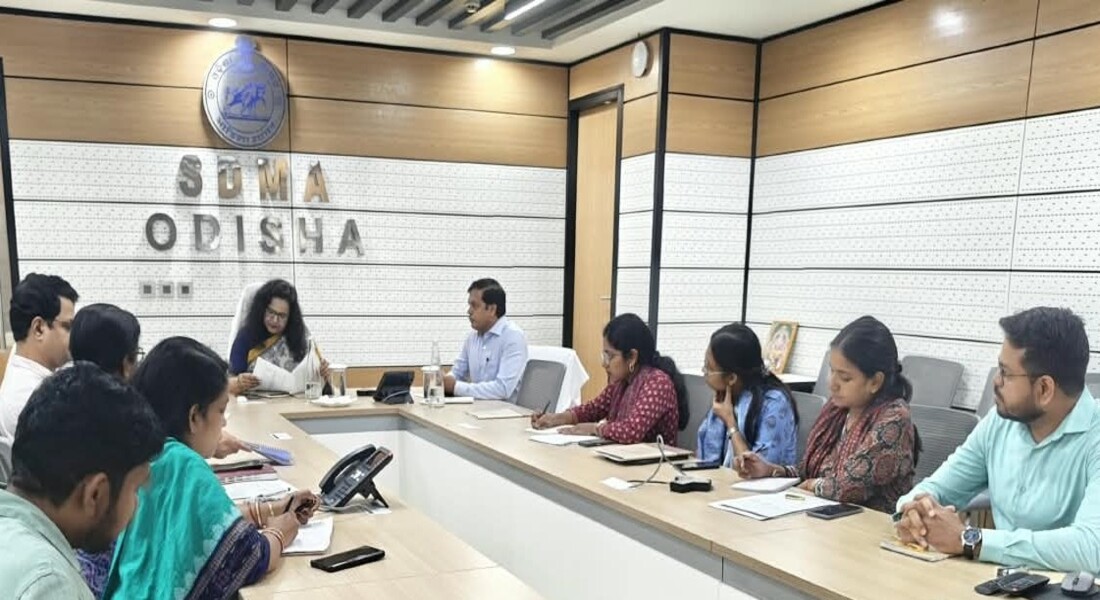

Bhubaneswar: Odisha Chief Secretary Anu Garg on Wednesday reviewed the impact of Cyclone Arnab, the state’s preparedness to deal with the situation, and ongoing repair and restoration work following the cyclone.
The review meeting was held at the office of the Special Relief Commissioner (SRC), where SRC Rajesh Prabhakar Patil briefed the Chief Secretary on the prevailing situation, precautionary measures and emergency arrangements.
According to Patil, the government has intensified its response with a focus on preventing loss of life.
The meeting also assessed preparations made ahead of the cyclone and the steps being taken to address the impact of continuous rainfall.
The state government has taken necessary measures to deal with the possible damage caused by the cyclone and the associated rainfall. Disaster mitigation efforts are being carried out with the prevention of casualties as the highest priority, following direct reviews by Chief Minister Mohan Charan Majhi and Revenue and Disaster Management Minister Suresh Pujari.
As part of the response, authorities have stepped up evacuation arrangements, emergency services and the deployment of disaster management personnel across the affected areas.
A total of 31,255 people have been evacuated from eight affected districts and accommodated in 324 active shelters. The government has also kept 2,067 shelters ready across Odisha to meet any further evacuation requirements. These include 141 permanent shelters and 1,926 temporary facilities.
District administrations have been directed to maintain round-the-clock vigilance as the situation continues to be monitored. All district control rooms are functioning 24 hours a day, while the leave of government employees has been cancelled to ensure their availability for emergency duties.
Schools and Anganwadi centres in the affected areas have also been ordered to remain closed as a precautionary measure.
The administration has paid particular attention to the safety of pregnant women. Of the 4,139 pregnant women identified in the affected areas, 2,245 have been shifted safely to nearby hospitals and health centres to ensure access to medical assistance during the adverse weather conditions.
Authorities have also taken steps to protect the fishing community. A total of 19,143 fishing boats have been brought safely ashore, including 11,955 boats from the sea and 7,188 from Chilika Lake.
Continuous rainfall associated with Cyclone Arnab has affected several parts of Odisha, with some blocks recording particularly heavy precipitation.
According to rainfall data recorded up to 8.30 am on Wednesday, the state received an average of 23.9 mm of rainfall during the preceding 24 hours. During the same period, 14 blocks and three urban areas recorded rainfall exceeding 100 mm.
Pattangi block in Koraput district recorded the highest rainfall at 188 mm, followed by Mohana in Gajapati district at 182.4 mm. Ganjam block received 161.4 mm, while Chhatrapur recorded 154.6 mm and Semiliguda in Koraput district received 143.1 mm.
At the district level, Gajapati recorded the highest average rainfall at 121.2 mm. Ganjam followed with 83.1 mm, while Koraput received an average of 61 mm and Puri recorded 54.2 mm.
The rainfall figures underline the need for continued monitoring of vulnerable areas and the maintenance of emergency response arrangements as the state deals with the effects of the cyclone.
To strengthen disaster response operations, Odisha has deployed 62 teams of the Odisha Disaster Rapid Action Force (ODRAF), nine National Disaster Response Force (NDRF) teams and 244 Fire Service teams across the state.
The government has also mobilised equipment and resources required for emergency operations, including 1,510 power chain saws, 225 towing tenders, 110 boats, 135 water drainage pumps and 225 tower lights.
These resources are intended to support response and restoration activities, including emergency access, water drainage and other essential operations in affected areas.
The availability of boats and drainage pumps is particularly important for areas experiencing heavy rainfall, while power chain saws and other equipment can support field operations where fallen trees and obstructions require clearance.
The government has also sanctioned Rs 19 crore in relief assistance for the eight cyclone-affected districts.
Ganjam district has received Rs 5 crore, while Gajapati, Malkangiri, Koraput, Rayagada, Nabarangpur, Kalahandi and Kandhamal have each been allocated Rs 2 crore.
The funds are intended to support relief measures in the affected districts as the administration responds to the situation.
The government has arranged adequate stocks of essential relief materials to meet immediate requirements in affected areas. These include chuda (flattened rice), jaggery, rice, biscuits and polythene sheets.
Anti-snake venom (ASV) has also been stocked as part of the emergency preparedness measures.
The availability of food supplies and other essential materials is a key component of relief arrangements for people moved to shelters and communities affected by the cyclone and heavy rainfall.
With district control rooms operating around the clock and government employees required to remain available for emergency duties, the administration is continuing to coordinate preparedness and response measures across the affected regions.