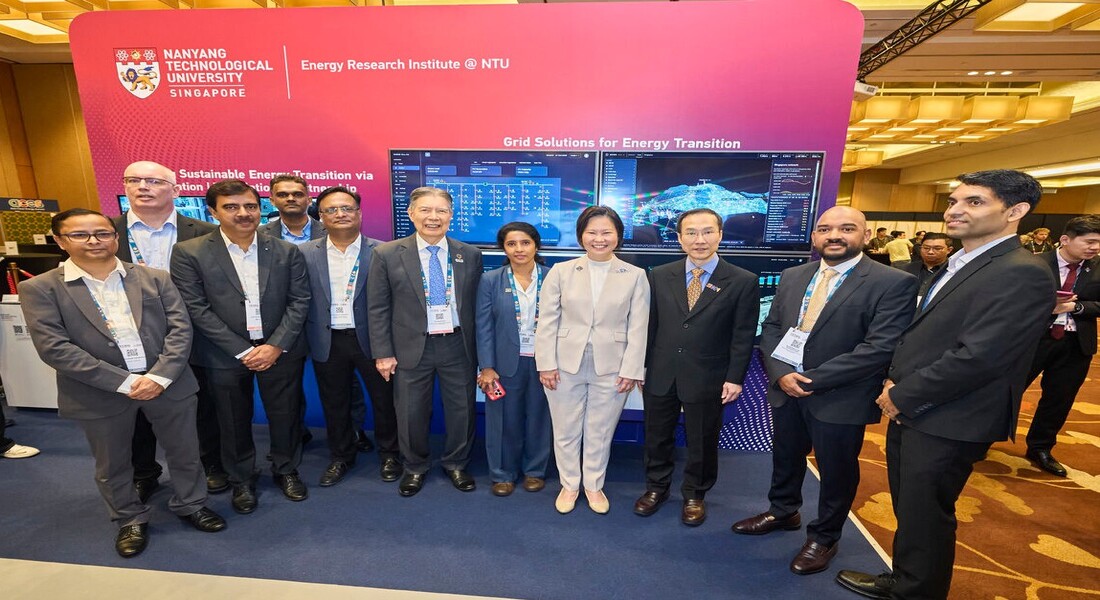

Bhubaneswar: Odisha has strengthened its international clean energy partnerships by signing four Memoranda of Understanding (MoUs) with global technology and energy companies at the Asia Clean Energy Summit in Singapore.
The MoUs are expected to open new avenues for research into battery storage, Artificial Intelligence (AI), smart grids and green hydrogen.
The agreements were signed by the State Energy Department during Singapore International Energy Week 2026, held from October 27 to 29, with Nanyang Technological University (NTU), Singapore, serving as the knowledge partner.
The four partnerships bring together expertise from Singapore and Finland to explore emerging technologies and develop solutions for Odisha’s evolving energy requirements.
The agreement with Tata Consultancy Services, Singapore, will focus on digitalisation and AI-enabled workbench solutions aimed at improving smart governance and consumer services. VFlowTech, Singapore, will collaborate on flow battery technologies to strengthen energy storage capacity and grid resilience.
Another agreement with PHENOGY, Singapore, will support research into sodium-ion battery-based Battery Energy Storage Systems for grid applications. The fourth MoU, signed with DANFOSS Drives Oy, Finland, will cover next-generation microgrids, smart grid integration and green hydrogen production.
These agreements extend an existing research partnership established in January 2023, when Odisha’s Energy Department signed an MoU with NTU Singapore and IIT Bhubaneswar to advance renewable energy research. The latest arrangements bring international industry expertise into the collaboration, with a greater emphasis on technology development and practical applications.
Deputy Chief Minister Kanak Vardhan Singh Deo welcomed the initiative, saying international partnerships would play an important role in accelerating Odisha’s transition towards clean energy.
He said the State was committed to developing a sustainable and future-ready energy sector through innovation, research and global cooperation. The partnerships, he added, would help explore advanced solutions in energy storage, artificial intelligence, smart grids and green hydrogen while supporting renewable energy ambitions, strengthening energy security and attracting clean energy investment.
Dr Debidutta Tripathy, Special Secretary, Energy Department, Government of Odisha, and Prof. Madhavi Srinivasan, Executive Director of the Energy Research Institute at NTU (ERI@N), signed the agreements on behalf of the Odisha Government and NTU, respectively.
The Odisha delegation included Dr Satya Priya Rath, Managing Director of GRIDCO Limited; Er. Debasish Das, Director (Commercial), GRIDCO Limited; and Prof. Subhransu Ranjan Samantaray, Dean (PG & Research), IIT Bhubaneswar.
During the summit, Energy Department officials also met Singapore Minister of State for Trade and Industry Siow Huang Gan and representatives of the country’s Ministry of Foreign Affairs and Ministry of Trade and Industry, including Permanent Secretary (Energy and Trade) Augustin L.
The delegation briefed the Singapore representatives on collaborative initiatives involving GRIDCO, IIT Bhubaneswar and NTU Singapore.
The four MoUs mark another step in Odisha’s efforts to build international research partnerships and strengthen cooperation between industry and academic institutions. The State aims to draw on global technological expertise to improve grid resilience, accelerate renewable energy development and reinforce its long-term energy security.