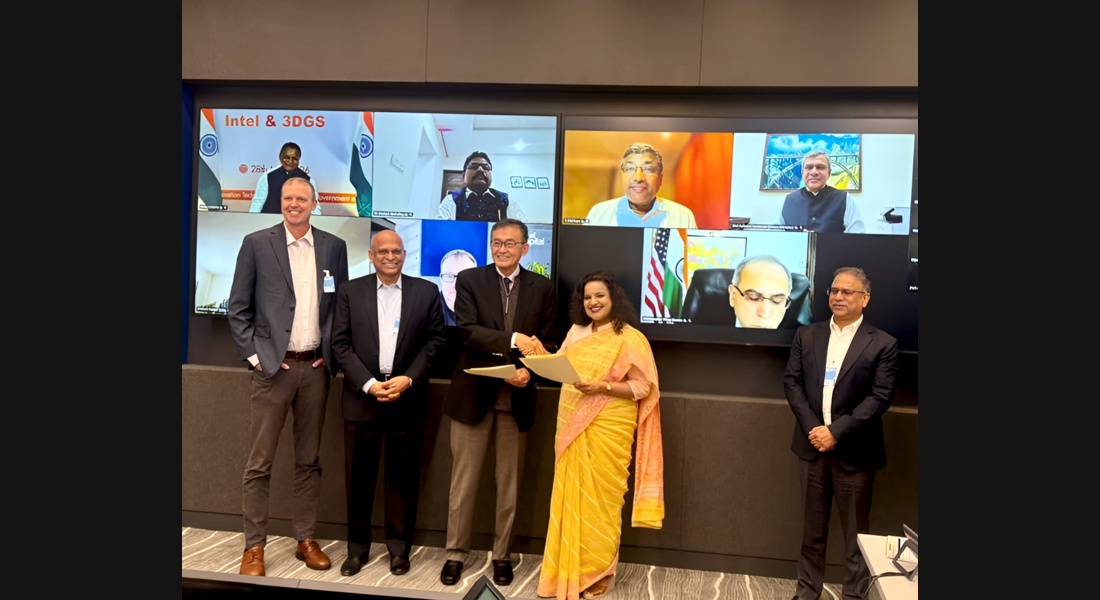

Bhubaneswar: Odisha on Friday moved a step closer towards becoming a semiconductor manufacturing hub after a major agreement was signed to establish an advanced packaging glass core substrate manufacturing facility in the Bhubaneswar-Khurda region.
The Memorandum of Understanding was signed between the government of Odisha, Intel Corporation, and 3DGS Inc. in the presence of Union Electronics and IT Minister Ashwini Vaishnaw, Chief Minister Mohan Charan Majhi, Intel CEO Lip-Bu Tan, and other senior officials.
The proposed project is expected to attract an investment of nearly USD 3.3 billion, making it one of the country’s largest investments in high-technology manufacturing, according to an official statement.
Officials said the facility will focus on advanced packaging glass core substrates, high-density interconnect substrates, and related semiconductor technologies. Intel is expected to provide technology expertise and process support for the initiative.
Speaking at the event, Vaishnaw said the agreement aligns with the Centre’s broader push to develop a complete semiconductor manufacturing ecosystem in India. He noted that the participation of global technology firms reflects increasing international confidence in India’s semiconductor ambitions.
The minister referred to the growing presence of companies such as Applied Materials, Lam Research, Tokyo Electron, and Merck Electronics in India’s semiconductor ecosystem. He also highlighted the recently signed partnership between Tata Electronics and Dutch semiconductor equipment maker ASML.
The project is planned to be executed in phases over the next five to six years and is expected to create more than 1,800 direct high-skilled jobs, apart from generating indirect employment across the wider manufacturing and technology sectors.
The initiative is part of the ongoing efforts under the India Semiconductor Mission aimed at strengthening domestic manufacturing capabilities, semiconductor design infrastructure, and supply chain development.
Officials said the proposed facility could help position Odisha as an emerging centre for semiconductor manufacturing and digital infrastructure development in India.